

The Ruger 10/22 needs no introduction to most shooters. It is one of the most popular semi-autos of all time. Part of that success is Ruger’s efficient rotary box magazine and the endless number of copies that truly set the 10/22 apart. There are many great 22 rifles out there, such as the Marlin Model 60 or the Browning SA-22, but that magazine system set the 10/22 up as not just a .22 rifle but one you can make your own. Follow along as we explore the world of 10/22 mags to see which might be best for you.

My Ruger 10/22 carbine loaded with a Ruger BX-25 magazine.
Ruger 10/22 Mag Evolution
Ruger first produced the 10/22 in 1964, and over seven million have been made since then. It seems as if everyone has one or three in their collection and for a good reason. The little carbines are comparatively inexpensive, remarkably reliable, lightweight, and accurate. There is also a cottage industry of aftermarket parts rivaled only by the famed 1911 and the AR-15 platforms.
10/22s magazines, like 10/22s, are like potato chips; it’s hard to have just one. For most of its production run, however, Ruger only made stock 10-round magazines. In that vacuum, a host of aftermarket companies emerged to supply cheaper magazines and higher capacity magazines. You can stick with ten-round flush fit magazines, twenty-five round extended “banana clips,” and even fifty-round drum mags. It was not until 2009 that Ruger decided to produce extended mags of their own.
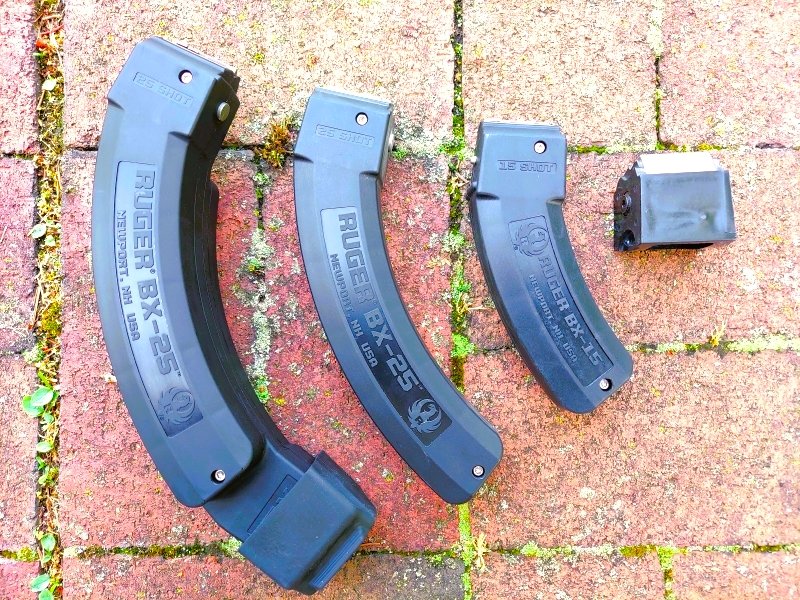
The Ruger factory magazine lineup: Left to right, the BX-25 x 2 (for a total of 50 rounds), BX-25, BX-15, and the standard 10-round rotary magazine. There’s something for everyone from Ruger!
The 10-Round Rotary
Each Ruger 10/22 mag is equipped from the factory with a 10-round rotary magazine. These are time tested, incredibly robust, and reliable. Sometimes, though, we yearn for more than just the standard. So many of us take things to the next level, and Ruger was brilliant for recognizing that.
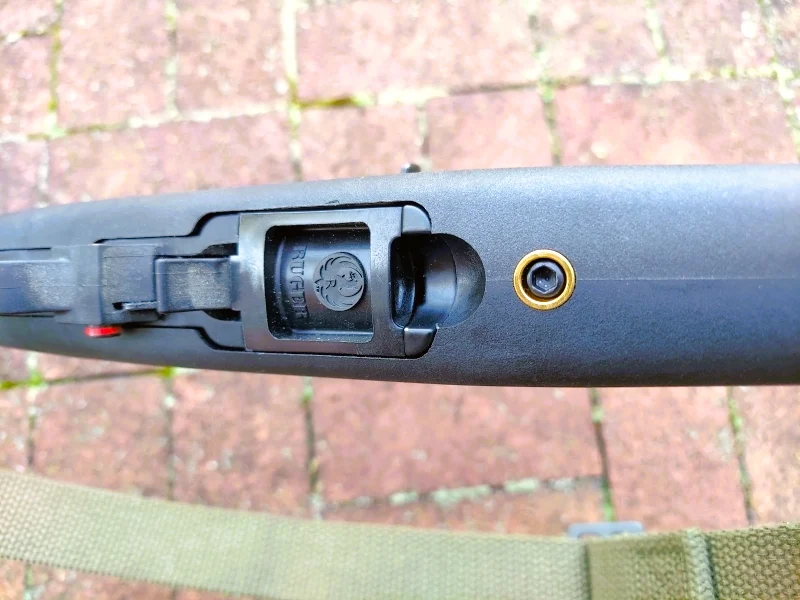
One of the pleasant aspects of the factory 10-round magazine is that it fits flush with the bottom of the carbine yet still offers a respectable capacity. Still…we sometimes yearn for more.

So, it often seems that aftermarket products don’t live up to the expectations that OEM (Original Equipment Manufacturer) products do. Doesn’t it suck when you plunk down your hard-earned cash for a product that doesn’t meet expectations? Then you’re stuck trying to return it, or in some cases, you give up, and it goes into that box in your closet with the other junk that you don’t want to throw out (because, dammit, it was expensive), but that you know you’ll never use. That is how some aftermarket 10/22 magazines are.
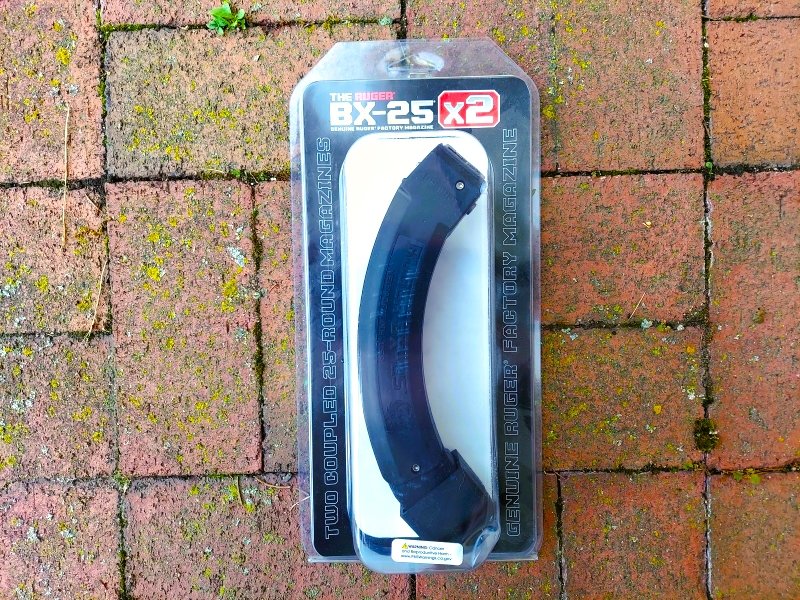
Now Ruger has the BX-15, a fifteen-round extended magazine that gives you greater capacity without too much hanging off the bottom of the rifle. But if you need the extra firepower, the BX-25 25-round magazine should do the trick. If not, the BX-25×2 will certainly satisfy. It consists of two BX-25 magazines bolted opposite each other to have extra ammo on the rifle for a faster reload.
Happily, I can report to you that Ruger’s extended magazines will not need to make their way into such a Box Of Forbidden Gadgetry, and for two reasons: They work. Damn well! Ruger takes care of its customers, so they’ve got your back even if you have issues.
Construction of The Ruger 10/22 Magazine
Each type of Ruger extended magazine is made from very thick, sturdy plastic. They are not flimsy in any way, shape, or form. In addition, all have stainless steel feed lips, which increases feeding reliability.
Stainless steel feed lips and an anti-tilt follower, along with heavy construction, make the Ruger mags ultra-reliable.
Ruger says that anti-tilt followers are made from “high-lubricity polyacetal for consistent reliability.” And as I mentioned, they DO work well! The springs used in all their magazines are stainless steel. The magazines can be disassembled for cleaning if necessary, as well.
Ruger advises that these magazines will work in all 10/22 rifles, SR-22 rifles, .22 LR Ruger Precision Rimfire Rifle, .22 LR Ruger American Rimfire Rifle, .22 LR Ruger 77/22 rifle, and .22 Charger pistol. Do you like versatility? I can’t imagine much that’s any more versatile than fitting all of those models! Another stroke of genius by Ruger was having one type of magazine do so many of their firearms! Other gun makers could take note of this and follow suit!

10/22 Mag: 15 Rounds
Are ten rounds not doing it for you? No problem, What about the BX-15 fifteen-round magazine. Yep, they make ’em! And they’re pretty cool because they don’t hang down under your carbine very far. Granted, they’re several times longer than the 10-rounders, but that’s because the 10-rounders are of the rotary type. But the 15-rounders are not bulky and are of a convenient size. Plus, having 15 rounds on tap is nothing to sneeze at. So, pick up several of these, and you’re all set for a fun day at the range. The 15-rounder is a nice balance of compactness and capacity. It might just be ideal!
10/22 Mag: 25 Rounds
Are 15 rounds not floating your boat? Well, gosh and golly! There are other options. Namely, a 25-rounder! Most people realize that the .22 is not a powerhouse cartridge, and that’s the truth. However, it’s not to be laughed at, either, as cemeteries are filled with people who found out the hard way that the .22 LR can cancel a person’s birth certificate.

In my mind, having 25 rounds of .22 LR is a decent start to defending oneself should the need ever arise. And if it doesn’t, then it equates to a whole lot of fun on the target range. With a 10/22 mag on hand, I believe it elevates The Ruger 10/22 Magazine into a decent defensive category.
I don’t typically tout the .22 LR as a tremendous defensive round. However, with 25 of them on tap and a few spare magazines, you’re talking some serious holes in bad guys. As an aside, if used indoors, the .22 LR rifle is a lot quieter than larger calibers, which would save your hearing. So less noise and muzzle blast is a good thing going for it.
10/22 Mag: 50 Rounds?!?
What’s that? Aren’t twenty-five rounds quite enough for your taste? Fine, you greedy bastard, Ruger has a little something for you! How does 50 rounds sound? They’ve molded two 25-round magazines together for a total of 50 rounds. Mind you, it’s not 50 rounds successively, as you’ll have to stop when one of the 25-rounders has run dry, eject the mags and flip them, then start on the other 25 rounds.
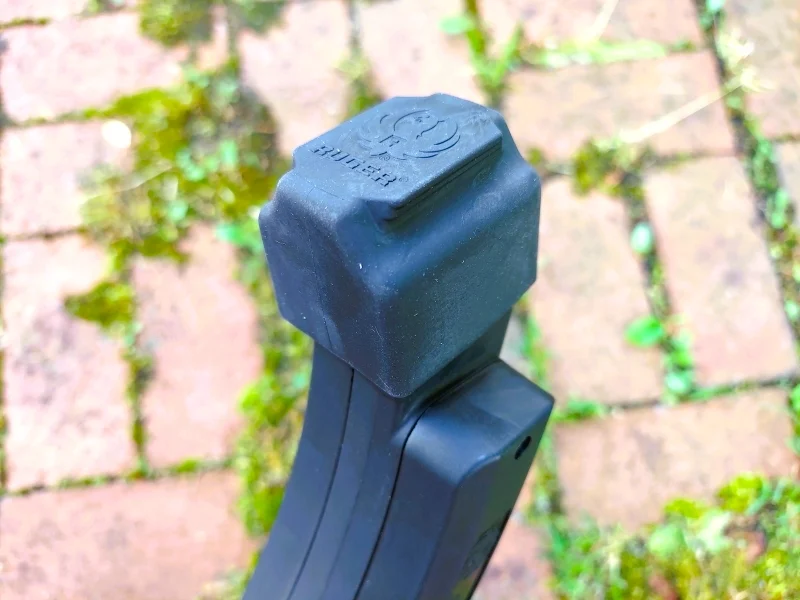
As one end of the magazine is inserted into your carbine, the other end will be hanging down with bullets exposed in the feed lips. The 10/22 mag includes a dust cover to keep out crud and gunk in the event you’d be dragging the magazine through the nasties. This dust cover is a sort of hard, rubber-like substance that is stiff yet pliable.
*chortle/snort*
A removable, hard rubber cover protects the exposed end of the BX-25 x 2, so you don’t drag it through the mud.
In use, it’s a simple matter to eject one end of the mag and flipping the other end upward and into your magazine well. Although I have to admit, it’s neat having 50 rounds carried on board your carbine at once. Keeping one or two of these around for defensive purposes would be prudent should you feel the need.
A total of 50 rounds on board with the BX-25 x 2 magazines. Badass! My personal favorite, though, is the 25-rounder. It supplies a good amount of ammunition in the rifle and is light and sleek enough not to get hung up on things.
I have a few of these magazines and can tell you that they are great items to have around. Of course, this setup isn’t something I’d pick to drop into a hot LZ with, but for defending the old homestead against garden-variety invaders, I’d be good with it. If you haven’t invested in additional Ruger 10/22 magazines yet, I recommend picking up some of these. The prices are quite reasonable so that they won’t break the bank.






This is a decent article, though it probably should mention that due to variations in tolerances, there are a lot of 10/22 rifles out there that won’t run with the 15 or 25 round mags for sour apples. Some of them have mag wells in the stock that are not cut square and hold the magazine a bit crooked, which the 10 round rotary mags tolerate a bit better. If it’s good enough to work with the 10 round rotary mag, Ruger ships it.
Also the 10/22 was originally designed about sixty years back around that same ten round mag. Putting more weight in that mag well can result in the stock magazine catch and spring not holding the mags stable. That’s part of the reason the 15s, and, especially, the 25s, tend to wobble in the mag well more than the 10s. And the 10/22 is no AK. It doesn’t like wobbling magazines a bit. They can cause both failures to feed and failures to eject. There are aftermarket extra-power magazine catch springs and extra-length aftermarket magazine catches intended to mitigate this, and sometimes they help a little.
Magazine wobble makes a weak point of the design of the 15 and 25 round mags much worse, too. They use a coiled ribbon leaf spring. One end of the spring is attached to the metal block at the top that has the feed lips. The other end is wound on a little bobbin. The bobbin is anchored to a peg on the side of the magazine follower. The follower’s fit inside the mag tube is rather sloppy, especially in that area where it neither nearly full nor nearly empty. It jiggles and slips side to side and this can slightly delay the top cartridges upward motion, which the 10/22 usually tolerates, unless the magazine fit is so poor that it wobbles badly. Then you have three-point stoppages, nose-dives, and bolt-over-base malfunctions. One trick to mitigate this is to put a fired .22 Short case in the center of the spring bobbin, to make the magazine follower a bit less sloppy in its movement when the mag is partially full. Another is to polish the interior of the steel block with the feed lips. Neither one is a magical cure-all but they can sometimes help a bit in marginal cases.
The other reason the 15 and 25 round mags tend to wobble is that the squarish block at the top of those mags isn’t shaped exactly like the magazine body of the 10 round rotary mags. You don’t even need calipers. Just hold them side by side and eyeball them. The 15s and 25s are often 1/8″ shorter front to back at the part that sits in the mag well than the 10s, sometimes more. I am astonished that Ruger approved the design, and astonished that they work as well as they do in as many 10/22s as they do. The longer mags are very prone to wobbling forward and back, and, depending on the magazine cutout in the stock, side to side also. Any gun forum will have lots of stories about this kind of thing. Some people address the problem by modifying the mag catch cutout in the stock, either cutting away material, adding material in the form of stuff like Devcon putty, or both. Others modify the magazines themselves. I’ve seen people who claimed to fix the problem with everything from layers of duct tape to set screws to blobs of epoxy formed to act as shims, usually affixed at the bottom rear, below the rear side’s metal stud, or above the metal stud in the front, or both.
Over the years there have been lots of aftermarket magazines for the 10/22 also. Not many of them have ever been worth the trouble.