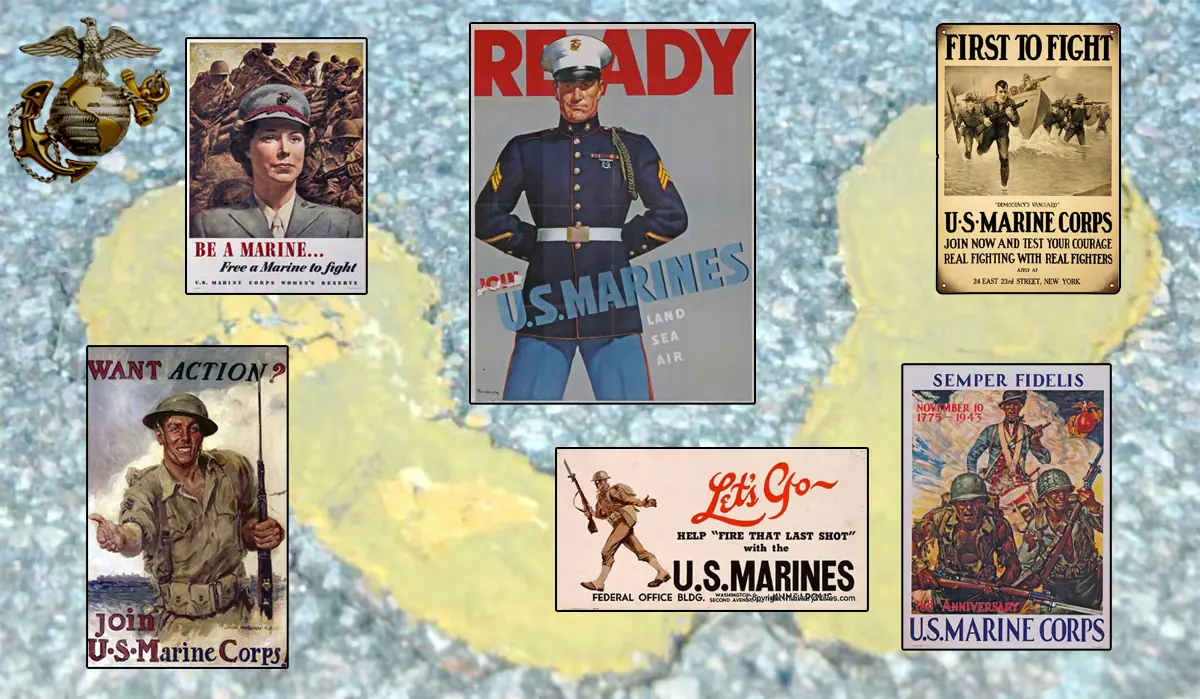
Here we go. It’s the start of Gyrene Week. Or Marine Week, or Leatherneck Week, etc. Call it what you want, just don’t do it disrespectfully. One week from today marks 250 years of Marine Corps history. That’s right, it’s the Marine Corps’ 250th birthday, and you, oh lucky, lucky reader, are about to get your learn on, not just about the Eagle, Globe, and Anchor, but even why the Marine Corps exists. Our very own Nate Murr has returned (after about a decade-long hiatus!) to write what is probably the most accurate, academically sublime, utterly serious history of the USMC (with a little help from researcher and champion incessant c’mon Nate, you know you want to! pleading editor David Reeder).
Anyway, you’re welcome. ~ Mad Duo
Table of contents
- Marine Corps History
- I. Early Marine Corps History: The Age of Sail and the Small Corps (1775–1899
- II. USMC History: The Interwar Development and Global War (1900–1949)
- III. Marine Corps History: The Cold War and the MAGTF Era (1950–1989)
- IV. USMC Historical Timeline: The Post-Cold War Crisis Response (1990–2000)
- V. Marine Corps History: The GWOT, COIN, and Force Design Eras (2001–2025)
- The Definitive Timeline of Marine Corps History: CONCLUSION
Marine Corps History
From Tun Tavern to Force Design 2030: a 250-Year Marine Corps History Timeline
Before the United States Marine Corps was formed in 1775, the world’s ground forces deployed for mass wars were mostly a sloppy mess of conscripts and angry villagers. The British, French, and Spanish all maintained standing professional armies (often foreign regiments), but the majority of the good shooters were on the water.
Unlike the established European empires, the young United States was an anomaly. It (we) distrusted professional standing armies, favoring militias—which made the Continental Marines’ professional, Navy-focused existence pretty radical.
The essential history of the Marine Corps is a 250-year-long argument for why the Marine Corps exists: to deliver violence from the sea, resolve global crises, and continually adapt. Our founding fathers were fully aware that a strong, professional naval force was critical to victory against the British. The new US Marine Corps was based on the very model of naval military organization used by our previous oppressor, the British Empire.
The Second Continental Congress officially formed the United States Marine Corps on November 10, 1775:
“That two battalions of Marines be raised consisting of one Colonel, two Lieutenant-Colonels, two Majors, and other officers, as usual in other regiments; that they consist of an equal number of Privates with other battalions; that particular care be taken that no persons be appointed to offices, or enlisted into said battalions, but such as are good seamen, or so acquainted with maritime affairs as to be able to serve by sea when required; that they be enlisted and commissioned to serve for and during the present war with Great Britain and the Colonies, unless dismissed by order of Congress; that they be distinguished by the names of the First and Second Battalion of Marines.”
Tasked with recruiting the first colonial Marines was a young officer, Captain Nicholas of Philadelphia. Where would he find his men? How would he convince them to risk it all, for little pay and guaranteed hardship? For the dream of independence, which would be won through blood?
Captain Nicholas did the natural thing; he went to his favorite bar, the Tun Tavern.
The rest, of course, is Marine Corps history! (Something you can help celebrate, by the way, by wearing one of our Marine shirts.)
Tun Tavern was named for the Old English word “tun”, meaning a barrel or keg of beer. Located in southern Philadelphia, Marines still meet every year near the old site of the long-gone tavern to celebrate every November 10th. (Although a new bar, sharing the same name, has been recently built!)
(FYSA, Captain of Marines Samuel Nicholas was promoted not too much later, holding the rank of Major as the de facto Commandant.)
Anyway, if you haven’t gone to where Tun Tavern once stood, 2025 might be the year to go, as usually the Philly police are proactive in shutting down several city blocks for the biggest street party imaginable.
Born in a bar, these “Soldiers of the Sea” got immediately to work. And they haven’t had much time off ever since.
I. Early Marine Corps History: The Age of Sail and the Small Corps (1775–1899
1775 (CMC) Major Samuel Nicholas assumed the role as the senior-most officer of the Continental Marines (de facto Commandant).
1776 The first American flag flown over foreign soil by Marines was in Nassau, Bahamas; the first amphibious operation in USMC history.
1777 Continental Marines participated in the defense of Philadelphia at the Battle of Brandywine, supporting Washington’s retreat.
1778 Marines from the frigates Ranger and Warren were involved in the Battle of Rhode Island, supporting the Continental Army.
1779 A Marine, Sergeant William Hamilton, was cited for gallantry aboard the Bonhomme Richard during the fight with HMS Serapis.
1780 Continental Marines suffered a major loss when forces serving aboard the frigates Providence, Boston, and others fighting ashore were captured during the Siege of Charleston, SC.
1781 (CMC) Major Samuel Nicholas’s tenure as senior officer effectively ended.
[Seat on the board of Lockheed not looking promising.]
1782 The final commissioned Marine officer of the Continental Corps was discharged.
1783 The Continental Marine Corps was officially disbanded in April, leaving no legal standing for a military force on U.S. naval vessels for 15 years.
[The first of many congressional blunders to haunt the Corps]
1784 The nascent U.S. Navy relied on temporarily detailed soldiers or armed merchant seamen for ship security. Many of these were prior-service Marines.
1785 The only official documentation of the “Marines” role around this time was related to the maintenance of barracks property that remained after the disbandment.
[“We need you guys to count the contents of these CONEXs.”]
1786 Congress formally requested reports on the status of all former Continental military property, including Marine armaments and records.
1787 Former Continental Marine officers petitioned Congress for back pay and land grants.
[Everyone loves fighting the VA!]
1788 The War Department began consolidating military records, cataloging Marine muster rolls alongside those of the disbanded Continental Army.
[“Sorry, but we lost your records” becomes a new term used widely by S-3 shops.]
1789 The first Act to Establish the Department of War included no provision or mention of a separate Marine force.
1790 Congressional debate over the need for naval forces included discussions about armed guards.
1791 The U.S. Navy’s first ship, the Revenue Cutter Massachusetts, was crewed entirely by sailors.
1792 Marines from the now-defunct Continental Corps began to be integrated into state militias.
[i.e., The natural life cycle of all Marines.]
1793 The U.S. Navy began rebuilding with the construction of six large frigates.
1794 The Secretary of War lobbied Congress, arguing that only a dedicated Marine force could enforce discipline and conduct landing operations.
[True!]
1795 The first Congressional appropriations for naval armament included funds for “Marines to serve as guards,” an ad-hoc allowance.
[Before man was, firewatch waited for him…]
1796 Marines aboard the new frigates were still officially detailed sailors with a temporary “Marine” designation.
1797 The Marine Detachment aboard the new frigate USS Constitution was comprised of sailors temporarily detailed as Marines.
1798 (CMC) Lieutenant Colonel William W. Burrows became the first de jure Commandant of the re-established Marine Corps.
[We are so back, baby!]
1799 Marines deployed for the “Quasi-War” with France, serving aboard the newly commissioned frigates to quell French privateering.
1800 Lieutenant Colonel Commandant William Ward Burrows moved the headquarters from Philadelphia to the new capital.
[Bad call, Sir, bad call.]
1801 (Base) Marine Barracks Washington, D.C. (8th & I) was established as the USMC Headquarters.
[Pogue jokes likely invented the same year.]
1802 The Marine Band played at the inauguration of Thomas Jefferson, earning the nickname “The President’s Own.”
1803 Marines served with a Navy-led expedition against the Barbary pirates.
[WE GET TO FIGHT PIRATES!!!]
1804 (CMC) Lieutenant Colonel Franklin Wharton became the 3rd Commandant on March 7.
[3 Marines fall out from locking their knees during the change of command ceremony.]
1805 Lieutenant Presley O’Bannon received a Mameluke Sword after the Battle of Derna; the first U.S. flag flown over foreign soil in the Eastern Hemisphere.
[Officers get stuck with the worst-looking sword ever.]
1806 Commandant Wharton focused the Corps on barracks duty, leading to a decline in their reputation as a versatile landing force.
[Field day is Thursday, Gents.]
1807 Commandant Wharton directed the Corps’ largest peacetime deployment to date. While Marines were enforcing the Embargo Act, others were tasked with suppressing the Territory of Orleans Insurrection, a slave revolt in Louisiana.
[Not cool.]
1808 Marines enforced the Embargo Act of 1807, conducting patrols and seizing ships suspected of violating trade restrictions.
[Kinda cool.]
1809 Marines were dispatched to the Florida coast to prevent potential Spanish privateer landings.
[Really cool.]
1810 Marines were assigned to the captured West Florida territory to suppress local resistance.
[“In other news, Florida man bites Marine…”]
1811 Marines aboard the USS President were instrumental in the fight against the British sloop HMS Little Belt.
[Sharpshooting officers from up in the rigging, Scout-Sniper!]
1812 A detachment of Marines, under Captain Samuel Miller, fought a key role on land at the Battle of Bladensburg as part of Commodore Joshua Barney’s Naval Battalion, manning heavy shipboard artillery. This battalion made the only credible resistance to the British advance on Washington, D.C.
1813 A Marine detachment held the fort at Craney Island, Virginia, against a superior British landing force.
[The Brits get spanked again.]
1814 Marines from the frigates USS Constitution and USS Guerriere took part in the defensive operations at New Orleans.
1815 Marines participated in the Second Barbary War.
[Pirate War 2: Sandy Boogaloo]
1816 The Corps adopted the first standardized system for training new recruits.
[“Get on my dang-gone quarterdeck now, Nasty!”]
1817 Marines served aboard the frigate USS Congress during a diplomatic mission to China.
[Man, the food here is amazing, surely these guys will always be cool!]
1818 (CMC) Lieutenant Colonel Franklin Wharton died in office on September 1.
1819 (CMC) Lieutenant Colonel Anthony Gale became the 4th Commandant on March 3.
1820 (CMC) Lieutenant Colonel Anthony Gale was dismissed on October 8. He’s the only Commandant ever to be fired. This might not be as bad as it sounds, though – after all, he killed a Navy Lieutenant in a duel for insulting the honor of the Corps, and he was described as taking an “active and gallant” role in the Siege of Ft. McHenry during the War of 1812.
[Lt. Col. Gale is the only CMC we don’t have a portrait or picture of…in fact, he’s also the only one we don’t know a burial location for!]
(CMC) Major Archibald Henderson became the 5th Commandant on October 17.
1821 Commandant Henderson first established a mandatory system for Marine barracks record-keeping.
[Spoiler alert: it also sucked.]
1822 Marines participated in the anti-piracy operations of the West Indies Squadron.
[Pirates just won’t learn!]
1823 The Corps established a Marine Detachment at Pensacola, Florida.
[Keep those Skates sharp, Gents!]
1824 The Corps officially adopted the Musket, Model 1816, as the primary infantry weapon.
[“This is my Musket. There are many like it, but this one is mine!”]
1825 The use of the Mameluke Sword was authorized for Marine officers by Commandant Henderson.
[Poor officers, they didn’t even get the matching magic carpet.]
1826 The Mameluke Sword, authorized the previous year, began to be officially distributed to Marine officers.
1827 Marines were deployed to the Falkland Islands to protect American sealing interests against Argentine interference.
[Hands off our Seals!]
1828 The Corps formalized the ranks of Sergeant Major and Quartermaster Sergeant as permanent NCO billets.
[“Keep off the grass” and “Closed for inventory” signs invented.]
1829 Marines served in a punitive expedition against pirates in Kuala Batu, Sumatra.
Seriously, WTF is up with all these Pirates?
1830 Marines deployed to Argentina (then the United Provinces of the River Plate) to protect U.S. commercial interests.
[See also: “War is a Racket” by Major General Smedley D. Butler.]
1831 The Corps established the first formal, written regulation governing Marine barracks construction and maintenance.
[Black mold is invented.]
1832 Marines from the USS Potomac successfully assaulted a fortified pirate stronghold in Quallah Battoo, Sumatra.
[All your strongholds are belong to us.]
1833 The first mention of Marines utilizing an organized small-scale land force for inland security in Sumatra was recorded.
1834 The Act for the Better Organization of the United States Marine Corps officially placed the Corps under the direction of the Secretary of the Navy.
[Giving the Navy a Men’s Department isn’t necessarily a Bad Thing.]
1835 Marines served extensively in the Second Seminole War in Florida.
1836 Marines were part of General Winfield Scott’s force during the Creek War in Alabama.
[We call these the bad years.]
1837 Marines were dispatched to the Delaware River to suppress a major labor riot at a Navy Yard.
1838 Marines served with the Army in the forced relocation of the Cherokee Nation, known as the Trail of Tears.
1839 Commandant Henderson successfully argued for an increase in Marine pay and allowances.
[COLA adjustments!]
1840 The first permanent Marine recruiting station was established in Baltimore.
[Note to self; rewatch “The Wire”]
1841 Commandant Archibald Henderson lobbied Congress for increased appropriations to expand the Corps.
[Shot-out Army muskets procured instead.]
1842 Marines enforced treaty obligations by protecting U.S. commercial interests in West Africa.
1843 Marines were deployed to China to protect the American legation during the signing of the Treaty of Wanghia.
1844 Marines served in the first official U.S. military mission to the independent Republic of Liberia.
1845 Marines were deployed to Texas prior to the Mexican-American War to reinforce the land forces protecting the disputed border.
[Those sandbags aren’t going to fill themselves!]
1846 Marines seized the port of Monterey, California, early in the Mexican-American War.
1847 A Battalion of Marines participated in the Battle of Chapultepec as part of a U.S. Army division.
[Nice Castle you have there! It would be a shame if someone…captured it!]
1848 Following the Mexican-American War, the Corps was subjected to a significant reduction in force.
[Why do they always do this to us?]
1849 Marines were deployed to Panama to protect U.S. interests during the California Gold Rush migration.
1850 The Corps began adopting the new percussion cap musket as a standardized weapon, replacing the older flintlock system.
[The “Don’t align the gas rings on your musket, it will jam!” legend is formed.]
1851 The Corps published its first manual detailing artillery drill and employment for landing parties.
[“Cannon Cockers” nickname first used by Grunts.]
1852 Marines deployed to Argentina for the second time, primarily to protect American lives and property during internal conflicts.
[The Steaks were amazing!]
1853 Marines participated in the ceremonial landing and demonstrations of U.S. power during the opening of Japan to Western trade.
[These guys… I don’t know, man, I got a bad feeling…”]
1854 Marines were part of the crew that landed at Shimoda, Japan, during Commodore Perry’s mission.
1855 Marines participated in the Battle of the Barrier Forts near Canton, China.
Some Marines begin fielding the Model 1855 percussion rifle-musket, replacing their Springfield Model 1842s.
[Diplomacy through force, but at least we got a signed agreement for U.S. neutrality out of it.]
1856 An obscure landing occurred at Walla Walla, Washington, to defend against an American Indian uprising.
1857 Marines served in a punitive expedition against the local tribes in Fiji who had murdered American sailors.
1858 Marines deployed to Uruguay to protect American property during a civil war.
1859 (CMC) Colonel John Harris became the 6th Commandant on January 7, ending Henderson’s 38-year tenure.
[Seat on board of Northrop Grumman looking doubtful.]
1860 Marines were aboard the USS Wyoming during its diplomatic mission to the Far East.
1861 Commandant Harris quickly mobilized the few available Marines to defend Washington, D.C.
1862 (MoH) Corporal John F. Mackie earned the Marine Corps’ first Medal of Honor aboard the USS Galena for action at the Battle of Drewry’s Bluff, at Ft. Darling on the James River.
[OORAH!]
1863 (MoH) Private Michael Conboy earned the MoH for heroism aboard the USS Vermont near Port Royal, SC, during a fire.
[Stellar performance, Leatherneck!]
1864 (CMC) Brigadier General Jacob Zeilin became the 7th Commandant on June 10, becoming the first Marine Corps general officer.
1865 Marines participated in the successful assault on Fort Fisher, North Carolina, during the Civil War.
[All your forts are belong to us.]
1866 The Commandant ordered the Corps to conduct mandatory, standardized light infantry drill.
[Snap! Pop! Walk that tight rope, tight – tight -tight!]
1867 The rank of Brigadier General was formalized for the Commandant.
[Remember, Be…My…Little…]
1868 Marines deployed to Japan to protect the U.S. consulate during the Boshin War (Civil War).
1869 Marines were ordered to use the Colt Revolving Rifle, but funding delays prevented full adoption.
[Figures, thanks, Congress.]
1870 The Corps saw an average of only 1,900 Marines on active duty.
1871 Marines participated in the Korean Campaign (Shinmiyangyo), landing on Ganghwa Island and fighting against Korean forces.
(MoH) Private John Coleman earned the MoH for valor during the assault on the Korean forts on Ganghwa Island.
(MoH) Sergeant John H. Denig earned the MoH for valor during the assault on the Korean forts on Ganghwa Island.
(MoH) Private James Dougherty earned the MoH for valor during the assault on the Korean forts on Ganghwa Island.
(MoH) Sergeant Hugh Purvis earned the MoH for valor during the assault on the Korean forts on Ganghwa Island.
(MoH) Private Michael M. Smith earned the MoH for valor during the assault on the Korean forts on Ganghwa Island.
1872 Commandant Jacob Zeilin initiated a study into the feasibility of a dedicated Marine Expeditionary Brigade concept.
[Turns out: Way feasible.]
1873 Marines were sent to Aspinwall, Colombia (Panama), for the sixth time in 20 years to protect the railroad.
[“Panama”, an original song written by Lance Corporal John Van Halen, lost in transit for more than 100 years; rediscovered in 1983.]
1874 Marines deployed to Panama (then part of Colombia) to protect American transit rights across the Isthmus.
1875 The Corps formally adopted the Eagle, Globe, and Anchor emblem. (Learn more abou that in our jarheads and gyrenes archives.)
[Immediately recognized as the greatest military emblem of all time.]
(CMC) Colonel Charles G. McCawley became the 8th Commandant on November 1.
[4 Marines fall out of formation due to locking their knees during the change of command ceremony.]
1877 Marines deployed to the Isthmus of Panama to guard the transit route during a period of civil unrest.
[“Jump back, what’s that sound? Here she comes, full blast and top down Hot shoe, burning down the avenue…Model citizen, zero discipline…”]
1878 The Commandant mandates the use of Standardized Drill Regulations across all barracks and ship detachments.
[Morale reduced 34%.]
1879 Commandant McCawley successfully blocked a Navy proposal to transfer all Marine battalions to Army control.
[Thank God, dodged a bullet for sure!]
1880 The Corps began adopting the Springfield M1873 rifle, standardizing with the Army’s main battle rifle.
[Nice!]
1881 Marines in the Mediterranean were used to protect American citizens in Alexandria, Egypt, during anti-foreign riots.
[Who wants to go on the MEU?]
1882 The Commandant successfully secured funding to replace all obsolete muskets with the modern M1873 rifle.
[1873? Modern? LOL!]
1883 Marines deployed to the Isle of Pines, Cuba, to protect U.S. property during civil disturbances.
1884 Marines deployed to Korea to guard the American legation during political turmoil.
[You have to try the BBQ, brother…]
1885 Marines conducted a large-scale landing at Panama City to protect the railroad.
[Don’t you know she’s coming home to me? You’ll lose her in the turn, I’ll get her, ah!]
1886 Marines were used as an internal security force in several U.S. cities during labor strikes following the Haymarket Affair.
1887 The Commandant ordered the first formal survey of potential U.S. naval base sites in the Caribbean and Pacific.
[It’s nice duty, if you can get it!]
1888 Marines deployed to Haiti to protect the American consulate during a political coup.
[‘’There’s no way we will ever come back here, right Gunny? Right, Gunny?!?]
1889 A Marine detachment was deployed to the Samoan Islands during a standoff between the U.S., Germany, and Great Britain.
1890 The Corps began experimenting with the Krag-Jørgensen rifle, the new U.S. Army bolt-action weapon. (Nice!)
1891 (CMC) Major General Charles Heywood became the 9th Commandant on June 30.
1892 Marines were used in anti-poaching operations in the Bering Sea.
[WE FIGHT POACHERS!!!]
1893 Marines in a landing force from the USS Boston were instrumental in the controversial, albeit bloodless, coup d’état that overthrew the Hawaiian monarchy, landing in Honolulu.
1894 Marines deployed to Shanghai, China, to protect U.S. commercial interests during the Sino-Japanese War.
[Turns out, the Corps Shanghai’d us again!]
1895 The Corps formalized the organization of detachments for the protection of American legations and consulates.
[Those embassies aren’t going to guard themselves!]
1896 Marines deployed to Nicaragua to protect U.S. interests during unrest over the construction of a proposed canal.
1897 The Corps begin adopting the M1895 Lee Navy rifle, a straight-pull bolt action, to standardize with the Navy.
[Nice! New blaster!]
1898 Marines land at Guantanamo Bay, Cuba, establishing the first overseas base of operations for the U.S.
(MoH) Private Daniel Campbell earned the MoH for heroism under fire during the Battle of Cienfuegos, Cuba, while securing a vital telegraph cable
(MoH) Private Oscar W. Field earned the MoH for heroism under fire during the Battle of Cienfuegos, Cuba, securing the telegraph cable.
(MoH) Private Oscar W. Field earned the MoH for heroism under fire during the Battle of Cienfuegos, Cuba, securing the telegraph cable.
1899 Marines participated in the Philippine-American War, beginning to experiment with counterinsurgency (COIN) tactics.
[Two to their heart, one to their mind…]
(MoH) Private Howard M. Buckley earned the MoH for rescuing a fellow Marine under heavy fire in the Philippine Islands.
(MoH) Sergeant Bruno A. Forsterer earned the MoH for carrying dispatches under heavy enemy fire at Vigan, Luzon, P.I.

II. USMC History: The Interwar Development and Global War (1900–1949)
1900 (MoH) Private First Class Daniel Daly earned his first MoH at Peking during the Boxer Rebellion, defending a portion of the wall.
[Promote over peers.]
1901 The Corps was reorganized into a Headquarters, an Expeditionary Force structure, and barracks/ship detachments, creating the first modern structure.
(MoH) Colonel Hiram I. Bearss earned the MoH during the Philippine Insurrection in January.
1902 The Commandant officially required Marine detachments to conduct weekly shore landing drills.
1903 (CMC) Major General George F. Elliott became the 10th Commandant on October 3.
(Weapon) The Corps began the transition to the M1903 Springfield rifle.
[Nice, we are going to keep this one around for a long time!]
1904 The Corps established the Philippine Scouts as a native constabulary force, officered by Marines.
1905 Marines deployed to Cuba as part of the provisional government.
1906 The Corps established the School of Application at Washington Barracks, an early professional military education effort.
[“If you feel yourself falling asleep, stand up in the back of the classroom and drink water!”]
1907 The Commandant released a paper titled “Small Wars Operations,” the first formal U.S. military document on counterinsurgency.
1908 Colonel Joseph H. Pendleton proposed a permanent, centralized training base, which ultimately led to the base at San Diego.
1909 Major General George F. Elliott, Commandant, published a detailed plan advocating for an expeditionary force of 15,000 men.
[Those are rookie numbers, you need to bump those numbers up!]
1910 (CMC) Major General George F. Elliott retired on November 30.
1911 (CMC) Major General William P. Biddle became the 11th Commandant on February 3.
[6 Marines die of hypothermia while standing in change of command ceremony formation.]
1912 First Lieutenant Alfred A. Cunningham became the first Marine aviator, and the Marine Corps created its first official aviation company.
[First pilot to use “hand airplanes” while telling exciting flying stories at the bar.]
1913 The Marine Corps Manual codified the responsibility of Marines for the landing party doctrine.
1914 (CMC) Major General George Barnett became the 12th Commandant on February 25.
(MoH) Captain William P. Upshur earned the MoH for extraordinary heroism in command of a company of Marines during the seizure of Veracruz.
(MoH) Major Smedley Butler earned his first MoH during the occupation of Veracruz, Mexico.
[Seriously, read “War is a Racket.]
1915 The Corps executed a complex, multi-day amphibious landing at Port-au-Prince, Haiti, which evolved into a 19-year occupation.
[Here we go again!]
(Base) Marine Corps Recruit Depot (MCRD) Parris Island, SC was officially designated a recruit depot on November 1.
[3rd recruit training Bn officially recognized as the best, now and forever.]
(MoH) Sergeant Major Daniel Daly earned his second MoH (one of only two Marines to do so) during the Caco War in Haiti.
[Motivator!]
(MoH) Private Samuel Gross earned the MoH for holding his position against a superior force of Caco rebels in Haiti despite being seriously wounded.
1916 The Naval Act of 1916 authorized a significant increase in Marine Corps strength, preparing the Corps for WWI.
The Marine Corps Gazette was founded by Colonel John A. Lejeune.
(MoH) Private Ernest C. Williams earned the MoH during the Dominican Campaign in June.
1917 (Base) Marine Corps Base (MCB) Quantico, VA was established on May 14.
[Extra crayons and construction paper requisitioned from Congress.]
(Regiment) The 5th and 6th Marine Regiments were activated.
[Kill!]
1918 (Specialty) The Corps established its first official course for Scout Snipers at the Overseas Depot on Marine Barracks, Quantico, VA.
[The commandant super-pinkie swears to never disband Scout snipers, as long-range precision fire will always be in demand.]
(MoH) Private John J. Kelly earned the MoH for actions at the Meuse-Argonne Offensive in October.
(MoH) Sergeant Louis Cukela (awarded both Army and Navy MoH) for single-handedly rushing a machine gun nest at Bellicourt, France.
[GOOD ON YOU, YOUNG DEVIL DOGS!]
1919 The first Marine Air Group (MAG-1) was formed in France, though it only saw limited post-war occupation duty.
(MoH) Corporal William R. Button earned the MoH during the Caco War in Haiti in October.
1920 (CMC) Major General John A. Lejeune became the 13th Commandant on July 1.
[Arguments on how to pronounce his last name begin.]
1921 (Base) Marine Corps Recruit Depot (MCRD) San Diego, CA was formally commissioned on December 10.
[Get on my quarterdeck!]
1922 The Marine Corps Schools at Quantico began in-depth study of the Japanese mandate islands (Palau, Marshalls).
[“I have a bad feeling about these guys…”]
1923 The Corps successfully trialed the “Lejeune-Cowan Plan,” which mandated that all Marine detachments must maintain readiness for shore duty.
1924 The Marine Corps Gazette was founded, providing a platform for officers to debate and develop new doctrinal concepts.
[First copies issued to BN HQ office waiting rooms.]
1925 Congress formally established the Marine Corps Aviation as an integral component of the Fleet Marine Force.
1926 Brigadier General Logan Feland directed the creation of the Tentative Manual for Landing Operations.
1927 Major General Smedley Butler was placed in charge of the Department of the Pacific, managing all forces west of the continental U.S. \
[“I heard Butler is working on a book, did you hear any scuttlebutt?”]
1928 The Corps conducted its first major exercise utilizing amphibious landing boats (L-Boats).
1929 (CMC) Major General Wendell C. Neville became the 14th Commandant on March 5.
[ 23 Marines fall out of the change of command ceremony due to locking their knees.]
1930 (CMC) Major General Ben H. Fuller became the 15th Commandant on July 9.
1931 The Fleet Marine Force (FMF) was formalized, requiring all combat units to train and operate specifically under the command of the Navy.
[When you turds finally get to the fleet….]
1932 Marines were present during the Bonus Army incident in D.C.
[Washington police met resistance, shot at military veteran protestors, and two veterans were wounded and later died. Not a proud day.]
(MoH) Corporal Donald L. Truesdale earned the MoH for extreme disregard of danger while retrieving confidential documents during a battle with Nicaraguan bandits.
[WE FIGHT BANDITS TOO!]
1933 Navy General Order No. 241 officially establishes the Fleet Marine Force (FMF).
(Regiment) The 3rd Battalion, 5th Marines was deactivated in January after Nicaraguan service.
1934 (CMC) Major General John H. Russell, Jr. became the 16th Commandant on March 1.
[54 Marines fall out of the change of command ceremony, despite 16 hours of formal classes held on the TTPs of not locking your knees.]
1935 The Corps published its first manual dedicated solely to Marine Aviation’s role in supporting landing operations.
1936 (CMC) Lieutenant General Thomas Holcomb became the 17th Commandant on December 1.
1937 Marines began the development of the Higgins boat (LCVP) and the Alligator (LVT).
[YAT-YAS!!!]
1938 The Naval Reserve Act established the Fleet Marine Corps Reserve.
1939 The organization of Headquarters Marine Corps was restructured, including the creation of the staff M-2 (Intelligence).
1940 The FMF Training Command was activated at Quantico, responsible for war-gaming and perfecting the amphibious assault doctrine
(Regiment) The 7th Marine Regiment was activated at Guantanamo Bay, Cuba.
[Things are about to get spicy!]
1941 (Division) The 1st Marine Division was activated on February 1.
(Base) MCB Camp Lejeune, NC, was established as Marine Barracks New River on May 1.
(Wing) 1st Marine Aircraft Wing (MAW) was activated on July 7.
(MoH) First Lieutenant George H. Cannon earned the MoH for heroism on Wake Island.
(MoH) Major Henry T. Elrod earned the MoH posthumously for successfully sinking a Japanese destroyer while flying a F4F Wildcat during the defense of Wake Island.
1942 (Base) MCB Camp Pendleton, CA, was dedicated on September 25.
(Division) The 2nd, 3rd, and 4th Marine Divisions were formally activated.
(Wing)The 4th Marine Aircraft Wing was activated.
(Weapon) The M1 Garand rifle became the primary standard-issue weapon, replacing the M1903 Springfield; however, many combat units in the early Pacific war were still armed with the M1903.
[Nice! First Semi-auto blaster!]
(MoH) Major General Alexander A. Vandegrift earned the MoH on Guadalcanal.
(MoH) Sergeant John Basilone earned the MoH for single-handedly defending his position against a regiment-sized Japanese force on Guadalcanal.
(MoH) Colonel Merritt A. Edson earned the MoH for leadership of the 1st Raider Battalion during the fierce defense of the Lunga Ridge perimeter on Guadalcanal (Edson’s Ridge).
1943 (Division) The 5th Marine Division was activated at Camp Pendleton.
(Wing) 3rd Marine Aircraft Wing was activated.
(MoH) Captain Joseph J. Foss earned the MoH for air combat over Guadalcanal.
(MoH) First Lieutenant William D. Hawkins earned the MoH posthumously for actions on Betio Island during the Battle of Tarawa.
(MoH) Colonel David M. Shoup earned the MoH for his leadership during the Battle of Tarawa.
[November 1943: The Ka-Bar fighting knife is officially adopted. 550 cord, ration containers and enemy throats are now in extreme, permanent peril!]
1944 (CMC) General Alexander A. Vandegrift became the 18th Commandant on January 1.
[No one falls out of formation, we don’t have the manpower for it.]
(Doctrine) The modern 4-man fire team structure was formally adopted via the F-series Table of Organization.
(MoH) Corporal Lewis K. Bausell earned the MoH posthumously for smothering a grenade on Peleliu. (Many MoH to follow for such selfless bravery).
(MoH) Captain Louis H. Wilson Jr. earned the MoH for leading his company in a fierce battle to secure Fonte Hill on Guam despite being wounded four times.
(MoH) Private First Class Robert L. Wilson earned the MoH posthumously for smothering a hand grenade with his body during the Battle of Tinian Island.
1945 The Corps peaked at 485,113 Marines in WWII, a testament to the massive mobilization.
(Division) The 6th Marine Division was activated in China in September for occupation duty.
The Corps’ war planning estimated a casualty rate of over 100,000 for the invasion of Japan, a grim calculation that informed the strategic decisions of the time.
[“Operation Glass Parking Lot” starts to look more attractive.]
The Battle of Peleliu demonstrated the flaw of frontal assault tactics against prepared defenses, leading to a later doctrinal shift toward fire-and-maneuver tactics. (Note: While the battle occurred in 1944, the institutional lesson and analysis of the flawed frontal assault became definitive in 1945 planning.)
(MoH) Pharmacist’s Mate Second Class George E. Wahlen (Navy) earned the MoH for heroism with the 5th Marine Division on Iwo Jima.
[Get some Doc!]
(MoH) Private First Class Jacklyn H. Lucas earned the MoH for smothering grenades on Iwo Jima at age 17, making him the youngest recipient of the 20th century.
[We are still a country and Corps that produces such incredible men…]
(MoH) Corporal Charles J. Berry earned the MoH posthumously for smothering a grenade on Iwo Jima in March.
(MoH) Private First Class John P. Fardy earned the MoH posthumously for actions on Okinawa Shima in May.
1946 The Corps formally established its first “Reserve” divisions and air wings, anticipating the eventual 3-division/3-wing mandate.
The 6th Marine Division was deactivated in March, having been formed just months earlier in 1945 for occupation duty.
1947 (Another Abolishment Attempt) The National Security Act of 1947 defined the roles and missions of the US Armed Forces, a process that led to serious attempts by the Army to absorb or dismantle the Corps post-WWII.
[They will keep on tryin’.]
(CMC) General Clifton B. Cates became the 19th Commandant on January 1.
(Aviation) Marine Helicopter Squadron One (HMX-1), the first USMC rotary-wing unit, was activated on December 1.
1948 Major Bill Hendricks officially launched the Reserve Toys for Tots program.
[Note, Walt Disney designed the logo; he was a friend and colleague of Major Hendricks, who was a Marine! He was not a Marine, that’s a myth!]
1949 (Doctrine) The Corps was still organizing and equipping forces for its new structure; it formally established the doctrine for amphibious assaults utilizing the newly mandated 3-division/3-wing structure.
(Unit) The Air Naval Gunfire Liaison Company (ANGLICO) concept was founded in December to coordinate fire support.
III. Marine Corps History: The Cold War and the MAGTF Era (1950–1989)
1950 (TF) The 1st Provisional Marine Brigade was designated for the Korean deployment, forming in just 15 days. The brigade was designated Task Force 90 for the Inchon Landing.
(MoH) First Lieutenant Baldomero Lopez earned the MoH leading the assault at Inchon, Korea, in September.
(MoH) Major Raymond G. Davis earned the MoH for leadership of the 1st Battalion, 7th Marines, during the breakout from the Chosin Reservoir.
(MoH) Private First Class William B. Baugh earned the MoH posthumously for actions during the Battle of the Chosin Reservoir.
1951 (CMC) General Clifton B. Cates’ tenure ended;
(Unit) 1st ANGLICO was formally established, composed of volunteers, to coordinate fire support for joint and allied forces in Korea.
[Yeah! Steel Rain!]
(School) The forerunner to the Mountain Warfare School, the Cold Weather Training Battalion, was activated at Bridgeport, CA;
[You can still find M1 Garand clips out there to this day!]
(TF) The 1st Marine Division participated in Operation Ripper, a major U.S. Army-led counter-offensive in Korea.
(MoH) Major Raymond G. Davis earned the MoH leading the breakout from the Chosin Reservoir.
[A pretty hard Corps story!]
(MoH) Staff Sergeant Robert S. Kennemore earned the MoH for actions near Yudam-ni, continuing to direct the defense despite losing both legs.
1952 (CMC) General Lemuel C. Shepherd, Jr. became the 20th Commandant on January 1.
(Legislation) The Douglas-Mansfield Act of 1952 legally guaranteed the Corps’ size (at least three active divisions and three air wings), officially ending the most serious attempts by the Army to absorb or dismantle the Corps.
(Doctrine) The Corps developed the first comprehensive helicopter doctrine for troop insertion and logistics, laying the groundwork for vertical envelopment.
[Whirly bird means less walking? I’m in!]
(MoH) Staff Sergeant Robert S. Kennemore earned the MoH for actions at the Chosin Reservoir in Korea (awarded this year).
(MoH) Staff Sergeant Harold E. Wilson earned the MoH posthumously for sacrificing his life to destroy an enemy machine gun position during the Battle of the Hwachon Reservoir.
1953 The first use of an “On-Call” Marine Expeditionary Unit (MEU) deployment was trialed, a small, composite landing force kept ready to react to global crises.
(Base) The training center at Twentynine Palms, CA was officially designated as Marine Training Center, Twentynine Palms, in February.
[If I owned both Hell and 29 Palms, I’d live in Hell and rent out 29 Palms!]
(MoH) Corporal Duane E. Dewey earned the MoH (awarded this year) for smothering an exploding anti-tank mine in Korea in April.
1954 (Tank) The Corps began receiving the M48 Patton tank, gradually replacing the aging M4 Sherman tanks from World War II and the Korean War.
The Corps published its first formal doctrinal manual, Vertical Envelopment, outlining the use of helicopters for assault.
1955 The Corps formally adopted the 4-man fire team structure at the lowest level.
(Weapon) The M14 rifle was formally adopted, beginning the phase-out of the M1 Garand.
[BOOOOO!!!! BOOOOO!!!]
(MoH) Private First Class Jacklyn H. Lucas’s MoH for Iwo Jima (1945) was presented this year (awarded in 1945).
[“Better late, than never devil!”]
1956 (CMC) General Randolph M. Pate became the 21st Commandant on January 1.
(Doctrine) The Corps formally adopted the “Reconnaissance-in-Force” concept, focusing on using MAGTFs to penetrate enemy defenses quickly.
[“Rule #1, Always look cool…”]
(Aviation) The A-4 Skyhawk attack jet began delivery to Marine Corps Squadrons, replacing older propeller aircraft.
[Badass! Close Air Support!]
1957 (Specialty) 1st Force Reconnaissance Company was activated on June 19, marking the formalization of deep reconnaissance capabilities, deemed essential for preliminary distant reconnaissance of proposed landing areas for nuclear-era helicopter assaults.
[Rule #2, Never get lost…”]
1958 (Division) The 4th Marine Division (Reserve) was reactivated on July 1.
Marines deployed to Lebanon in response to political instability, marking the first large-scale deployment of a helicopter-supported MAGTF in a major political crisis.
1959 The Commandant ordered the first dedicated cold-weather training for a full MEU in Norway.
[“Welcome to HELL: Norway!]
1960 (CMC) General David M. Shoup became the 22nd Commandant on January 1.
(Tank) The Corps began receiving the M60 Patton tank.
(Weapon) The Commandant ordered all infantry companies to transition from the M1 to the M14 rifle, increasing individual firepower.
[Booooooooo!]
1961 The Corps formally adopted the term “Marine Expeditionary Force (MEF)” for its three largest warfighting formations, refining the force structure within the Fleet Marine Force (FMF) umbrella.
1962 (Weapon) The M16 rifle was first introduced to Marine aviation and security units in limited numbers for evaluation.
[Fun Fact: You could buy an AR-15 at Sears several years before the adoption of the M-16.]
(Base) Marine Corps Air Station (MCAS) Yuma, AZ, was officially designated as a Marine Corps Air Station on July 20.
(Aviation) Marine Medium Helicopter Squadron 362 (HMM-362) was the first constituted USMC formation to deploy to Vietnam as part of Operation Shufly, conducting transport and support for the South Vietnamese Army.
1963 (School) The Cold Weather Training Center was renamed Marine Corps Mountain Warfare Training Center (MCMWTC) at Bridgeport.
(Aviation) The F-4 Phantom II fighter-bomber was introduced into Marine Aviation squadrons.
1964 (CMC) General Wallace M. Greene, Jr. became the 23rd Commandant on January 1.
(January) The Joint Chiefs creates Military Assistance Command Vietnam (MACVSOG), a component of which is the Naval Advisory Detachment (NAD). UMSC Force Reconnaissance Marines are assigned to the Top Secret, joint unconventional warfare task force.
The Corps adopted the first M40 sniper rifle, a heavily modified commercial Remington 700, setting its own distinct standard from the Army.
[Some of these receivers were updated & rebarreled all the way into GWOT.]
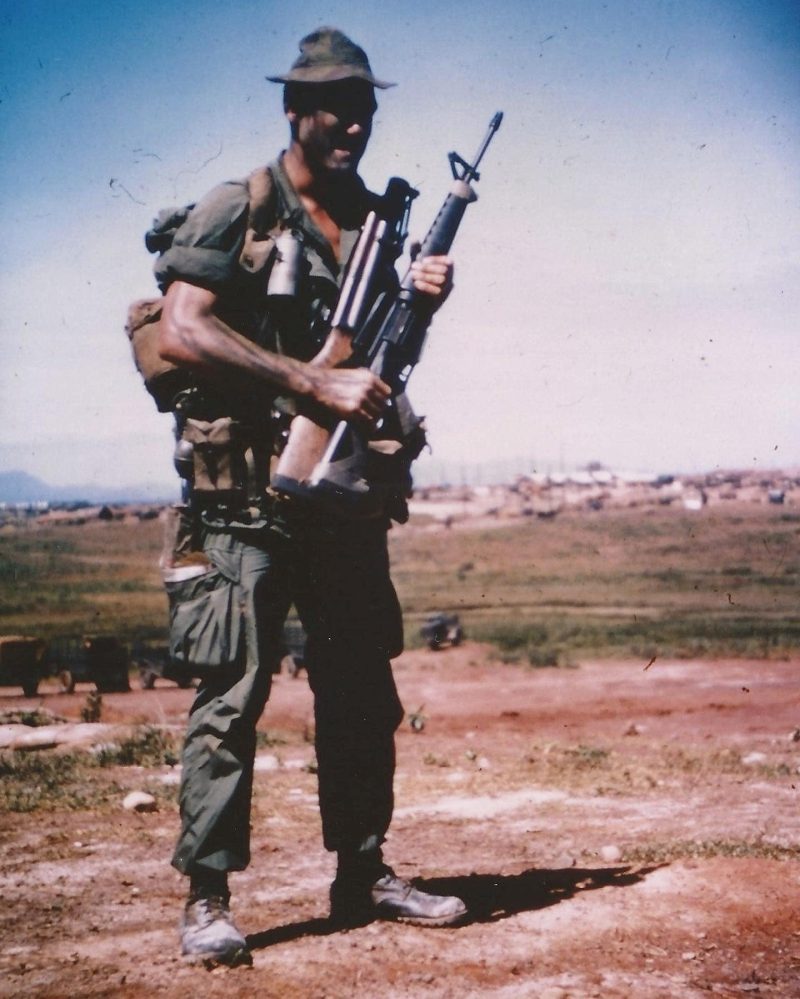
1965 (MEF) III Marine Expeditionary Force (MEF) was activated on May 6 in Vietnam, establishing the Corps’ forward command element for the war;
(Doctrine) The Combined Action Program (CAP) was initiated in Vietnam, embedding Marine squads with local militias for village defense—a unique, long-term COIN experiment.
(MoH) Sergeant Jimmie E. Howard awarded the MoH for defense of Hill 488 in June;
(MoH) First Lieutenant Harvey C. Barnum Jr. awarded the MoH in Quang Tin Province in December.
1966 The Corps adopted the M16A1 rifle, replacing the M14 as the standard service rifle;
(MoH) Private First Class Rodney M. Davis earned the MoH for smothering a grenade in September.
(MoH) Major Howard V. Lee earned the MoH for actions in Quang Nam Province in August.
1967 (MoH) Private First Class Gary Wetzel earned the MoH for action in the Republic of Vietnam in January.
(MoH) Hospital Corpsman Second Class Donald E. Ballard (Navy) earned the MoH for actions with the 3rd Marine Division in May.
(MoH)Lieutenant Vincent R. Capodanno (Navy Chaplain) earned the MoH posthumously for actions in Quang Tin Province in September.
[Hard men. Undeniably brave.]
1968 (CMC) General Leonard F. Chapman, Jr. became the 24th Commandant on January 1.
(Weapon) The Corps officially recognized the M67 90mm Recoilless Rifle as the primary anti-tank weapon for the infantry squad.
(MoH) Private First Class James Anderson Jr. earned the MoH posthumously for smothering a grenade in Vietnam in February.
(MoH) Gunnery Sergeant John L. Canley earned the MoH leading his company in Hue City in January-February.
1969 The Corps began formally experimenting with close-quarters battle (CQB) training.
[Don’t worry, we will only change CQB 1,000,000,000 times in the next few decades.]
(MoH) Private First Class Oscar P. Austin earned the MoH posthumously for actions west of Da Nang in February.
(MoH) Private First Class Bruce W. Carter earned the MoH posthumously for throwing himself on a grenade in Quang Tri Province, saving a number of Marines.
(MoH) Lance Corporal Miguel Keith earned the MoH posthumously for single-handedly assaulting an enemy position in Quang Nam Province, eliminating the threat despite mortal wounds.
1970 (MEF) II Marine Expeditionary Force (MEF) was activated as the East Coast MAGTF command element;
(MoH) Lance Corporal Miguel Keith earned the MoH posthumously for actions in Quang Nam Province in May.
(MoH) Private First Class Raymond M. Clausen Jr. earned the MoH for repeatedly volunteering to extract wounded Marines and Corpsmen by helicopter from a minefield under heavy fire in Quang Tri Province.
1971 The last major Marine combat troops officially departed Vietnam, significantly reducing the Corps’ operational footprint in Southeast Asia.
[We didn’t lose, we left.]
1972 (CMC) General Robert E. Cushman, Jr. became the 25th Commandant on January 1.
(Doctrine) The MOS system, including 0311 (Rifleman), was formally adopted.
[Yut!]
The Corps reduced the size of its active force by roughly 25% following the end of its involvement in Vietnam.
[The bad years begin.]
1973 (Tank) The Corps retired the last of its M48 Patton tanks, standardizing the M60 as the main battle tank.
The Corps implemented the M151 Light Utility Vehicle (MUTT) as the primary jeep, replacing the M38, for its Vietnam-era forces.
1974 Marines participated in the Operation Nickel Grass airlift to Israel.
The M40 sniper rifle is retained as the new standard Sniper rifle, after great success in Vietnam.
1975 (CMC) General Louis H. Wilson, Jr. became the 26th Commandant on July 1.
Marines participated in Operation Frequent Wind, the final evacuation of Saigon, with the last Marines departing from the U.S. Embassy rooftop.
1976 The Corps established the Landing Force Training Command, Atlantic (LFTCLANT).
1977 (School) The permanent Marine Scout Sniper School was established at Quantico.
[A wealth of knowledge and experience, that surely the Corps will never abolish?]
The Corps fully transitioned to the AV-8A Harrier jump jet, giving the MEU organic, fixed-wing close air support from small ships.
[That thing was cool in the movie “True Lies”!]
1978 The Corps introduced the M203 grenade launcher to replace the stand-alone M79, integrating high-explosive indirect fire directly into the rifle squad weapon system.
[No one wants to carry it, everyone loves to shoot it. THUMP!]
1979 (CMC) General Robert H. Barrow became the 27th Commandant on July 1.
The Corps conducted its first major exercise, simulating a defense of the Suez Canal, to practice rapid intervention in the Middle East.
1980 The Rapid Deployment Force (RDF) was created, with the Marine Corps being a key component, highlighting the political utility of the MAGTF concept for rapid global response.
1981 The Corps officially designated the CH-53E Super Stallion as its Primary Heavy Lift Helicopter, validating the need for the ability to move heavy equipment and vehicles by air.
1982 The Corps began adopting the Maneuver Warfare philosophy, shifting away from Soviet-style attrition warfare toward concepts of speed, initiative, and attacking the enemy’s critical vulnerabilities.
1983 (CMC) General Paul X. Kelley became the 28th Commandant on July 1.
A devastating truck bombing attack on the Marine Barracks in Beirut, Lebanon, directly led to a significant overhaul of security procedures for deployed forces worldwide.
(MoH ) Private First Class Bruce W. Carter (killed in action in Vietnam in 1969) awarded the Medal of Honor posthumously this year.
1984 Marines conducted Operation Urgent Fury in Grenada.
(Doctrine) Failures in joint communication during Urgent Fury directly informed the need for the Goldwater-Nichols Act of 1986.
1985 The Light Armored Vehicle (LAV-25) was fielded, giving Marine light infantry a fast, wheeled reconnaissance and transport capability, emphasizing speed over heavy protection.
1986 (Tank) The Marine Corps formally adopted the M1A1 Abrams Main Battle Tank to replace the aging M60s, significantly upgrading its armor and firepower capability for major conventional conflict.
1987 (CMC) General Alfred M. Gray, Jr. became the 29th Commandant on July 1.
The Corps fully transitioned to the AV-8B Harrier II jump jet, giving the MEU organic, fixed-wing close air support from small ships.
1988 The Corps began developing the Marine Corps Tactical Systems Support Activity (MCTSSA) to manage and integrate all IT and C4 systems, reflecting the growing importance of digital warfare.
1989 The Marine Corps officially embraced MCDP-1, Warfighting, formalizing Maneuver Warfare.
[“Did you do your MCI’s yet devil?”]
IV. USMC Historical Timeline: The Post-Cold War Crisis Response (1990–2000)
1990 The 8th Marine Regiment was one of the first units deployed to Saudi Arabia for Desert Shield, utilizing Maritime Prepositioning Ships (MPS) for the first time on a massive scale.
1991 (CMC) General Carl E. Mundy, Jr. became the 30th Commandant on July 1.
[87 Marines fall out of the changing of command ceremony, 4 are medically separated as a result. Locked Knees are officially banned Corps-wide.]
(TF) Task Force Ripper (TF-Ripper) was named in Desert Storm, part of the major ground assault into Kuwait.
I Marine Expeditionary Force (I MEF) conducted a highly successful, deception-heavy feint, convincing the Iraqis of a major amphibious assault that never materialized.
1992 (Abolishment Attempt) The U.S. Naval Institute Proceedings published Major H.C. Peterson’s influential article, “Let’s Abolish the Corps,” which argued for eliminating the USMC in the post-Cold War era.
[Booooooooo! Nice try, assholes!]
Marines deployed to Somalia for Operation Restore Hope, conducting a night amphibious landing to secure the port of Mogadishu, emphasizing the MEU’s utility as a crisis-response force.
[Spoiler alert: Hope was not restored.]
1993 Marines participated in Operation Able Sentry in Macedonia, becoming the first U.S. combat troops deployed in a peacekeeping role in the Balkans.
1994 Marines participated in Operation Able Sentry in Macedonia, becoming the first U.S. combat troops deployed in a peacekeeping role in the Balkans.
1995 (CMC) General Charles C. Krulak became the 31st Commandant on July 1.
The Corps transitioned to the M2 .50 Caliber Machine Gun in the vehicular role, replacing older, less reliable variants.
[MA likes to eat! Get some!]
1996 The Corps fielded the M249 Squad Automatic Weapon (SAW), increasing the sustained rate of fire capability in the infantry squad.
[Nice when new, bad when worn…]
1997 (Base) MCAS Miramar, CA, was officially transferred from the Navy to the Marine Corps on October 1.
The Concept for Distributed Operations was published by the Marine Corps Warfighting Lab, testing small, highly-networked units and foreshadowing later Force Design concepts.
2000 The last permanent Marine Detachments (MarDets) were disestablished aboard Navy ships, ending a continuous 200-year-old tradition of Marines serving as ship’s guards.
[Kinda sad, kinda good?]
The Corps published a white paper arguing for a new class of “Sea-Based Expeditionary Platform” (SBEP), a concept that eventually evolved into the modern Light Amphibious Warship (LAW) requirement.
V. Marine Corps History: The GWOT, COIN, and Force Design Eras (2001–2025)
2001 (CMC) General James L. Jones became the 32nd Commandant on July 1.
[Immediately orders study into why Marines lock their knees in formation.]
2002 The M4 Carbine was formally approved for use by Marine special operators and other select units.
[We should have issued them to everyone, right then and there!]
2003 The highly specialized Marine Corps Detachment One (Det One) was activated to conduct special operations in Iraq.
(TF) Task Force Tarawa (TF-Tarawa), centered on the 2nd MEB, was instrumental in the heavy fighting during the push to secure the bridges at An Nasiriyah, enabling the main assault toward Baghdad.
[Watch “Generation Kill”, awesome story.]
(Weapon) The Squad Advanced Marksman Rifle (SAM-R), a modified M16A4, is used as an interim designated marksman rifle, initially fielded by II MEF.
2004 The “Heavy” Marine Corps structure reached its zenith of employment during the Second Battle of Fallujah.
(MoH) Corporal Jason L. Dunham earned the MoH posthumously for smothering a grenade near Karabilah, Iraq.
2005 Commandant General Michael W. Hagee published the Concept for Distributed Operations, which envisioned small, highly-networked units, foreshadowing Force Design 2030.
2006 (CMC) General James T. Conway became the 34th Commandant on November 13.
(Specialty) MARSOC (Marine Forces Special Operations Command) was formally established on February 24, integrating the Corps into USSOCOM.
2007 Commandant Hagee’s tenure ended on January 1.
2008 Commandant Conway directed a shift to increase the authorized strength of the Corps from 180,000 to 202,000 Marines to sustain the demands of two wars (Iraq and Afghanistan).
2009 The Corps implemented the HK M27 IAR as a Limited Fielding measure, replacing the M249 SAW in the squad automatic rifle role.
(MoH) Sergeant Dakota Meyer earned the MoH for actions in Kunar Province, Afghanistan in September.
2010 The Marine Corps fully adopted the M27 Infantry Automatic Rifle (IAR) in December, with the first few IARs deployed to Afghanistan in April, 2011.
(MoH) Lance Corporal William K. Carpenter earned the MoH for actions in Marjah, Afghanistan in November (awarded in 2014).
2011 (CMC) General James F. Amos became the 35th Commandant on October 22.
2012 The Commandant announced the adoption of the M27 IAR to replace all M4s in the squad automatic rifle role. The decision to replace all M4s in every infantryman’s hands with the M27 was made later, around 2017/2018.
[We could have updated the M4, which would have been faster and more cost-effective, but hey, lobbyists.]
2013 The Corps successfully tested the Expeditionary Fire Support System (EFSS), a 120mm mortar system designed for rapid transport by MV-22 Osprey, showcasing lightweight artillery concepts.
2014 The Corps began the mandatory replacement of the M40 sniper rifle with the longer-range MK 13 sniper rifle
2015 (CMC) General Robert B. Neller became the 37th Commandant on September 24.
[Bans locking of knees in all formations, results are null.]
2017 The Corps officially designated the Indo-Pacific theater as its Primary Focus Area.
[Fore-shadowing a future war with China?]
(Weapon) The M27 IAR was officially chosen to replace the M4 as the standard rifle for all infantry Marines.
[We are getting suppressors and cool helmets too!]
2018 Commandant Neller stated that the Corps was “not organized, trained, equipped, or postured” for the future, initiating the public discussion that led to Force Design 2030.
2019 (CMC) General David H. Berger became the 38th Commandant on July 11.
(Doctrine) General Berger released his Planning Guidance (CPG), the foundation for Force Design 2030.
2020 (Tank) The divestment of all M1A1 Abrams Main Battle Tanks was announced, ending the Corps’ tank program.
[Stupid. We will want those tanks in the future.]
2021 (Regiment) The 8th Marine Regiment was deactivated on January 28, the first major combat unit cut under Force Design 2030.
[Also a shortsighted idea.]
(Aviation) Marine Attack Training Squadron 203 (VMAT-203), the AV-8B Harrier training unit, was decommissioned on October 29.
2022 The MQ-9A Reaper Unmanned Aerial System (UAS) was formally integrated into Marine aviation units.
[How long did that take?]
2023 (CMC) General Eric M. Smith became the 39th Commandant on September 22.
(Formation) The 3d Marine Littoral Regiment (MLR) in Hawaii completed its initial activation.
The last class of the Marine Corps Scout Sniper Course graduated on December 15, 2023, at Camp Geiger, North Carolina. This marked the end of the traditional 0317 MOS as part of the Marine Corps’ Force Design 2030, which is phasing out the scout sniper role in favor of new Reconnaissance Sniper (0322) units.
[A horrible decision the USMC will live to regret.]
2024 The Corps began fielding the Organic Precision Fires (OPF) system, providing ground units with long-range strike capabilities.
2025 (October) The current focus is on fielding the NMESIS (Navy/Marine Corps Expeditionary Ship Interdiction System) to enable sea-denial missions from shore.
10 November 2025 MARINES CELEBRATE 250 YEARS OF STACKING BODIES
The Definitive Timeline of Marine Corps History: CONCLUSION
The Few, The Proud, The United States Marines!
If you read through the entire historical list, you will see that the USMC has participated in nearly every major conflict since before America even formed as a Nation. 250 years of selfless sacrifice, ironclad devotion, and a band of brothers so close, there are few rivals. The Marines have been there, ready to fight and protect America no matter what the cost.
It’s been said that, “America doesn’t need a Marine Corps, It wants a Marine Corps!”
Hopefully, that remains true. Perhaps in the next 250 years, we will escort the Space Navy in exploring the solar system. It would be pretty badass to fight some space pirates, but I’m sure any future young Jarhead will be content just to drop a few rounds into a Xenomorph or two!
Regardless, I do truly believe that for as long as the Marine Corps survives, our grand Nation will as well.
The Corps collects some of the best and brightest men and women our nation can produce, and is full of courage in its ranks. It might have been 250 years since it all started in a musty Philadelphia bar, but I’m sure the legacy of the Corps will only grow with time and honor over the next 250 years!
Happy Birthday Marines, and Semper Fidelis!




Just one minor correct. Please, heroes do not “earn” the MOH. It is awarded for conspicuous gallantry. It isn’t a long distance run, it isn’t getting the top grades in class. It is awarded for gallantry above and beyond the call of duty. It is rare that the recipient survives the acts that nominated him for the award. President Harry S. Truman who served as an artillery captain in WWI is quoted as saying he would rathe be a recipient of the MOH than be president of the U.S.
This November 10, 2025 will celebrate 70 years since my attending my first Marine Corps Birthday at Tent Camp Two, Camp San Onofere, Camp Joseph Pendleton, Oceanside, CA. I intend to sweep the 60 and over pulp contest.