There’s no more recognizable American knife than the USMC Ka-Bar. The iconic Marine fixed-blade fighting knife is it–nothing else comes close. It’s the knife equivalent of the 1911. The iconic Marine knife went to war in 1942 (specifically, the M1219C prototype), and it hasn’t left the battlefield since. Here’s a retrospective look, and review.
Ka-Bar knives may need little introduction for our readers, but we’ll dive in with some salient details.
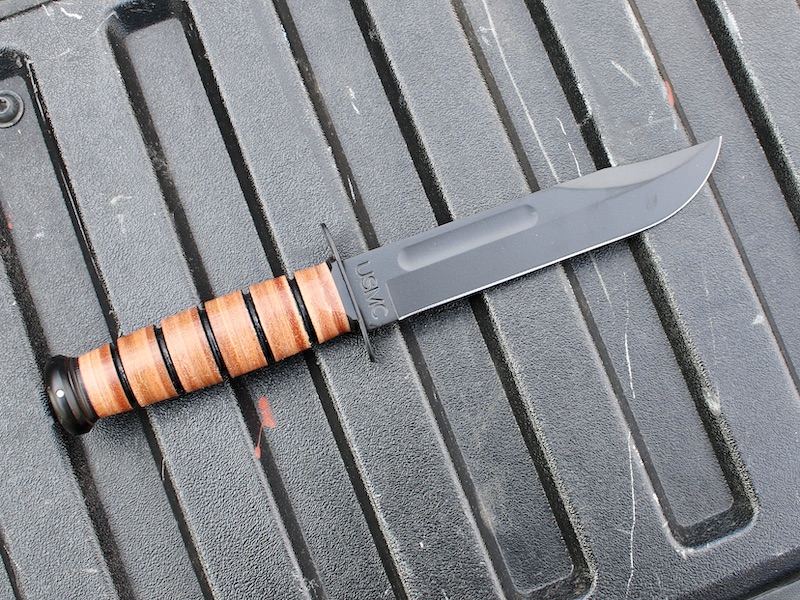
These new Ka-Bars come with a variety of blade stamps, including many branches of service and other commemorative designs.
Want to cut-to-the-chase, as we say in the parlance of our times? Get a Ka-Bar.
The original incarnation of this article was written by David Higginbotham. It has been updated by the original author and David Reeder to its current format. If you have any comments – or you see anything we got wrong! – let us know in the comments.
The Origins of the Ka-Bar
At the heart of the Ka-Bar design is the unending desire for Indefectibility.
The United States Marine Corps picked up the fixed blade Ka-Bar on November 23rd, 1942. This wasn’t some proactive, “visionary” decision on behalf of the Corps. It was a reactionary measure militated by the truly abysmal performance of previously issued knives like the U.S. Mk 1 trench knife.
The United States joined World War II, and the country was dealing with a mix of issues: supply shortages, production demand, antiquated designs, and tactical changes. Americans heading to both Europe and the Pacific were bringing hunting knives from home, which highlighted the inadequacies of some of the knives issued early in the war.
The M1219C2 prototype was designed by unheralded architects USMC Colonel John M. Davis and Major Howard E. America. They based the dual-purpose weapon largely on existing commercial patterns, specifically using the rugged Western’s L77 hunting knife as the template for improvement. This USMC Ka-Bar belonged to USMC Pvt. Fred Mingledorff, a veteran of the Pacific War, donated it to the GHS Research Center. (Photo courtesy of the Georgia Historical Society)
The thin blades of the Mk 1 were notoriously prone to snapping, like when Marines used them to pry open ammo crates, ration tins, and other practical, everyday tasks that might not have been the intended use but were common and vital. What they needed, it turns out, wasn’t so much a fighting knife as a utility knife.
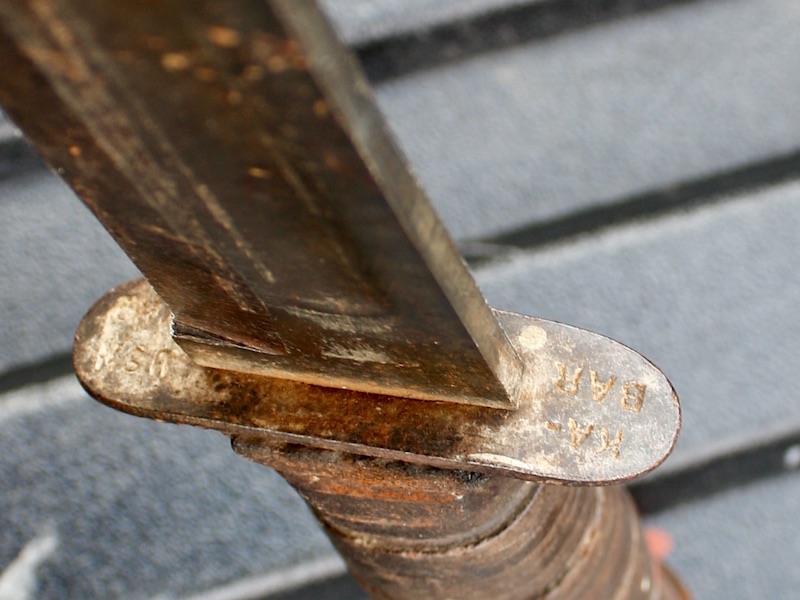
Some old Ka-Bars have markings on the crossguards.
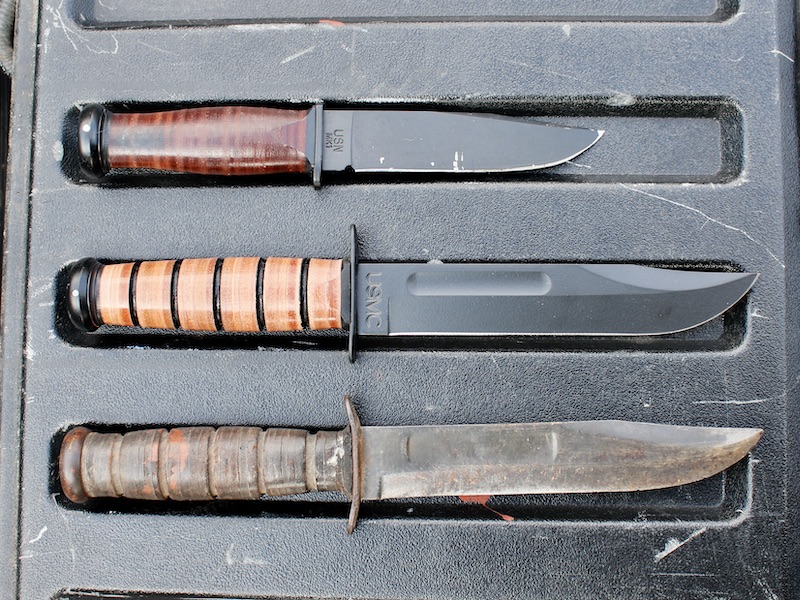
After the Marines adopted the Ka-Bar, the Navy followed suit. The Marine eventually designated the design the USMC Mark 2 after the Navy designated their version the USN Mark 2. Like the old 1911s of this period, the Garand and other guns, the Ka-Bar was produced by multiple companies. The design was built by PAL, Union Cutlery, Robeson, and Camillus. However, while Union Cutlery held the trademark, the Camillus Cutlery Company actually produced the lion’s share of the total output during the war.
Initial adoption of the new Marine knife wasn’t easy. Someone up the chain in the Quartermaster Department initially refused to order the new knives, insisting on adhering to existing inventories. Whether this was a Marine officer, an Army officer (the Marines fell under the Army’s Quartermaster Corps at the time) or some functionary is unclear. What is known is that the (typical military) entrenched bureaucracy had to be personally overriden by no less a personage than the highest Corps command authority: Commandant Lt. General Thomas Holcomb.
The design was personally mandated on 23 NOV 42.
Ka-Bar’s Ties to Tradition
Knife evolution is historically slow. Or it was. Now, in the age of CNC, companies are shitting out new models monthly.
While there are big leaps with materials and occasional changes for tempering techniques or grind angles, the basics tend to stick around. Many fighting knives of this era were long and double-edged. The pointy, stabby designs are meant for thrusting. The blades are thin, not easy to sharpen, and less about utility and more about punching holes in your enemy.
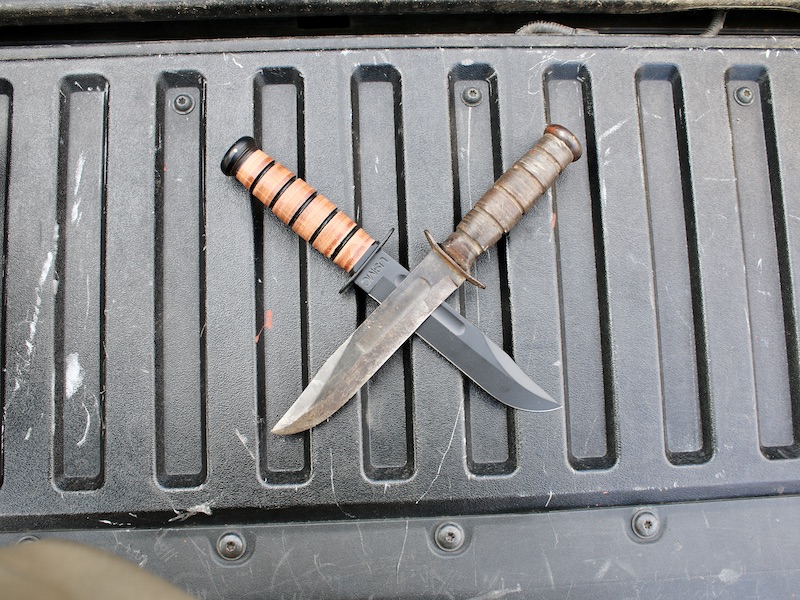
Some period knives, and one reproduction. A Cattaragus 225Q, an MK2, an M3, a Marble’s, a Fairbairn Sykes and a newer Ka-Bar MK1. There are new versions of the M3, and modern Fairbairns, too.
Hunting knives, though, were different. The blades were wider. The addition of convex blood grooves mitigated weight. Most were either flat or convex grinds that maintained the structural integrity of the edge.
The shallow groove along the side of the blade, often mistakenly referred to as a “blood groove,” is correctly termed a fuller. Its true purpose is structural: to reduce the weight of the long, 7-inch blade without compromising its thickness or structural integrity.
The Bowie clip-point was still in fashion. The Ka-Bar kept the false edge to allow the knife to have more punching potential. Even with the width of the blade, this point made it a more versatile fighting knife.
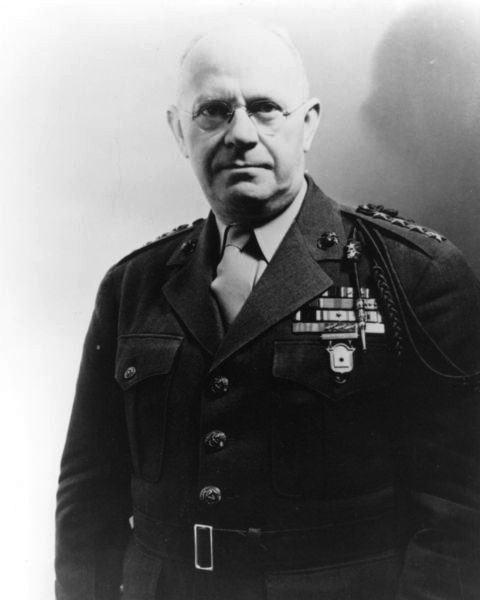
Gen. Thomas Holcomb, 17th Commandant of the Marine Corps. If it weren’t for Holcomb, there probably wouldn’t have been an official Marine combat knife.
This would probably be a good time to settle an old legend: depending on how old you are, you might’ve heard that Ka-Bar is an acronym for “Knife and Browning Automatic Rifle.” If you did hear that, you heard wrong. The name actually dates back to 1923 (a couple of decades before Bougainville, Guadalcanal, and Tarawa).
That year, the Union Cutlery company purportedly received a scarcely legible testimonial letter from an (unknown, that we can find) fur trapper, who claimed his rifle had jammed on him out in the wilderness, leaving him with just his knife to kill a wounded bear. Supposedly, all that was legible of his thanks were the letters K A BAR, which the company adopted as its name and trademark.
That story is actually reasonably well documented, but it’s a great tale even if untrue.
Material Scarcity and Engineering Compromises
The origins of the design are part of the genius of the design. This isn’t a full-tang knife. It could have been, and that would have made the design stronger, but this was a time when metal conservation was top-of-mind. The goal was to make something strong enough to endure field use but that also conserved our strategic supply of steel.
The knives of the time used 1095 carbon steel for their blades. That’ll make you cringe if you are a blade-steel snob. 1095 is about as utilitarian as steels come these days. It is easy to work with, wears well, can be sharpened easily, and has more than a century of history as a dynamic material for cutting tools.
Ka-Bar may now be using more bougie steels, but there’s nothing wrong with 1095.
Note how far back the crossguard on the MK2 is bent. When I was a kid, I thought this one had been bent. Not so.
The crossguard, blade, and pommel were parkerized. That provides the basic protection that a carbon steel blade requires—all but the cutting edge—minimizing the potential for rust. Minimizing, but not eliminating. The old Ka-Bar design will always require some care.
Due to the high-pressure production environment, the 1219C2 saw at least three distinct, officially used blade finishes in WWII: an early blued finish, an intermediate light gray phosphate finish, and the eventual standard parkerized (matte) finish.
Consider the stacked leather handle. These leather discs may well be the best grip material ever conceived, offering comfort and feel. I get it—that’s an opinion—but a well-worn stacked leather handle absorbs shock, provides a really good grip surface without being overly aggressive, and isn’t as cold-to-the-touch as some plastics or even other natural materials.
With a bit of oil to wipe down the blade and a bit of oil on the handle, the Ka-Bar will go for a long time.
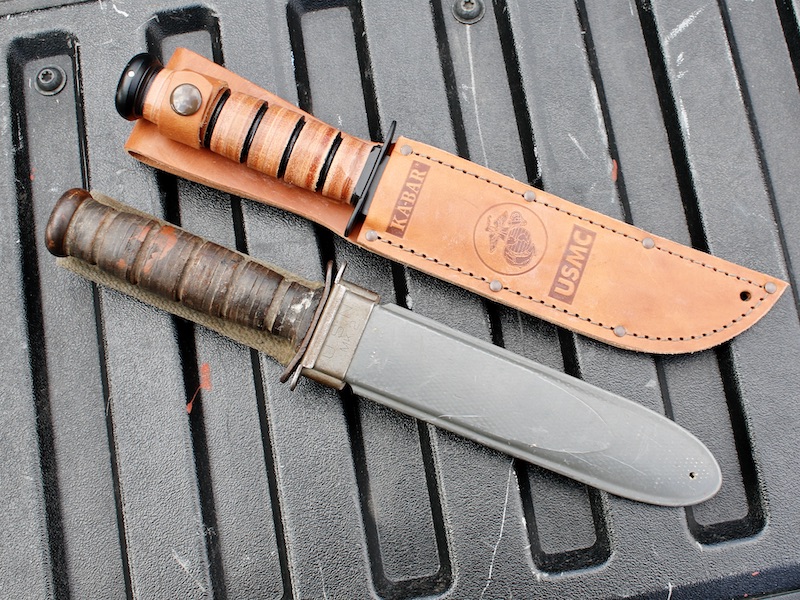
Originals came in one of two styles of sheath. One was fiberglass, the other leather. New Ka-Bars come in leather.
If you’re in the market for an old Ka-Bar, look for shrinkage in the leather washers. The pommel is peened on with the handle being compressed, but if the leather dries out, it will shrink, and the crossguard can pull away.
Can Opener Conundrum: the Ka-Bar as Utility Knife?
The original design was meant to function as both a fighting knife (for any Marine that wasn’t issued a bayonet) and as a utility knife. That part about “not carrying a bayonet” is significant; it contributed significantly to contemporary lore that the USMC KaBar was a close-combat and survival tool. This is particularly true for Browning Automatic Rifle (BAR) gunners, crew-served machine gun personnel, and others.
The fighting function is easy enough to envision. The blade length was increased (over most of the commercial hunting knives and previously issued utility knives) to 7 inches. This was considered at the time to be the magic length—long enough to hit internal organs—but light enough to carry.
Two recreations of the old Ka-Bar designs for the MK1 and the USMC, and an old MK2. The MK1 is much more of a utility knife than a fighting knife.
As a utility knife, the Ka-Bar is a solid performer. The blade is a good slicer and easy to keep functionally sharp. The grind angle is fairly wide—a 20-degree angle. The is solid for chopping, splitting, prying—anything you’d ask a basic camp knife to do.
Although it has a thick stick tang, that remains the weak point of the entire design. This isn’t my first choice for batoning. I’ve done it before, and will do it again, but I’m far more inclined to wail on a Becker Campanion than I am a USMC Ka-Bar.
Used on the Islands, for…Everything
One of the most definitive statements about the Ka-Bar’s actual use and purpose probably came from Eugene Sledge’s classic WWII memoir, With the Old Breed, who wrote,
We were introduced to the Marine’s foxhole companion, the Ka-Bar knife. This deadly piece of cutlery was manufactured by the company bearing its name. The knife was a foot long with a seven-inch-long by one-and-a-half-inch-wide blade. The five-inch handle was made of leather washers packed together and had “USMC” stamped on the blade side of the upper hand guard. Light for its size, the knife was beautifully balanced.
“Everybody has heard a lot about all those kinds of fancy fighting knives that are, or should be, carried by infantry troops: throwing knives, stilettos, daggers, and all that stuff. Most of it is nothing but bull. Sure, you’ll probably open more cans of C rations than Japs with this knife, but if a Jap ever jumps in your hole, you’re better off with a Ka-Bar than any other knife. It’s the very best and it’s rugged, too. If you guys were gonna fight Germans, I’d guess you’d never need a fighting knife, but with the Japs it’s different. I guarantee that you or the man in the next foxhole will use a Ka-Bar on a Jap infiltrator before the war is over.”
Marines, Corpsmen, Sailors, and Soldiers all tended to make field-expedient modifications never “approved” by field manuals, and the Ka-Bar was no exception. For instance, one common (*gasp* unauthorized!) modification was to file the unsharpened spine of the clip point to a 90-degree edge. This made it easier to throw ferrocerium rod sparks (and for that matter to scrape tinder to throw the sparks into).
A couple other modifications included filing a small “sighting notch” into the crossguard or etching a rough clock face on to the flat edge of the pommel to help with rudimentary direction finding.
The Ka-Bar may be the perfect epitome of that odd balance between the stasis of a life at war and the actual frenetic pace of the fight. The knife’s reputation was built in battle—that’s the legacy we celebrate and remember, but it is the brilliance and dutiful performance of the knife in every other task that really made it such a useful tool.
The USMC Ka-Bar
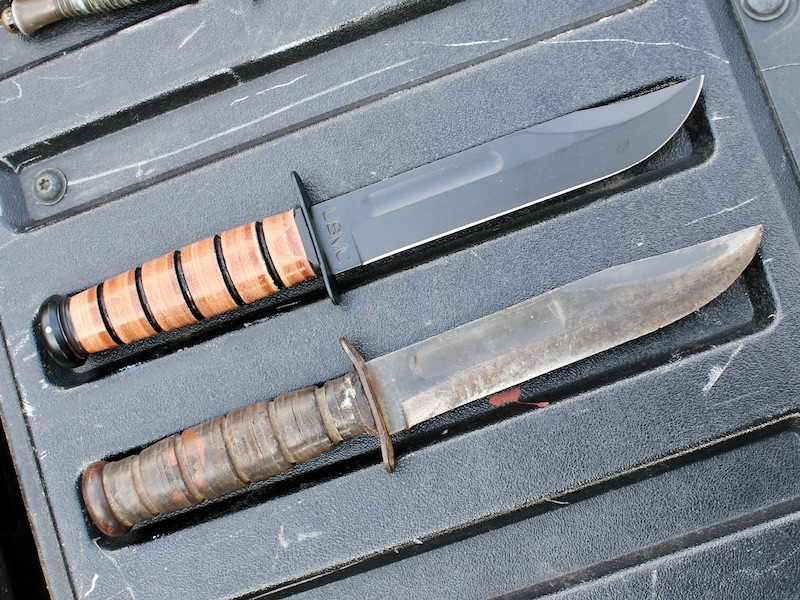
The current production models differ from the originals in one crucial way. The endcap is pinned on and not peened. Peening was done after the endcap was forced down, and the steel tang was then deformed by peening it over. Once peening is complete, the handle isn’t going anywhere.
The old MK2 is peened. The new USMC Ka-Bar is pinned.
Pinning, on the other hand, is a bit easier. Compress the leather, until a pre-drilled hole in the tang allows for the pin to be inserted. This holds pressure against the underside of the endcap, which secures the pin and keeps it from shifting.
The decision to switch from the original peened pommel to the later pinned pommel was another wartime compromise. Implementation of the change simplified the assembly process and strengthened it against impact. Perhaps most significantly from a logistical point of view, it sped up production.
Which is stronger? I’ve seen some Ka-Bars from the 40s that are broken at the endcap. This is rare, though. Theoretically, if a new USMS Ka-Bar were to break at the pin, it would be easy enough to replace. You could even do it with a simple bench vise (if it would open up to about five inches).
Ka-Bar Variants
There are many. So, so many. This is, after all, a knife that’s been in production for more than 80 years. At one point or another, it’s been used by every branch of the military, not to mention all the “specialty” and limited run versions that have been produced.
The main variants focus on blade serrations, blade length, and sheath materials. There are shorter versions, and the Big Brother (which is absurd). There are lots of commemorative blades, too, and presentation builds that pay homage to the long legacy this knife has with the military.
The D2 Extreme features a dog’s head hilt design, which is not common on many Ka-Bars.
Some collectors date early era WWII Ka-Bars by the location of the manufacturer’s stamp. For instance, knives from later in the war had their markings oved from the face of the blade to the underside of the crossguard.
If you are looking for a pure homage to the original, and one that comes in a leather sheath, this is the one. If you don’t want to imply that you were a Marine and would rather have one with no military markings, the Single Mark Ka-Bar (available here) has a naked leather sheath and no branch affiliation stamped into the blade.
I was not a Marine, but I respect the hell out of what they do (and did with these knives), so I went for the traditional model with the leather handle and sheath with no hesitation.
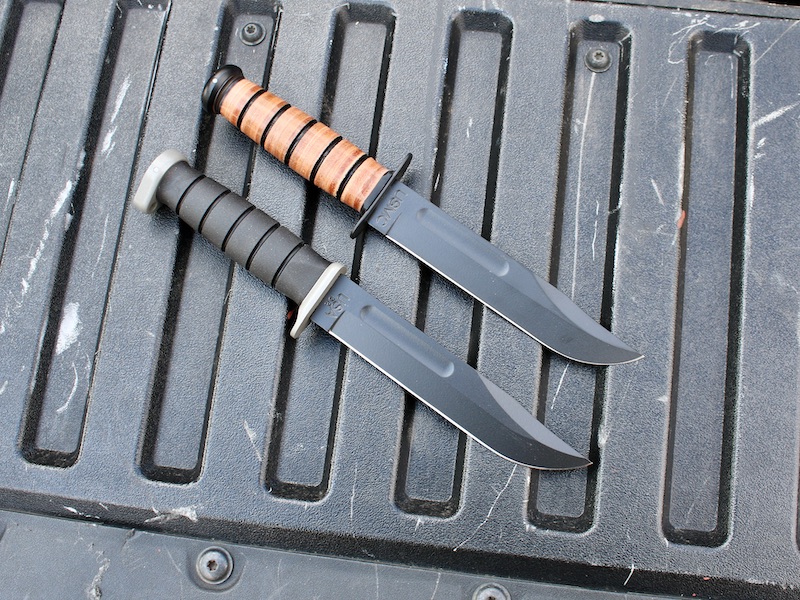
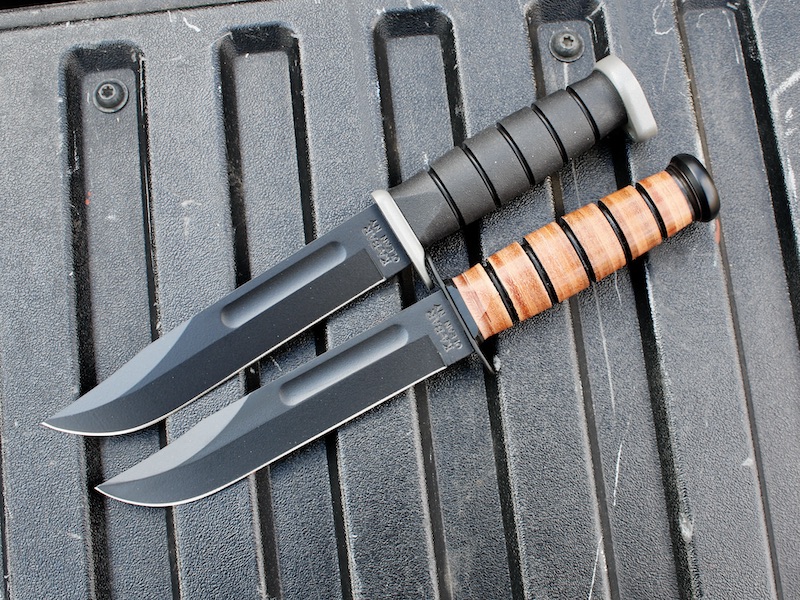
Though the blades look similar, one is 1095 and the other is D2. Both will hold their edges well, but the D2 is easier not as easy to sharpen.
For those who want something with a more modern edge to it, Ka-Bar’s Extreme line is perfect. The D2 Extreme builds on the Ka-Bar tradition by combining D2 steel, “powdered metal” handle furniture, and a Kraton G grip (a fancy elasticized rubber like substance that provides a solid grip, a softer feel, and extreme wear resistance.
These were available for a long time—several years—with a section of blade serrations. Recently, Ka-Bar released the straight-blade version. The crossguards on these are more one-sided.
Ka-Bar knows how to keep the tradition alive, but the company has also done well with modernized versions of the classics, such as this D2 Extreme.
If, like me, you’re inclined to carry your knives, the choice will be a mix of the aesthetic and the functionality. If you want slightly more functionality and don’t care about the historical homage, the Extreme is a fantastic knife.
D2 is known for its rigidity, edge retention capabilities, and it is almost as easy to maintain as stainless. The blade is the same length and width on both, but the D2 Extreme is slightly wider.
The Kraton handle won’t last forever, but it will outlast the leather you ignore.
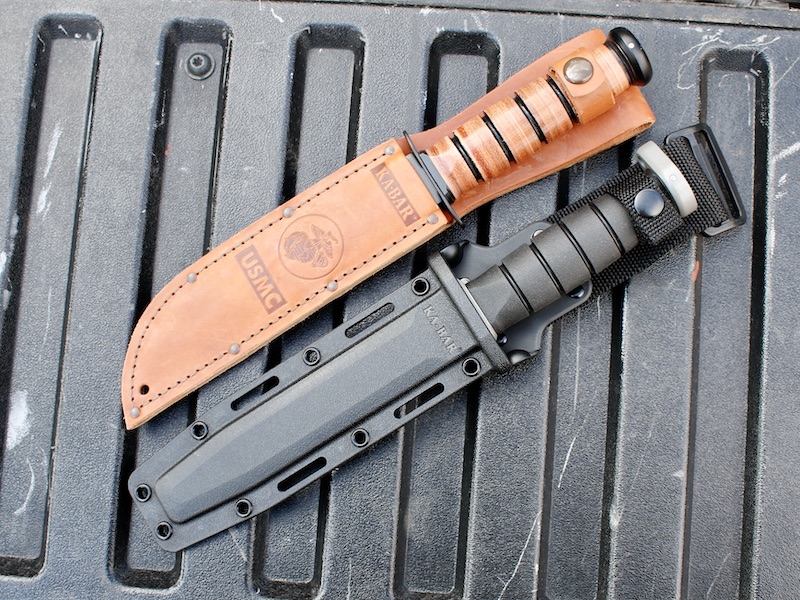
The back of the sheaths. The difference in the two styles is all about adaptability.
There’s a price difference, of course. The D2 Extreme will be north of $125 (prices vary depending on what kind of sheath option you want). The USMC will likely be closer to $90.
Either way, both of these are well worth what you’ll pay for them. Take care of them, and they’ll be the type of knives you pass on. Maybe more than once.
For more information on the Ka-Bar Fighting Knife, visit Ka-Bar Cutlery.
Find what’s in stock, and where, and compare prices.
⚠️ Some hyperlinks in this article may contain affiliate links. If you use them to make a purchase, we will receive a small commission at no additional cost to you. It’s just one way to Back the Bang. #backthebang










0 Comments