The Smith and Wesson Model 15 is a classic wheelgun with a 75-year history. It’s a K-frame revolver chambered in .38 Special. Though it’s primarily known for its military and law enforcement service, it remains extremely popular among wheelgun aficionados, collectors, and others who just appreciate a solid, iconic revolver for its own sake.
Smith & Wesson Model 15: Legacy Lawman Sidearm
Although the Model 15 is venerated in revolver circles (at least the older versions), I’m actually not that familiar with it. In fact, there are only a couple of reasons I really know anything about it at all.
First, it was still the duty weapon issued to LE troops in my unit when I was a brand-spankin’ new dumbass Airman. Second, it’s the pistol Chief Brody used in the movie Jaws. Hell, he used it in Jaws 2, too. I never understood why the hell he didn’t upgrade his firepower. (I don’t count using Quint’s M1 Garand.)
I guess the Power of Plot compelled him.
Some Model 15 History: Smith & Wesson’s and Mine
Its earliest incarnation debuted in the late 1940s as the K-38 Combat Masterpiece. It remained in common use by police agencies (like the Oklahoma Highway Patrol and LAPD) well into the 80s. Production of the 4″ barrel configuration continued until 1999.
As explained by the NRA Museum and numerous other sources, the Model 15 was derived from the 1947 “Target Masterpiece” revolver, which had a six-inch barrel and used square-cut Patridge sights. The “Combat” version, or at least some of them, was equipped with ramp front sights that were better suited for holster use, a four-inch barrel, and adjustable sights. It wasn’t actually called the Model 15 until some 10 years later, when Smith & Wesson started a new naming convention focusing on numerical model numbers.
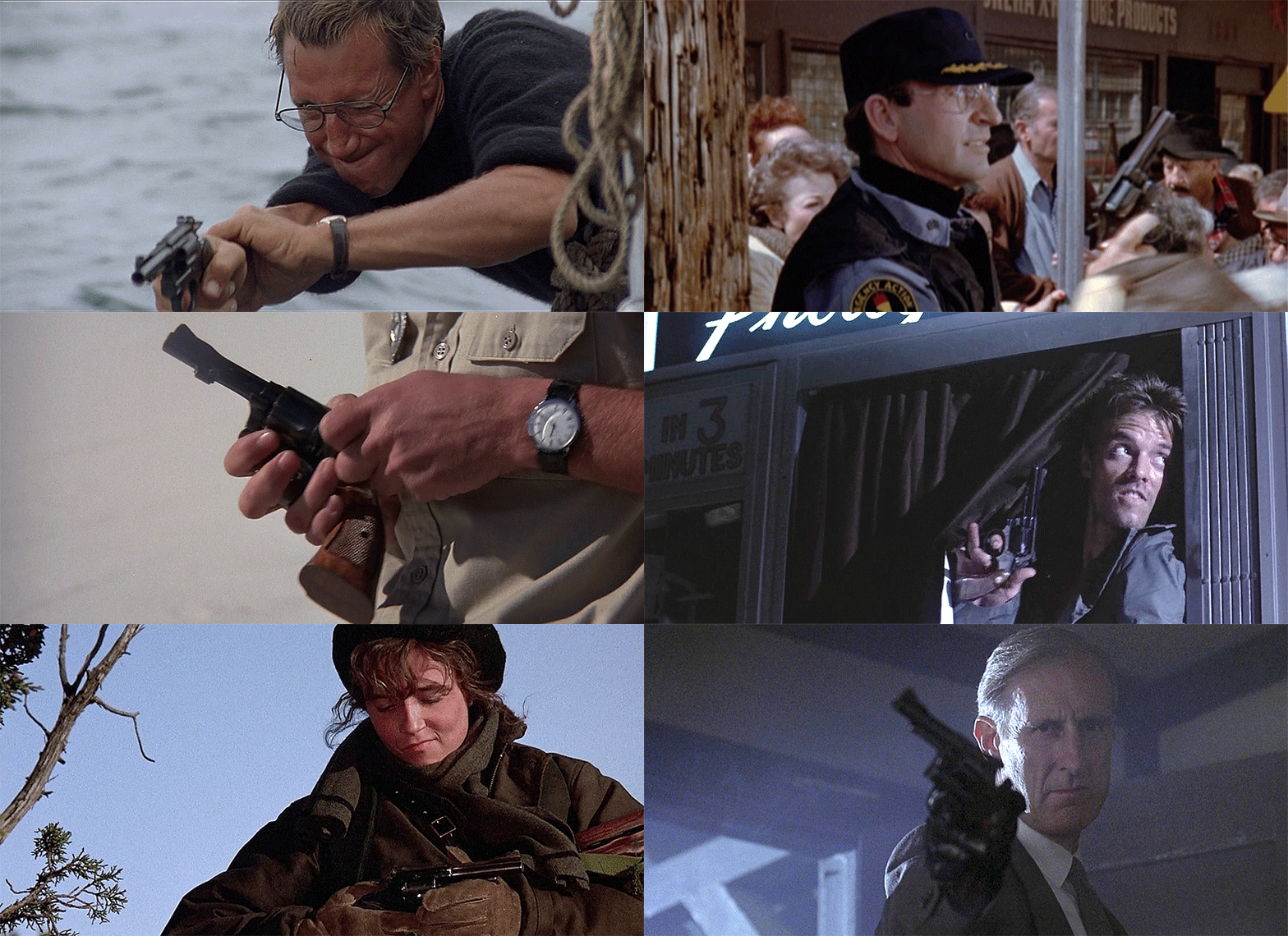
The Model 15 on film. As you can see here, Smith & Wesson’s classic revolver has appeared in dozens of movies and television shows, including Jaws, Red Dawn, Hill Street Blues, Terminator, LA Confidential, and many more. The Model 15 remains an admired revolver, even if it is completely unsuitable for use on Amity Island or the streets of
Speaking of which, there were several later evolutions of the original design, indicated by a dash after 15. For instance, the Model 15-1 saw the extractor thread direction changed from right-handed to left-handed. The 15-4 no longer had a pinned barrel, and so forth. An exception to this numbering convention was the Model 67, which was released sometime between the 15-3 and the 15-4. The M67 was a stainless steel version of the M15 preferred by many law enforcement agencies.
Would any of those serve as a modern service revolver? Actually, yes, though proven semi-autos like the Glock 19 would outnumber such a duty pistol by an order of magnitude.
My Brief Introduction to the Model 15
When I graduated from the Security Police Academy at Lackland AFB in 1989, our career field was divided into what we called the LE side and the Security side. This was before the attack on Khobar Towers and the long stretch of stupid from our “Top Cop” and the Air Force writ large that all but ruined the entire career field. AFSC 812XX was a Law Enforcement Specialist. AFSC 811XX was the Security Specialist.
Although the Beretta M9 was in use by that time, not everyone had them, particularly Guard and Reserve squadrons. The LE guys were carrying the S&W Model 15, complete with a terrible leather Bill Jordan holster with an over-the-hammer snap on the outside. For their part, Security troops were issued almost exclusively long guns (and 203s and M60s).
I honestly don’t recall if we qualified with the M9 in Tech School, but I do remember some familiarity training with the Model 15, so that was probably the first pistol I ever formally qualified with “professionally.” Unless you count what I think was a Colt Combat Commander at Camp Russell when I was in the Boy Scouts.
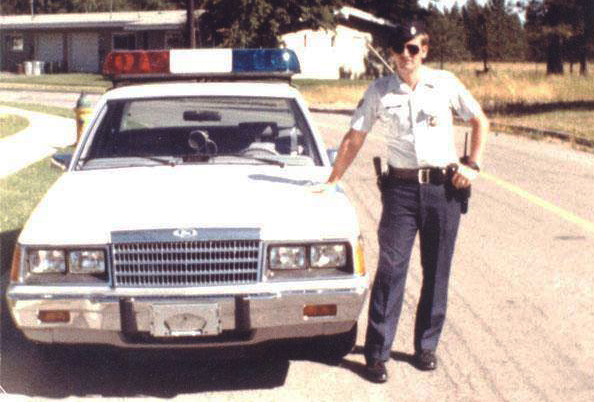
That’s not a picture of me; I haven’t been able to find an appropriate one. This image of an LE specialist carrying a Model 15 comes courtesy of the US Air Force Police Alumni Association.
Although I didn’t shoot it particularly well, and never put hands on one again, I may get around to buying myself someday. After I replace the Clinton-era CZ75 I stupidly sold, of course, but that’s another story.
A Lackluster Fate
The Model 15 was discontinued in 1999, brought back for a little while as part of the “Heritage Series”, then re-released in 2011 as the Model 15-10 as part of the Classic Revolver line. Unfortunately, it was hardly a faithful reproduction—many people, including dedicated wheelgun lovers, who didn’t care for the updated M15. One of the biggest reasons for that was the inclusion of a remarkably stupid internal trigger lock above the cylinder release. The built-in trigger lock was intended to prevent unauthorized use, but it looked like ass, turned off traditionalists, and worst of all, created a risk of malfunction. The 15-10 was discontinued again in 2013.
Another example from the silver screen. This guy might be even more undergunned than Chief Brody. It’s one thing to try to kill a great white shark with a .38 Special, but going after a supernatural slasher serial killer using a Model 15 seems like an even poorer choice. Dr. Loomis would have been better served jocking up like Dirty Mike does in our “tactical Halloween” Michael Myers shirt.
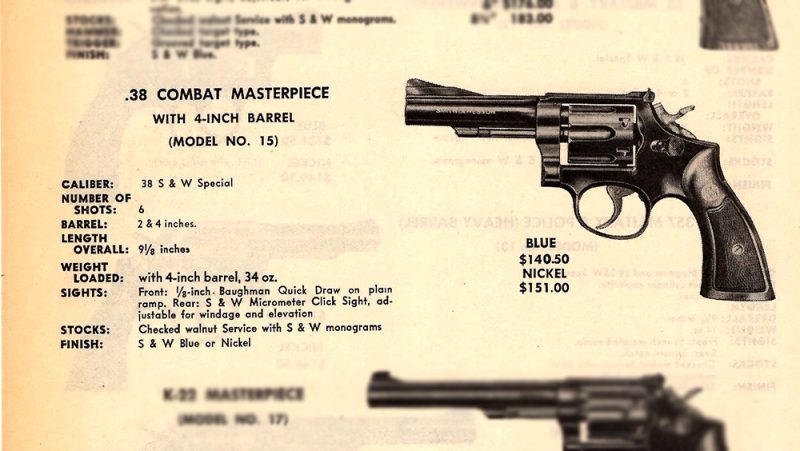
Standard S&W Model 15 Specs
Caliber: .38 Special (often used with .38 S&W +P)
Capacity: 6
Barrel: 4″
Sights: S&W Micrometer adjustable rear click sight, 1/8″ Baughman Quick Draw on the ramp
Trigger: S&W W grooving with adjustable trigger stop
Frame: K frame with square butt and grooved tangs
Length overall: 9 1/8th” with 4″ barrel
Weight loaded: 34 oz. with 4″ barrel
Nearly a dozen variations…including this one.
The S&W Model 15 – “The K-38 Combat Masterpiece” – never got the attention it deserved. “It’s only a .38 Special,” was a common comment. Keep in mind all this is way before hollow-point/defensive ammunition. With today’s “modern” ammo the .38 Special is a potent round.
The “Pre-Model 15” .38 Special was introduced in 1949. It’s a K frame pistol, a “five-screw” model – as opposed to four or three – with an adjustable rear sight, a square butt and a four-inch barrel. The first “15’s” were released in 1957, originally with a four-inch barrel, with the 15-2 two-inch barrels appearing in 1964. There are a few differences between the K-38 and the later 15, but all the good things carried over with the “new” pistol.
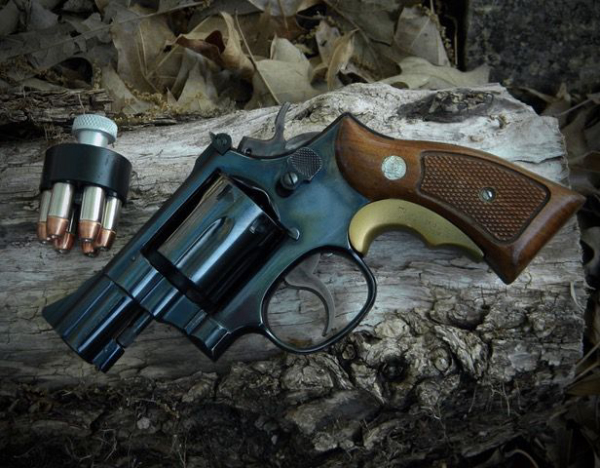
A Smith and Wesson Model 15-3 with a two-inch barrel, from a Tactical Wire article written by the late Tiger McKee.
Later, as different models were released, features were discontinued. The 15-1 was changed so that the extractor rod had left-hand threads. Definitely a good thing. The -2 deleted the trigger guard screw – another good change. With the 15-5 they stopped pinning the barrel. ~ Tiger McKee
There’s more to know about the Model 15…whole books’ worth of history and personal anecdotes dating back to the Korean War. My time with it was all too brief, but I liked it. I wish I had one, and I may correct that deficit someday.
Come to think of it, I need to do some checking. One of my grandfathers spent 50 years with the North Carolina Highway Patrol. Some asshole broke in and stole all his guns after his retirement, but maybe I can find a picture of him with a Model 15, assuming that agency ever issued those revolvers.
If I find one, I’ll update the article here.
In the meantime, if I’ve got something wrong or you have some info to share, feel free to let us know in the comments below.
S&W Model 15 Trivia
The Model Designation Precedent: The Model 15 was the first revolver in S&W history to receive the “Combat Masterpiece” moniker in 1949, three years before the legendary, yet larger, .357 Combat Magnum (which became the Model 19) was developed by Skeeter Skelton’s specifications. The Model 15 name defined the concept of a fast-handling, target-accurate K-frame duty weapon.
The “Dayton Guns” Barrel Hybrid: A small, specific run of Model 14-2 revolvers produced between 1965–1968, often referred to as the “Dayton Guns,” featured a shortened Model 14 heavy barrel but utilized the ramped Baughman Quick Draw front sight of the Model 15, creating a unique factory hybrid.
The Ejection Rod’s Screw-Change Subtlety (The “-1”): The transition to the Model 15-1 in 1959 was defined by the switch of the extractor rod threads from right-hand to a left-hand thread. This was a key engineering refinement to prevent the rod from unscrewing itself under sustained recoil, which could happen with the earlier K-frames.
The Rare Pre-Model Number Target Hammer: Early post-war K-38 Combat Masterpieces (pre-1957) occasionally left the factory with the heavier, wider target hammer, which was normally reserved for the Model 14. These are factory variations, not modifications, and are prized by collectors.
The Elusive .32 Caliber Combat Masterpiece: While never a standard catalog item, S&W produced a very small, uncataloged run of the Combat Masterpiece chambered for the .32 S&W Long cartridge, which would correspond to a hypothetical Model 16 Combat Masterpiece.
The Disappearing Top Sideplate Screw: Collectors can use the presence of the fifth screw—a small screw located at the top of the sideplate—to immediately identify K-Masterpieces made prior to 1955. Its deletion was a step toward simplified manufacturing.
The USAF’s Weak Load Scandal: The Model 15s issued to the Air Force Security Police were hampered by the anemic M41 ball ammunition (130-grain FMJ at ≈725−750 ft/s), a major factor that contributed to the transition to the 9mm Beretta M9, not a failure of the firearm design itself.
The 3-Screw Variation: Following the deletion of the sideplate screw (post-1955) and the cylinder stop screw in the front of the trigger guard (post-1961), the resulting frame is often referred to by collectors as the “3-screw” frame, which defines a significant portion of the Model 15’s life cycle.
The Short-Lived 2-Inch Barrel Variant: A 2-inch barreled version of the Model 15 (a true Combat Snub) was introduced in 1964 and, while popular with certain agencies, it was discontinued in 1988, having been overshadowed by the smaller J-frame options.
The Model 15/67 Transition: The Model 15, being the blued or nickel version, directly transitioned into the Model 67 when S&W introduced the stainless steel option in 1972, making the 67 simply the stainless Combat Masterpiece. The dash-number changes track almost identically between the 15 and 67.
The Model 15-4 Gas Ring Change: The Model 15-4 (introduced in 1977) saw a small but significant change where the gas ring was moved from the yoke to the cylinder. This detail is often used by smiths to track the evolution of the lockwork.
Pre-War K-Frame Heritage: The Combat Masterpiece’s core design (the K-frame) is a direct evolution of the Hand Ejector series, specifically the Military & Police model, which dates back to 1899 and provided the fundamental balance and lockwork still recognized in the Model 15.
The Pinned Barrel and Counter-Bored Chambers: Model 15s produced before 1982 (the 15-5 transition) feature the classic, high-quality pinned barrel (fixed to the frame with a solid pin) and counter-bored/recessed cylinder chambers, both features highly desired by collectors for their historical significance and perceived quality.
The Target-Sight Compromise: Unlike its cousin, the fixed-sight Model 10, the Model 15 was the first S&W revolver designed to meet the growing need for a duty weapon that still retained target accuracy via its adjustable rear sight, without the delicate Patridge front sight of the Model 14.
The Air Force’s Post-Retirement Use: Even after being formally retired from general service in the early 1990s, the USAF continued to use a number of Model 15s (loaded with blanks) for training Military Working Dogs (MWD) to acclimate them to gunfire and to use them as scent-detection aids.
The 8 3/8-Inch Masterpiece Anomaly: The Model 15 was technically cataloged for a brief period in 1986 with a long, 883-inch barrel, a length usually reserved for the Model 14. These long-barreled Model 15s are incredibly scarce and visually awkward but exist in S&W’s historical records.
The MIM Part Introduction (15-7): The Model 15-7 (introduced in 1994) marks the notable shift to Metal Injection Molding (MIM) parts for the hammer and trigger. This change is where purists begin to draw the line on “classic” Model 15 manufacturing, marking a change in production efficiency over hand-fitting.
The Baughman Sight Design: The standard front sight on the Combat Masterpiece is the Baughman Quick Draw ramp. While simple-looking, this design was specifically developed to combine a quick, non-snag draw with an excellent sight picture in various lighting conditions.
The Frame Difference from the Model 19: While the Model 15 (a .38 Special) and the Model 19 (a .357 Magnum) are both K-frames, the Model 19’s yoke and frame cutout for the cylinder were subtly beefed up to handle the longer magnum cartridge, a modification the purely .38-chambered Model 15 never required.
The Early “Grooved Tangs” Detail: Very early K-38 Combat Masterpieces featured checkering or grooving on the metal backstrap and forestrap (tangs) under the grips to aid in a secure hold—a subtle finishing detail that was later phased out for simplified polishing and manufacturing.
Find what’s in stock, and where, and compare prices.
⚠️ Some hyperlinks in this article may contain affiliate links. If you use them to make a purchase, we will receive a small commission at no additional cost to you. It’s just one way to Back the Bang. #backthebang







0 Comments