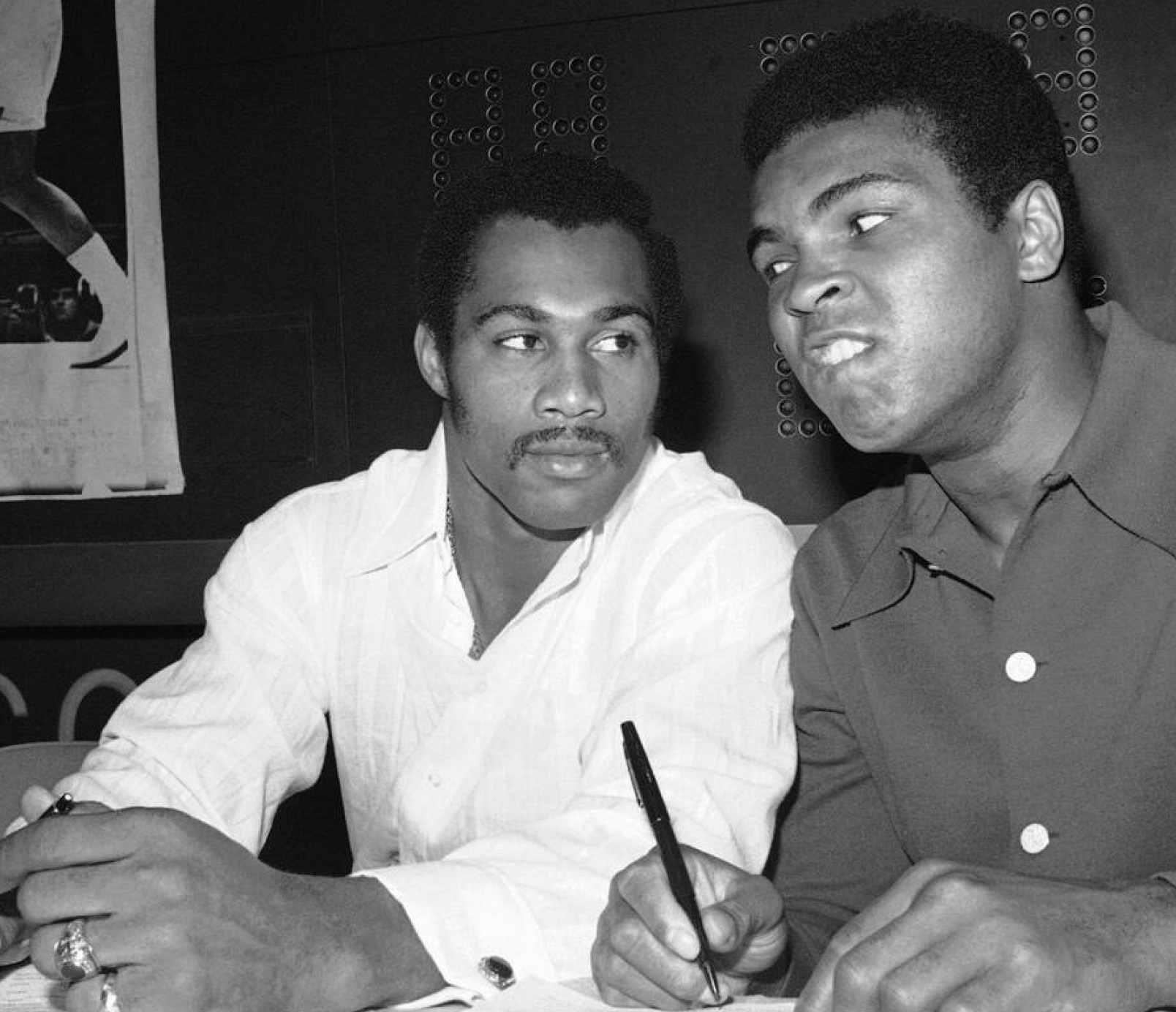
The US Marine Corps is an elite fighting force with the distinction of being the first tool of American force projection. Each Marine who has earned the title retains it, even when his or her time with the Corps has ended. Many go on to fight in other branches of the US Armed Forces. Others channel their athleticism in the combat sports. These are often termed Fighting Marines. On this birthday of the USMC, we celebrate the two most famed Fighting Marines: Gene Tunney and Ken Norton.
Gene Tunney: From Marine, to Lumberjack, to the Manassa Mauler
Gene Tunney was born to Irish immigrant parents in New York City in 1897. He was one of millions who came up in crowded circumstances in a land of opportunity and, like many who went into boxing professionally, physical fitness was his way out. Gene also had a certain high mindedness, as he grew up during the administration of Teddy Roosevelt, who projected an image of the fit renaissance man. Much to the chagrin of his critics, Gene had a love of English literature as much as boxing.
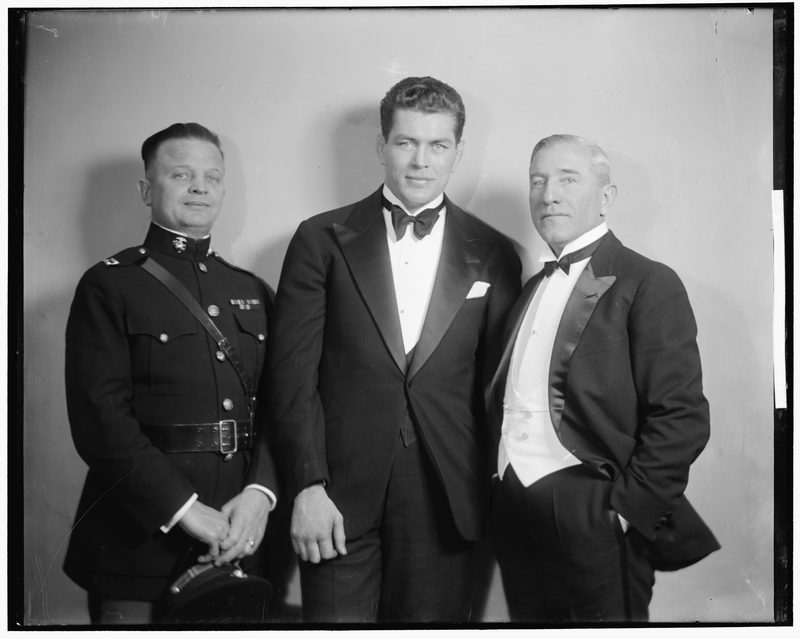
Standing 6 ft tall and 175 lbs, Tunney turned professional as a light heavyweight in 1915. He accumulated 11 wins, 1 draw, and no losses by the time the United States entered the Great War. At which point, Tunney joined the US Marine Corps and continued to box as he was deployed as part of the American Expeditionary Force to France in the spring of 1918. Tunney remained in France and the Rhineland until the end of 1919, but so no active combat. On his discharge from the 11th Regiment in late 1920, Tunney went into the Reserve and campaigned for the unified light heavyweight crown. Through 1921, Tunney worked as a lumberjack in Ontario to gain strength and move up in weight class to take on the legendary heavyweight champion, Jack Dempsey, otherwise known as the Manassa Mauler.
Dempsey earned his keep as a hobo fighting for food in mining towns throughout the West before turning professional. Dempsey, with his bobbing-and-weaving infighting style, destroyed heavyweight champion Jess Willard on July 4, 1919 in three rounds in spite of a sixty pound and foot-long reach disadvantage. Dempsey went on to defend the title against famed French fighter pilot George Charpentier in the first $ 1 million gate fight in 1921. During this time, Dempsey had the false reputation as a draft dodger and it gave the crowd reason to root for his opponents.
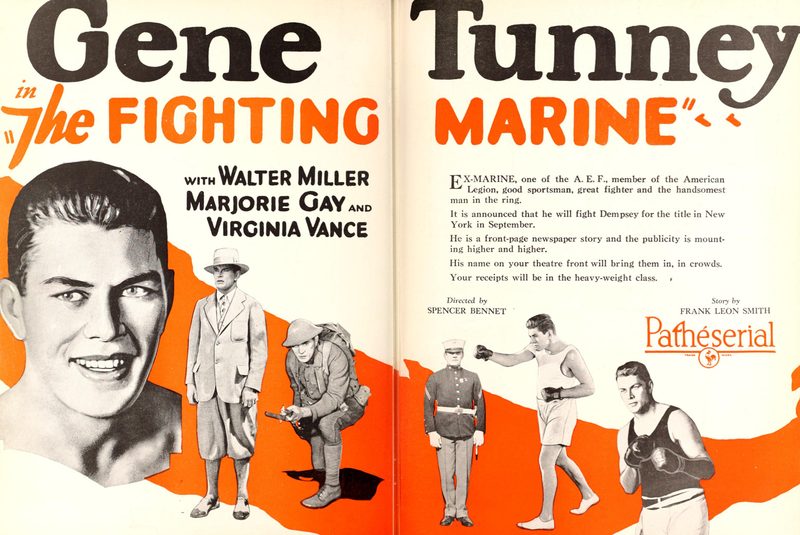
Meanwhile, Tunney racked up victories and took the light heavyweight title from Battlin Levinsky at Madison Square Garden in 1922. He went on to lose it to the legendary Harry Greb by decision in 1923. This would be Tunney’s only loss and one he would avenge. From then on, now at 189 lbs, he campaigned as a heavyweight, gaining victories over Dempsey victims like Georges Charpentier and Tommy Gibbons. Meanwhile, Jack Dempsey went to Hollywood and did not defend his title until he met Tunney in September 1926 in Philidelphia.
Dempsey v. Tunney I was a clash of styles and one warrior on the way up and one on the way down. In shades of Ali-Frazier, Tunney was fleet footed and fought from the outside behind a quick jab while Dempsey relied on relentless pressure and a bobbing style to stay safe. Tunney was the greatest technician of his time and used jabs and quick combinations to outland a slower but still-dangerous Dempsey. Tunney won the heavyweight crown after a ten round decision.
In defeat against the Fighting Marine, the slacker Dempsey’s reputation improved. The public clamored for a rematch between the most famous athlete of the age and the new darling of the sport. The two met again on Soldier’s Field in Chicago in September 1927. The gate was a then-record $2.7 million. Over 100,000 spectators were in attendance, as countless more listened on the newfangled radio.
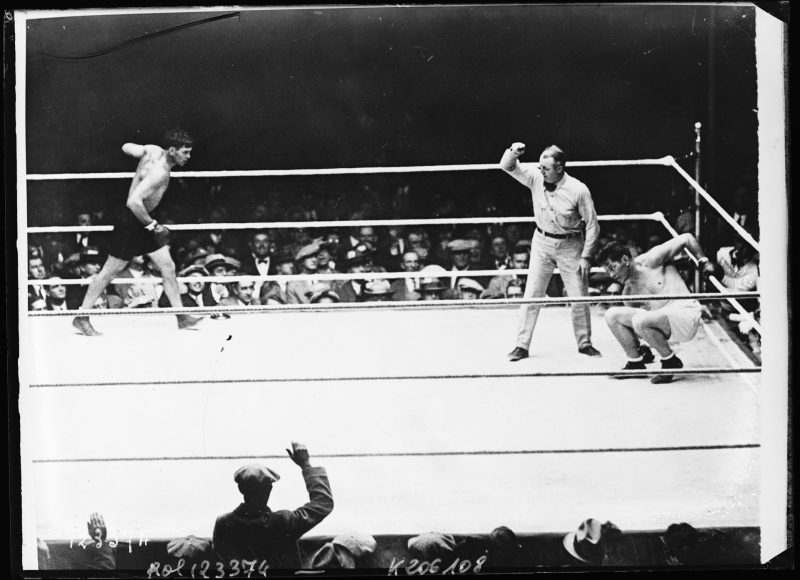
Tunney v. Dempsey began as a replay of the first fight, with Tunney firing first and darting away before Dempsey could cover the distance and get inside. But in round seven, Dempsey caught his man against the ropes and unleashed a ripping combination to the body and head that send Tunney to the canvas. It was the first and only time Tunney had been knocked down. Under the neutral corner rule, the referee would begin the ten count once the other fighter had moved to a neutral corner. Instead, Dempsey, out of habit, loomed over Tunney ready to hit him once his knees were off the canvas. The neutral corner rule was insisted on by the Dempsey camp but one that was scarcely enforced since the beginning of Marquis of Queensbury Rules. Dempsey’s delay in going to a neutral corner gave Tunney time to re-cooperate and he was up at an official nine count. Tunney went on to dominate the rest of the fight, retaining the crown in another ten round decision. Although Dempsey himself raised Tunney’s hand in victory, the real winner of the so-called Long Count Fight remains a topic of debate.
Jack Dempsey retired after the Long Count Fight and remained lifelong friends with Gene Tunney. He would later serve in the US Coast Guard during World War II and remained big in boxing commentary until his death in 1983. Tunney, having accomplished his goal of defeating Dempsey, defending his title one last time against Tom Heeney before retiring in July 1928. His record stands at 80 wins, 1 loss, 3 draws, and 1 no-contest. Tunney would marry, give lectures on Shakespeare, and both publish and commentate on boxing. He joined the Navy Reserve and served as a fitness instructor during the Second World War. He died in 1978.
Ken Norton: Black Hercules
When one Fighting Marine left the boxing scene, another named Ken Norton came to the top. But the nature of the game had changed since Dempsey and Tunney popularized the sport. Professional training, technique, and officianated opportunities had grown by leaps and bounds. But the driving force that kept many boxers in the profession remained the same. Ken Norton was born in 1944 in sparce circumstances in Jacksonville, Illinois and saw athletics as his way up. Norton found his calling in high school football and later played for Truman State. Norton left behind education and enlisted in the US Marine Corps in 1963. He served as a morse code operator in Florida before his enlistment expired in 1967. In that time, he took up boxing to win the Marine Heavyweight title. After winning the National AAU finals, he turned professional in 1967.
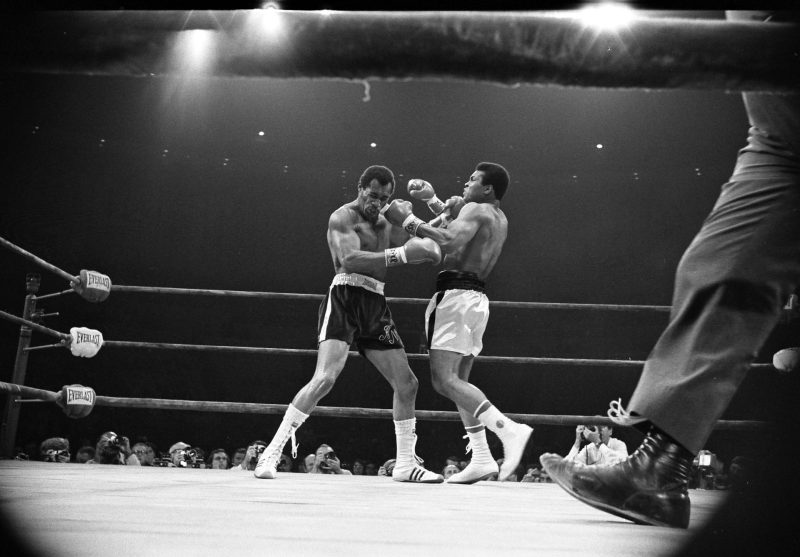
Norton was largely victorious, his initial bouts earned him little money and he had to choose between supporting a young son and getting professional training to continue his career. His luck changed when he became a sparring partner for heavyweight champion Joe Frazier. In Norton, legendary trainer Eddie Futch, found another fighter who could be an antidote to Muhammad Ali. Frazier, a Dempsey-like pressure fighter who fought out of a cross guard, wore down Ali in their legendary 1971 bout, giving Ali his first professional defeat. On a comeback tour to regain the title, Ali matched the rising Norton in March 1973. The bout would change Norton’s fortunes and bring him among the big names in the Golden Age of Boxing.
Like Frazier, Norton slowed Ali with heavy body punches to sharp left hooks while holding off Ali’s quick left jab with a flexible cross guard and bobbing head movement. After twelve rounds Norton had broken Ali’s jaw and won the decision as well as the NABF heavyweight title. The Greatest had his second loss. In the meantime, the heavyweight crown had changed hands when Big George Foreman steamrolled Joe Frazier in January 1973. Ali and Norton now had to contend to get a stab at Foreman’s title.
Six months after his historic defeat, Ali rematched Norton. This time, Ali took a close split decision. Ali’s inability to get inside Norton’s guard made the ultimate judgement controversial, but it gave Ali’s title comeback the momentum it needed. While the press heated between Foreman and Ali for what would become the Rumble in the Jungle, Foreman made his second title defense against Ken Norton in Caracas in March 1974. As he had done with Frazier, Foreman used his size and old-fashioned long guard tactics to push and smother the inside-fighting Norton before clobbering him with uppercuts and overhand punches. Two minutes into the second round, the fight was stopped in favor of Foreman.
Norton regained momentum by retaking the fringe NABF title in a tout with Jerry Quarry in 1975. Norton took another shot at the undisputed title by rematching with Ali, who had stopped Foreman in Zaire. Ali vs. Norton III took place in September 1976. In a fifteen-round slugfest, Norton outlanded Ali but lost another controversial decision, by which point Norton lost hope to capture championship glory.
In 1977, Norton defeated Jimmy Young to take another crack at the undisputed title. Instead, Ali was outworked by a relative unknown Leon Spinks (another Marine). But instead of facing Norton, Spinks opted to defend the title in a rematch against Ali. Although Ali would avenge his loss to Spinks in 1978, Spinks’ refusal to fight Norton caused the WBC to award the title to Norton.
In June 1978, Norton took on the WBC No. 1 contender, Larry Holmes, and lost in a whirlwind fifteen-round decision. Norton, now past his prime, fought on, struggling against big punchers like Ernie Shavers and Gerry Cooney. After the 1981 Cooney fight, Norton retired for good with a record of 42 wins, 7 losses, and 1 draw. Norton would continue to make public appearances, but his post-boxing life was nearly cut short by a 1986 car crash. With the support of Muhammad Ali, Norton rebounded, learning to walk once again. Ken Norton, the Fighting Marine in the Golden Age of the Heavyweight division, passed away in 2013 at age 70.





0 Comments