
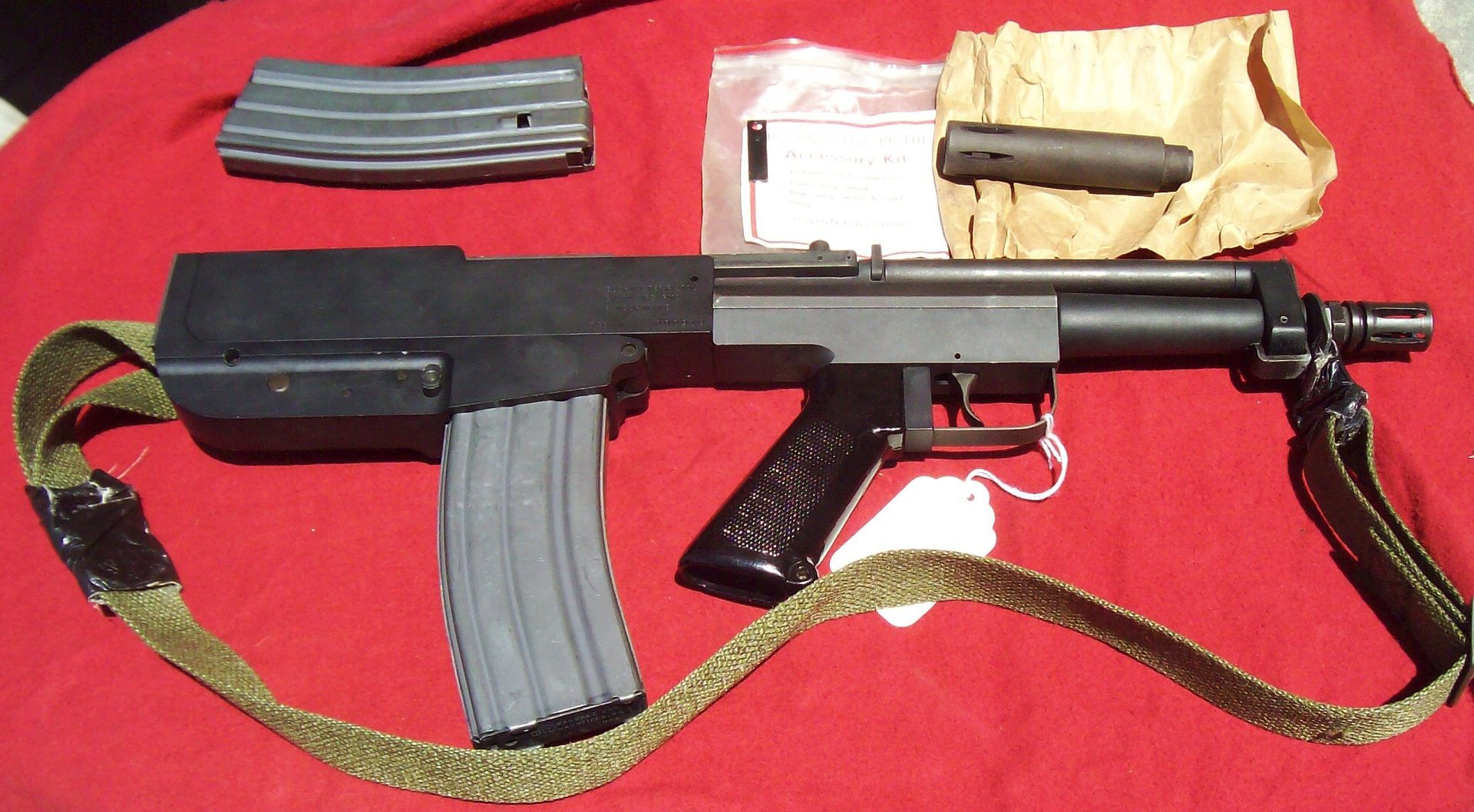
What’s the “Bushmaster Arm Pistol” you ask? We’re glad you asked. The Bushmaster Arm Pistol is a compact, bullpup-style weapon chambered in .223 and developed in the 70s as a “survival pistol.” Whether it’s more accurately termed a PDW, a “large format pistol,” an AR pistol, or an SBR seems largely dependent on whoever’s making the reference. It’s the direct descendant of the Colt IMP-221, a proposed Vietnam War era survival weapon for USAF pilots. IMP stands for Individual Multi-Purpose Weapon (from the Individual Multi-Purpose Weapon program). In this particular case, that’s a very unusual PDW chambered in the equally unusual 221 Remington Fireball cartridge. Weird would be the way we’d describe it, but that don’t mean we don’t want one. Learn more in this Throwback Thursday resurrection of a Soldier of Fortune magazine article written 50 years ago. Mad Duo
Estimated reading time: 13 minutes
Bushmaster “Assault Pistol”
I doubt you spend much time wondering what the gun writers of 50 years ago were talking about, and normally I’d be right there with you. Normally. But a couple of days ago, something took me off on a tangent, then into a rabbit hole, and eventually down an associative chain that I couldn’t possibly recount now if I tried.
I can tell you the result, though. The result is that I know about the IMP-221, which I’d never heard of, Remington’s .221 Fireball cartridge (which I was equally unaware of), and the (again, previously unknown to me) Bushmaster Arm Pistol.
I love learning new stuff, even if it’s about something that looks like the scrawny inbred cousin of a High Standard 10B shotgun.

Anyway, the following article about the Bushmaster ARM pistol first appeared in the summer 1976 edition of Soldier of Fortune Magazine.
THE BUSHMASTER
by David Steele

The Bushmaster is, to coin a term, an assault pistol. It is not a target pistol, a plinking pistol, a police sidearm (in the usual sense of the term), a submachine gun, a carbine, or an assault rifle. It is unique; only the Air Force IMP (Individual Multi-Purpose Weapon) and a few experimental weapons fit into the same category.
Basically, the Bushmaster is a semi-automatic, stockless, bullpup carbine. It is a .223 (5.56mm) semi-auto version of the Air Force selective fire IMP. The IMP was developed as an aircrew survival weapon. The idea was to provide a minimum size and weight weapon for the downed aircrewman to both live off the land and defend himself against enemy personnel.
In 1967, Hans Siewers, a Life Support Equipment Requirements officer for the Strategic Air Command, set up the following requirements for a survival weapon:
- Capable of killing a man at 100 yards.
- Accurate on man-sized targets at 100 yards, when used by the average aircrewman.
- Less than 13 inches long and one inch thick.
- Not over 39 cubic inches in volume or over one and one half pounds in weight.
- Should be semi-automatic and carry at least seven rounds.
Siewers’ idea was to develop a survival weapon which would not take up much of the mere 1500 cubic inches available for ground survival equipment on modern combat aircraft. It was also felt that with a probable use of less than a hundred rounds, most of the parts on such a weapon could be made from lightweight alloys.
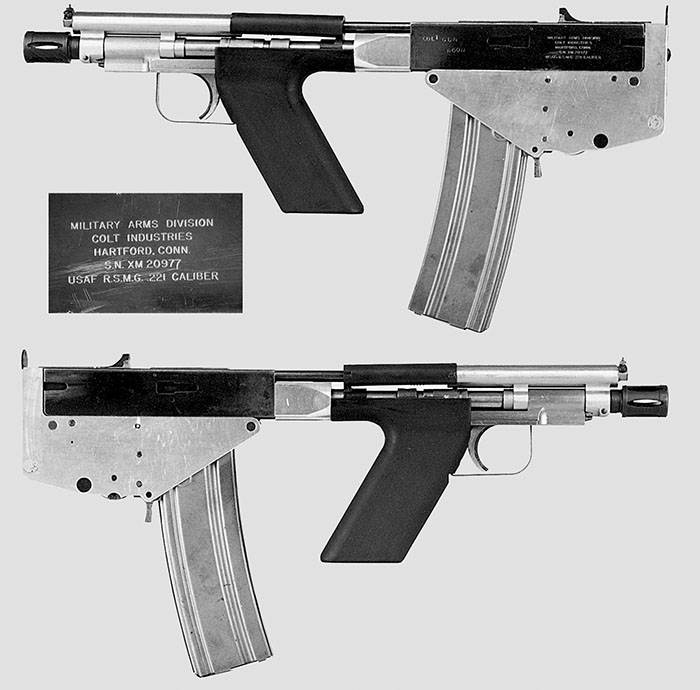
In any case, to the author’s knowledge, no weapon has been developed which satisfies all of Siewers’ requirements. The IMP, for example, fails requirement numbers three and four completely. However, it should be recalled that a small arm’s tested performance depends on the criteria used in the testing (The validity of small arms’ tests is as much open to question as that of any teacher’s exams).
Compare, for example, the criteria used by the Army in adopting a service pistol in 1907 and the criteria used by the BATF in handgun tests at H.P. White labs a few years ago. The objectives of the first example were clear and feasible, resulting in the adoption of the excellent Colt .45 M-1911 auto, while the objectives of the BATF example were vague and controversial, apparently an attempt to demonstrate the lack of quality in domestic handguns (which might eventually result in their falling under the same restrictions as foreign weapons).
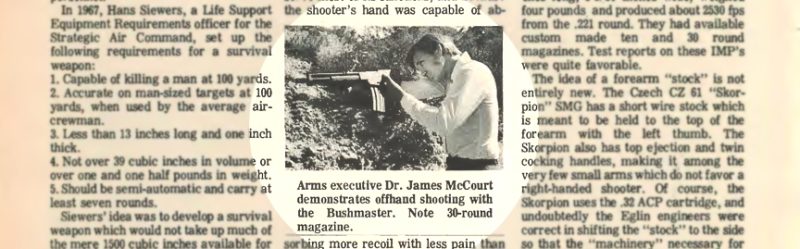
In any case, Siewers’ criteria resulted in some high-grade research and development by Dale Davis and others at Eglin AFB in Florida. It was determined that a shoulder stock could be dispensed with, since the shooter’s own arm could serve most of its functions, and because the shooter’s hand was capable of absorbing more recoil with less pain than his shoulder. Eventually, with the aid of a wooden model and a modified Remington XP-100 pistol, a design was arrived upon, with a forward handgrip and the action lying at an angle along the shooter’s forearm. The receiver was held to the forearm by light pressure from the shooter’s left thumb.
These early prototypes were for right-handed shooters only, although it was found that a southpaw could use them more easily than a conventional right-hand pistol or rifle. Eventually, a system was developed so that the pistol grip could be rotated 38° to the left for right-handed shooters and 38° to the right for left-handed shooters, with a straight-up position for storage or snap shooting from the ready.
Colt contracted to make up four prototypes for the Air Force. These were selective fire (a rotating dial moved from safe to semi to full auto), with a full cyclic rate of 550 rpm (slow for controllability). The caliber chosen was a .221 Fireball, a cartridge intermediate between the .17 SPIW and the 5.56mm, cartridges for which the military would have the most interest (the choice of the .221 Fireball must also have been influenced by the use of the XP-100 for the prototype.) One model used three peep sights, corresponding to the three grip positions and the three front post sights. There was also an optical sight, in the developmental stage, for right-handed shooters. The prototypes were 15 1/8 inches long, 1 11/16 inches wide, weighed four pounds and produced about 2530 fps from the .221 round. They had available custom made ten and 30 round magazines. Test reports on these IMP’s were quite favorable.
The idea of a forearm “stock” is not entirely new. The Czech CZ 61 “Skorpion” SMG has a short wire stock which is meant to be held to the top of the forearm with the left thumb. The Skorpion also has top ejection and twin cocking handles, making it among the very few small arms which do not favor a right-handed shooter. Of course, the Skorpion uses the .32 ACP cartridge, and undoubtedly the Eglin engineers were correct in shifting the “stock” to the side so that the “machinery” necessary for heavier calibers could be accommodated along the top of the forearm. The IMP could be carried by a shoulder strap clipped to the butt of the receiver. This lanyard could be used to further steady the weapon in offhand fire.
Mack Gwinn, at the Eglin IMP tests, set out to produce a semi-automatic version in the 5.56mm military cartridge. This weapon, called the Bushmaster, is now available to civilian and police purchasers.

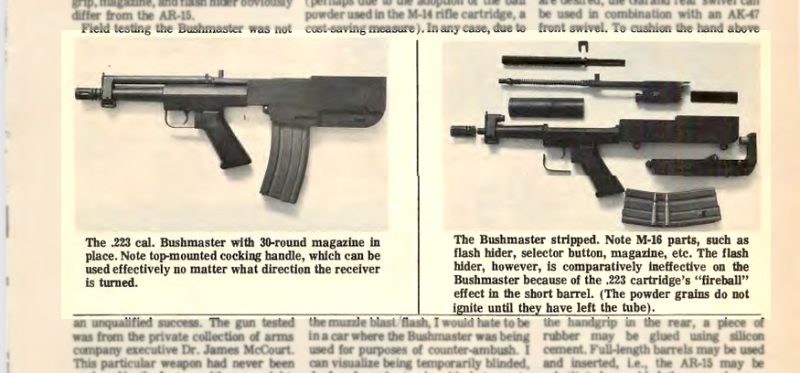
There are a number of internal differences between the IMP and the Bushmaster, perhaps mostly due to Gwinn’s attempt to use as many standard AR-15 parts as possible — to lower cost and provide easier replacement. The AR-15 (or M-16, if you will) parts used in the Bushmaster include: 1) barrel (modified); 2) flash hider and flash hider lock washer; 3) bolt and bolt cam pin; 4) firing pin and firing pin retaining pin; 5) hammer, hammer spring and hammer safety selector, safety selector locking spring and detent; 11) rear take-down pin, locking spring, and detent; 12) pistol grip, grip screw and lock washer; and 13) magazine (5, 20, or 30 rounds).
The exterior of the Bushmaster also differs from the IMP. It is noticeably heavier, longer and thicker than the IMP. Instead of three front sights, the Bushmaster has only one, which does not rotate but remains in position for all three shooting positions. Instead of a dial selector, it has a standard AR-15 arrow selector for safe or semi-auto. Its pistol grip, magazine, and flash hider obviously differ from the AR-15.
Specification Bushmaster Arm Pistol Colt IMP-221 / GUU-4/P Caliber 5.56×45mm NATO / .223 Rem. .221 Remington Fireball (5.56×36mm) Action Gas-operated, long-stroke piston; rotating bolt Gas-operated; rotating bolt; fired from closed bolt Barrel Length 11.5 in. (292 mm) ~10 in. (254 mm) Overall Length 20.63 in. (524 mm) ~17.1 in. (434 mm) Weight (unloaded) ~6.25 lbs < 1.5 lbs (stated USAF requirement — not met) Magazine Standard AR-15/M16, 20 or 30 rd Proprietary 10- or 30-rd box Rate of Fire ~600 rpm (select-fire variants) 500–550 rpmmodernfirearms+1 Muzzle Velocity ~2,700 fps (55-gr) ~2,500 fps (52-gr, from short barrel) Sights Fixed front post, adjustable rear aperture Three sets of iron sights (10, 12, and 2 o’clock positions) to accommodate rotated grips. Configuration Bullpup; no buttstock Bullpup; no buttstock Effective Range ~200–300 yds 100 m (stated military requirements)
Field testing the Bushmaster was not an unqualified success. The gun tested was from the private collection of arms company executive Dr. James McCourt. This particular weapon had never been equipped by the factory with a rear sight. Needless to say, accuracy testing was impossible. Only the functioning of the gun could be evaluated. If it had had a rear sight, however, it would have been only a fixed sight with three notches corresponding to the three receiver positions (hardly a sight which could take advantage of the accuracy potential of the cartridge).
The Bushmaster fires from closed bolt. Unlike the AR-15, the Bushmaster makes use of an operating rod which, theoretically, means that less carbon builds up in the chamber. However, since the test gun jammed on the feeding cycle after practically every shot, the question of carbon build-up is moot.
We function fired the Bushmaster up in Texas Canyon north of Los Angeles. After just a few shots of military ball ammo, I noticed a distinct ringing in my right ear, in spite of my ear plugs. The Bushmaster fires a cartridge designed for a rifle length barrel. The powder which does not burn in the short barrel is ignited outside of it, making for considerable muzzle blast and muzzle flash. These factors were also present in the XM177E1 Colt “Commando” sub-machine gun version of the M-16. On that weapon, a special flash hider was designed to dampen the “fireball” effect. (This special flash hider is not standard on the Bushmaster; only an ordinary M-16 flash hider is present; though a better one can be ordered at extra cost.)
This M-16 flash hider has only one real advantage: it can be unscrewed, so that the Bushmaster will fit in a standard attache case. The IMP, on the other hand, used a cartridge, the .221, which the 5.56mm cartridge is noted for incomplete burning even in rifle barrels (perhaps due to the adoption of the ball powder used in the M-14 rifle cartridge, a cost-saving measure). In any case, due to the muzzle blast/flash, I would hate to be in a car where the Bushmaster was being used for purposes of counter-ambush. I can visualize being temporarily blinded, deafened, and struck with hot empty case.
Recoil in the Bushmaster is negligible. As with the IMP, the recoil is absorbed mostly by the hand. The weapon can easily be fired from the hip. Whether it is more accurate when fired in this fashion than a standard submachine gun, carbine or shotgun would be, is a matter of conjecture. Since I had to hand cycle almost every shot, I was not able to see if it was a simple matter to walk shots on target. The Bushmaster can also be fired at eye level, using the sights (if any). Incidentally, the open rear sight is to be preferred to the experimental IMP peep sight, given the long pistol-style eye relief. Hopefully, a fully effective small optical sight will be developed which can be attached without trouble; perhaps the KWIK-Point or Single-Point sight will soon be adapted in this fashion.
Briefly, the Bushmaster is 20 inches long, with an 11.4 inch barrel; it weighs 4.2 pounds. The basic pistol costs $299 retail. An optional accessory package can be had which includes sling and swivels, modified rear sight, and compensator.
Regarding possible improvements in the Bushmaster, Dr. McCourt has this to say:
“The recoil spring has a life of only a thousand rounds. All roll pins should be replaced with drill rod stock. The rear cover should be long enough to cover the recoil buffer and also engage the machine cuts. It fits in at the front without impairing ejection. (In short, it may come out U-shaped at the front.)
The handguard should be stabilized by drilling and peening so that it will stay in position. The gas tube should be vented. If there is a detent for the front sight, the ball bearing and spring should be replaced with heavier duty. If swivels are desired, the Garand rear swivel can be used in combination with an AK-47 front swivel. To cushion the hand above the handgrip in the rear, a piece of rubber may be glued using silicon cement. Full-length barrels may be used and inserted, i.e., the AR-15 may be substituted, provided the crosspins are relocated as well as the gasport.
If the recoil spring fails, a .45 stock spring may be substituted. The safeties do not have detents in all the necessary positions. Therefore, additional detents must be drilled at 90° from the existing ones. The handguard detents should be matched with five-sixteenths dimples drilled in the housing.”
Upon hearing this, the police buyer may wish to wait for certain design changes before he puts down his $300 and/or trust his life to the Bushmaster. When perfected, the Bushmaster may become one of the best assault and counter-ambush weapons, suitable for aircrews, tank crews, artillerymen, State Department security branch, police stake-out squads, etc.
The idea of a short, handy, powerful hand weapon is not new. The Pepperbox to the Government .45, to the powerful Auto-Mag, even to the rapid MAC-11, all have their place. As owner of Ford’s Firearms Company, I am familiar with the Bushmaster, because I test, demonstrate and sell tactical police and military weapons and equipment.
The Bushmaster idea may have come from the Army’s XM177E2, short CAR-15. Bushmaster, however, was designed to be used in one hand, having a swivel action and barrel which allowed for its lying comfortably on the flat of either forearm. Bushmaster has a good pistol grip and is easy to hold onto during semi-automatic fire, but on full-automatic, fire is wild and difficult to control.
The cartridge-gun combination works fairly well during the day, but leaves a lot to be desired for night operations. For instance, I sold a Bushmaster to a narcotics officer who used it down on the border. The Narc reported that the Bushmaster is useless at night because of excessive muzzle flash. In fact, he was literally blinded after the first shot. He also complained about the weapon “spinning” in his hand.
Another Bushmaster, special-ordered through this shop, had been returned to the factory for a new barrel as it had an oversized chamber. Considerable buffing was required just to make the gun feed properly.
The third special-ordered Bushmaster had never had a round through it. It is now on display in a collection of modern firearms, so no one knows how or if it works. Perhaps, Bushmasters produced within the last three months have been improved over those tested here. One can always hope. As for me, I will continue to use my MAC-11.

There are some really damn interesting things to read in old magazines like this, and not just Soldier of Fortune, either. I’ve found some articles from various publications dating back to before WW2. You can expect to see some of them in the future.
DR






As a young Airman I read every SOF I could get may hand on until I finally got a subscription, I remember it was SOF when I first heard about it, and it seems maybe Guns & Ammo had a short article as well. Those were the good old days, thank you, I enjoyed it again!
I had a chance to buy one @ a Houston gun show back in the 80’s. Talking with the owner it sounded like an ideal terrorist weapon really load and easy to conceal. He said never fire it at night unless you wanted to be blind for the next 20 minutes due to the fireball.