
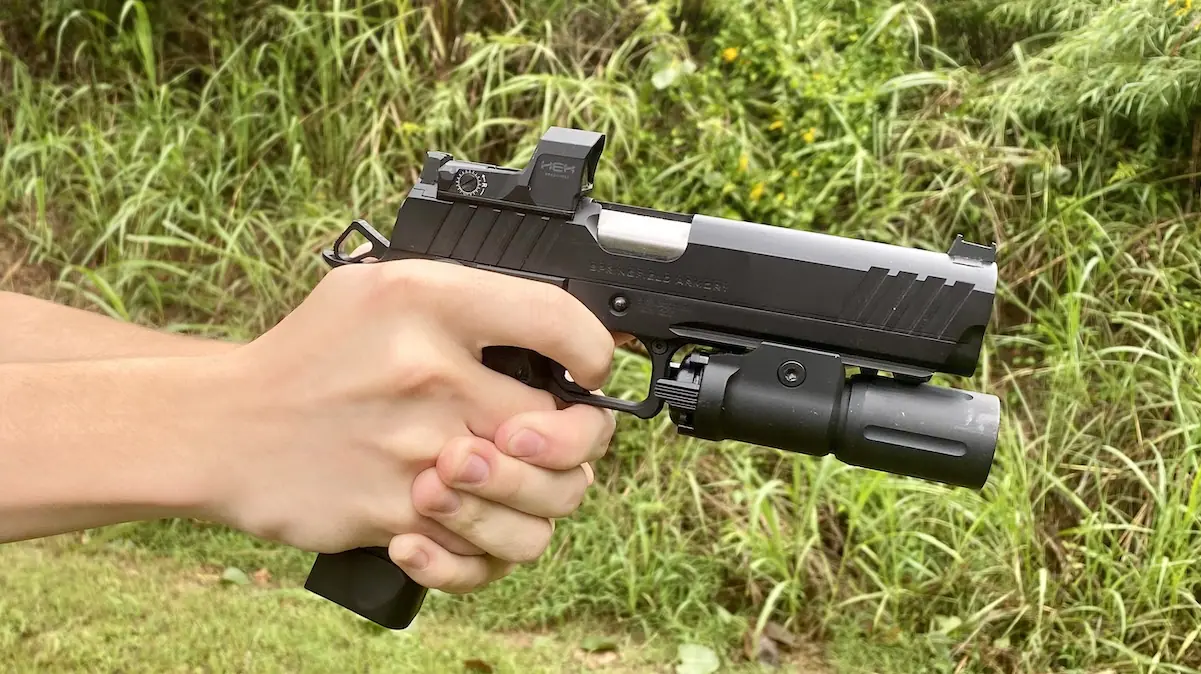
Springfield Armory Prodigy pistols have built on a legacy of .45ACP 1911 design to refine the double-stack 9mm. These guns are making precision performance affordable and may make you question what you get with the artificial scarcity that defines some of the more fashionable and exclusive brands competing for the distinction in the crowded 2011 market. Here’s my review.
Get Prodigious
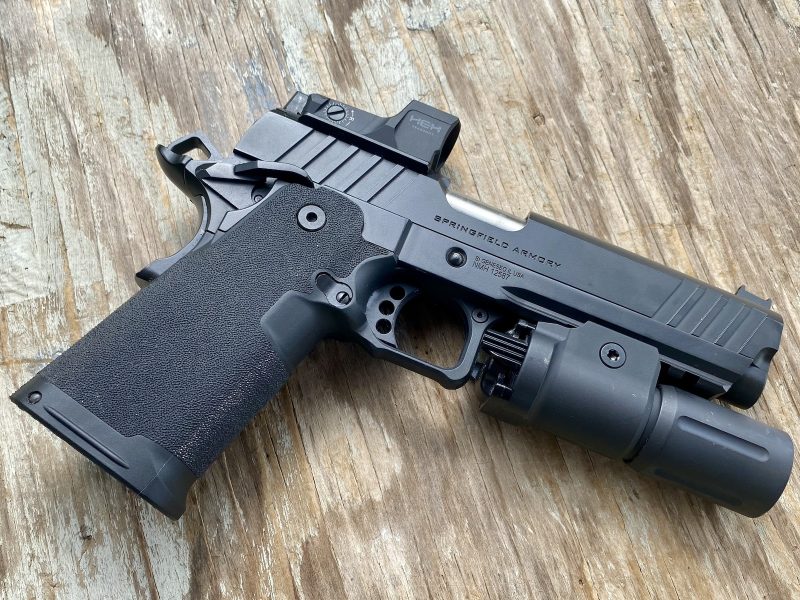
I’m a dedicated Springfield Armory fanboy. I’ve carried their single-stack .45s for years (both a 1911 and XDs). Echelon has long been one of my go-to carry guns. As such, I was an early adopter of the 5″ Prodigy featured in this review. While it draws inspiration from some big-name predecessors, Springfield has done what it does best with this stunning piece of exotericization.
Grunts: exotericization.
Any deep dive into a Springfield Prodigy is going to get nuanced. The ever-expanding world of heavy high-end 9mms is wildly complicated, and guided by trademarked names that prevent us, in print, from crossing colloquial lines that we all ignore in polite conversation.
Springfield Prodigy 2011? Actually, No.
Prodigy is not a 2011®. When most of us use the phrase 2011, we’re referring to a class of double-stack, single-action 9mm guns that have a separate grip that attaches to the frame. But the name belongs to Staccato, in that they own the trademark usage of the term. That ® (an R-ball, in popular parlance) belongs to Staccato. Pepsi can’t make Coke and call it a Coke, even if they had the secret recipe. So the Springfield guns are classed as double stack 1911s.
While they’re all part of the larger 1911 family tree, 2011 has become a proprietary eponym. We all know what it means, even if we can’t admit it for fear of trademark infringement.
So let’s go back a bit and begin at the double-stacked beginning. Because if you’re going to begin, the beginning is usually where you’ll wish you’d begun.
The 2011 ® Family — A Brief History
The 2011 platform didn’t begin and end with Staccato. It’s a broader lineage rooted in the 1911’s DNA, stretched to accommodate the demands of competition shooters. Demands for more capacity without abandoning the trigger and ergonomics they trusted.
Way back in the late 1980s, some crazy Canucks at Para built the P14-45. This beast had an enlarged frame and a staggered magazine, allowing it to hold 14 .45 ACP rounds. But who could hold it? These single-frame designs were chunky.
The double-stack 9mm story heats up in the early 1990s with Virgil Tripp and Sandy Strayer at Tripp Research. That company became Strayer-Tripp International — STI. What they were solving for was straightforward: competitive shooters loved the 1911 platform, but the single-stack magazine was a liability.
So they jammed more rounds into a bigger mag and blew up the grip. More rounds meant fewer reloads, and fewer reloads meant faster times.
Their innovation was the modular frame, a two-piece design that separated the grip module from the frame, allowing for polymer grips and deep customization without abandoning the steel upper that 1911 shooters expected.
Enter STI
Sandy Strayer eventually left to co-found Strayer-Voigt Inc. with competitive shooter Michael Voigt. They began producing pistols under the Infinity Firearms banner. Both companies worked from the same shared patent, which expired in 2016. This opened the door for other manufacturers to adopt similar designs.
STI rebranded as Staccato in 2020, shifting the platform’s identity from competition-focused to duty- and carry-oriented, and bringing the 2011 concept to a significantly wider audience.
As Staccato’s profile rose — driven by law enforcement adoption, competition success, and a product that genuinely justified its price — demand for the platform grew. Other manufacturers took notice. Some built true modular designs. Others, like Springfield, looked at what the market actually needed and made a different call.
Springfield Prodigy 1911 DS
What the Prodigy Is — and What It Isn’t
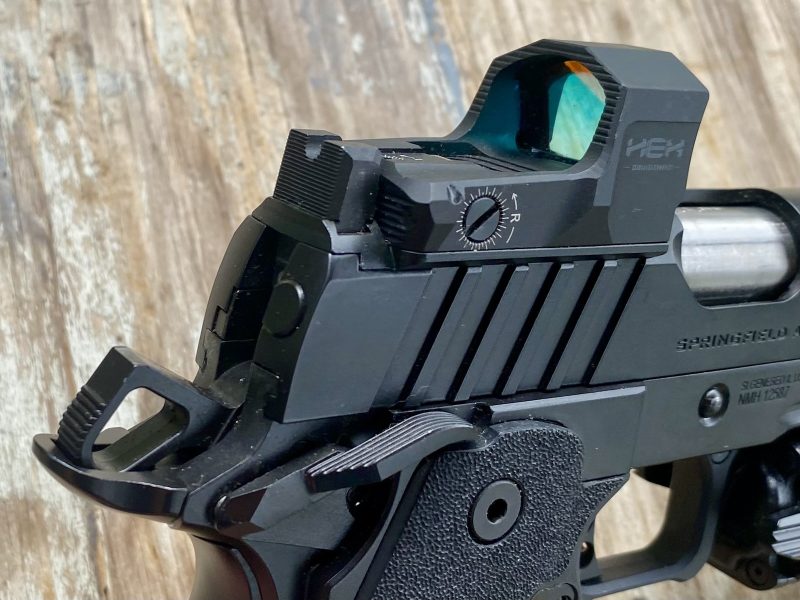
What the Prodigy shares with its more expensive cousins is the part that matters at the range. The 1911-style grip angle is right. The trigger breaks cleanly and resets with confidence. The sight radius on the 5″ model is exactly what you’d expect from a full-size competition-oriented pistol. The optics cut, standard on Springfield Prodigy AOS models, puts a red dot exactly where it should be. And it does so without requiring aftermarket machining.
The Prodigy AOS designation (Adaptive Optics System) is compatible with most major RDS footprints, including the Trijicon RMR and Leupold DeltaPoint Pro. It’s a practical solution that doesn’t lock you into a single optic. Standard models retain a traditional sight setup for those who prefer irons.
What you’re not getting is the boutique the brand cachet that comes with spending twice the money. If those things matter to you, the Prodigy probably isn’t your gun. But if you want a wide-body 1911-pattern pistol that runs, points naturally, and doesn’t require a payment plan — Springfield has you covered.
Specs and Variants
I’m a fan of the 5″ 1911 and Prodigy. But opinions vary. You may not want this much gun.
| Height: | 5.5″ |
| Width: | 1.3″ |
| Weight: | 33 ounces |
| Action: | Single-action semi-auto |
| Frame: | Forged carbon steel with polymer grip module |
| Slide: | Forged steel, Black Cerakote finish |
| Capacity: | 17+1 / 20+1 (extended); 26-round magazine also available |
| Sights: | Green fiber optic front, black serrated U-notch rear |
| Optics: | AOS (Agency Optic System) optic-ready slide cut; ships with HEX Dragonfly-compatible plate |
| Safety: | Extended ambidextrous thumb safety + grip safety |
| Hammer: | Skeletonized |
| Trigger: | Skeletonized, adjustable for overtravel; single-action |
| Rail: | Picatinny on dustcover |
| Magazines included: | 2 |
| MSRP: | $1530 |
The choice between the 4″ and 5″ models is a conversation about intended use. The 5″, some say, is a range gun — longer sight radius, softer shooting, better suited to the deliberate accuracy work.
A 4″ Prodigy is a more manageable package for carry or duty use. Springfield has expanded the line since I got this one to include 3.5″ and 4.25” versions, too.
Modularity lets you mix it up
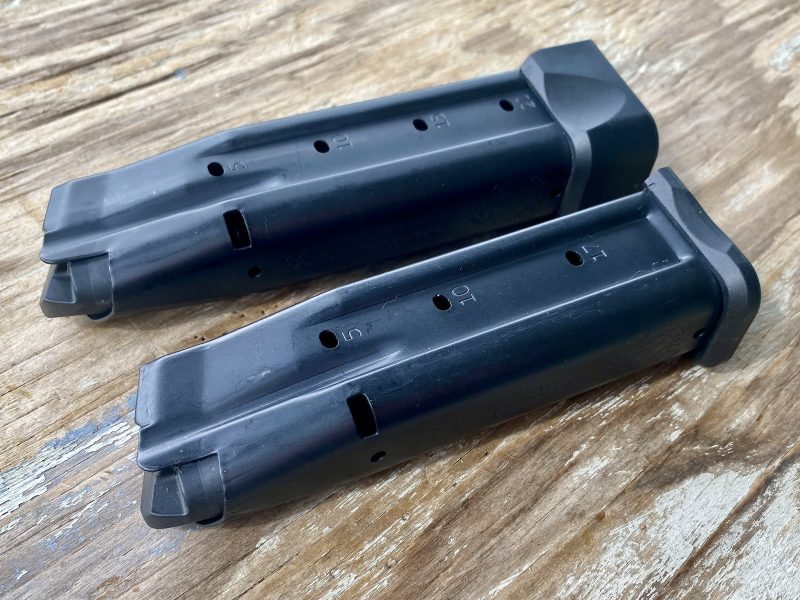
Capacity on the larger guns is 17+1 in the flush-fit mags. Compact models use 15+1. 20+1 and 26+1 extended mags are available. As the Springfield Armory grip modules are interchangeable, you have some control over how you mix and match.
All of these share the same basic specs: forged-steel slides, stainless-steel match-grade barrels, and double-stack magazines. There are many aftermarket double-stack 9mm mags available now, too—just check to make sure that they’re compatible with the Springfield Prodigy.
The trigger is a single action, as you’d expect from a 1911. It breaks at around 4.5 pounds from the factory, which is respectable out of the box and tunable if you want to lighten it up.
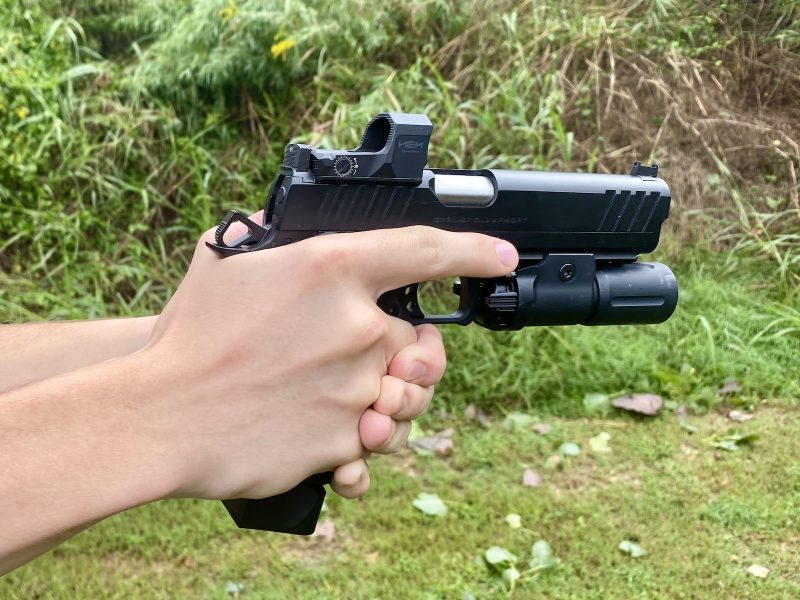
Shooting the 5″ Prodigy 1911 DS
I’ve run a handful of guns in this category. I’m an armchair expert in the single-action .45 ACP arena. Staccatos are exceptionally functional. As I’m not a competitive shooter. I don’t tend to find value in slick guns that can’t survive a range trip without constant babying. I’ve shot 2011-style guns that cost more than my Tacoma, but I miss the point.
Guns are tools. Most of them. Springfield’s guns are far from precious, and this is liberating. Prodigy is built to hit the range, meant to be put through active drills, and if it gets dirty, hosed down.
That doesn’t mean I can’t appreciate the nuances of Prodigy’s 1911-style grip angle, which I find points more naturally than some polymer 9mm pistols. It feels like a heavy extension of my arm.

When clean and oiled, this Prodigy runs smoothly and reliably. Its inherent accuracy is better than my core skills. I know when I miss, it is my fault, not the gun’s. It also runs well dirty. I’ve yet to have meaningful complications with the gun, other than losing the front sight’s fiber-optic insert.
Feed the beast
While I’d normally argue for steel-cased 9mm, in case packs of 500 or 1,000, I’m sticking with brass here (specifically, 115gr FMJ kindly provided by Ammo to Go for this review). Let’s show the Prodigy some love and feed it the good stuff.
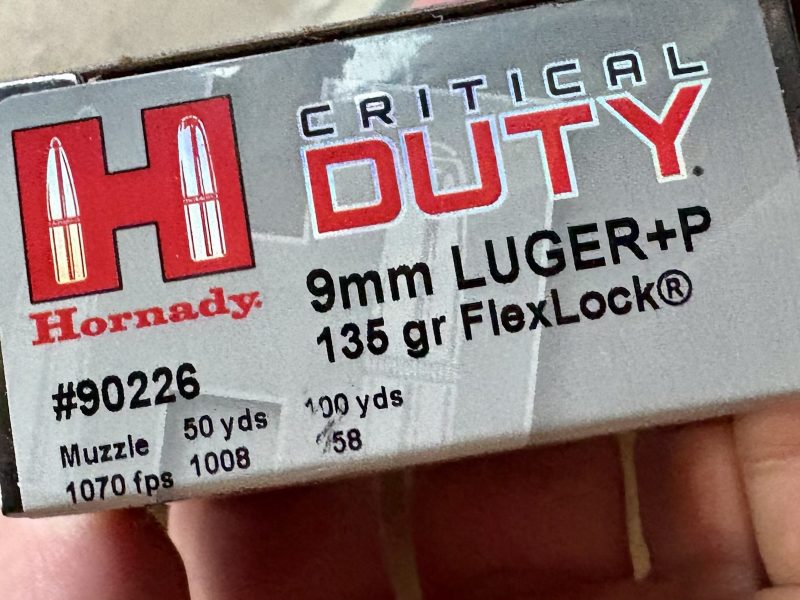
If this Prodigy is going to do double-duty as a carry gun, I am a big fan of Hornady’s Critical Duty. This is hot shit, and pokes really deep holes. Ammo to Go has this stuff available as well.
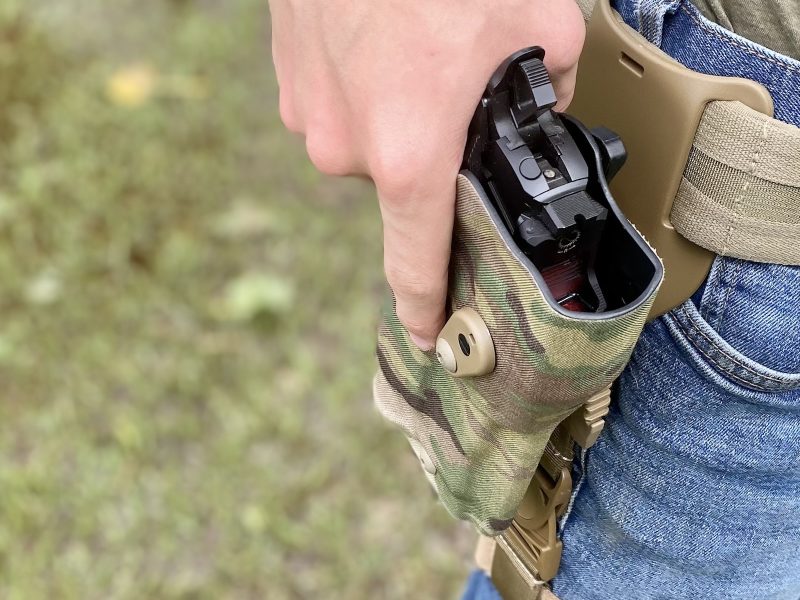
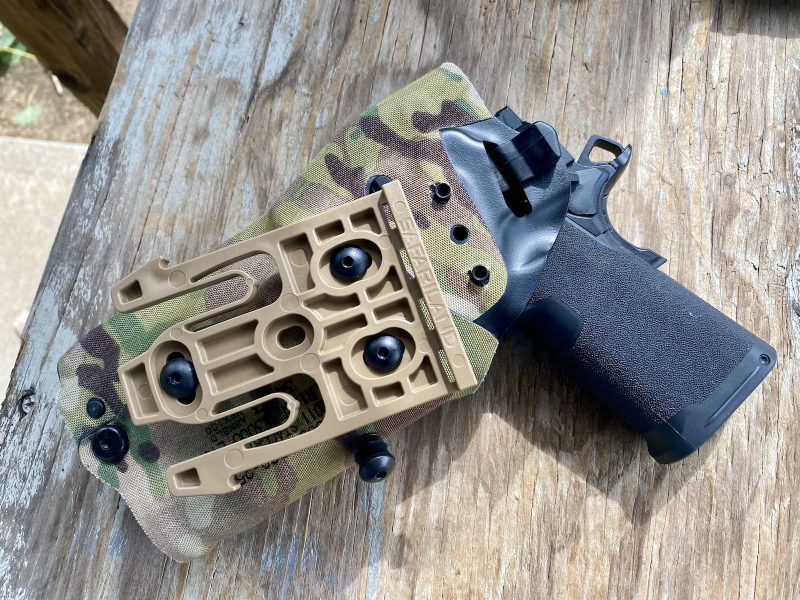
Holster Up: The Safariland 6354RDSO
For those who want to carry, on the range or off, I’d highly suggest the Level I retention provided by a 6TS holster. This is a Safariland 6354RDSO. RDSO stands for Red Dot Sight Open because the 6354RDSO uses an open pocket to protect the optic instead of a flip-up dust cover. It works exceptionally well – and you can get one online here.
Springfield Armory’s Ethos and Where the Prodigy Fits
Springfield Armory has never been a bougie brand. That’s not a criticism — it’s the point. For decades, the company has operated in the space between mil-spec and custom-shop aspirational, and they’ve done it deliberately.
XD series guns brought serious polymer pistols to buyers who couldn’t justify the inflated prices. The Range Officer made a kickass 1911 accessible without the four-figure entry fee. Hellcat punched into the micro-compact market with specs that embarrassed guns costing significantly more. The throughline is consistent: Springfield identifies what shooters want, then figures out how to deliver it without the premium.
The Prodigy is the same argument applied to the double-stack 9mm.
Springfield Prodigy Accessories and Gear Used or Mentioned in this Review
| Accessory | Brand / Model | Purchase Link |
| Duty Holster | Safariland 6354RDSO | At Optics Planet or direct from Safariland. |
| Weapon Light | Modlite Systems | At Midway USA or Primary Arms |
| Red Dot Optic | Trijicon RMR | At Optics Planet or Primary Arms |
| Red Dot Optic | HEX Dragonfly | On Grab-a-Gun or at BattleHawk Armory |
Prodigy is Springfield doing what Springfield does, engineering to a price without engineering out the parts that matter. The frame, the trigger, the barrel, the fit — none of it feels like a cop out. What was cut was the modularity, the boutique markup, and the cost of the name.
Support us by checking out Wilder Tactical!
HIGG – Springfield Prodigy Upgrades


0 Comments