
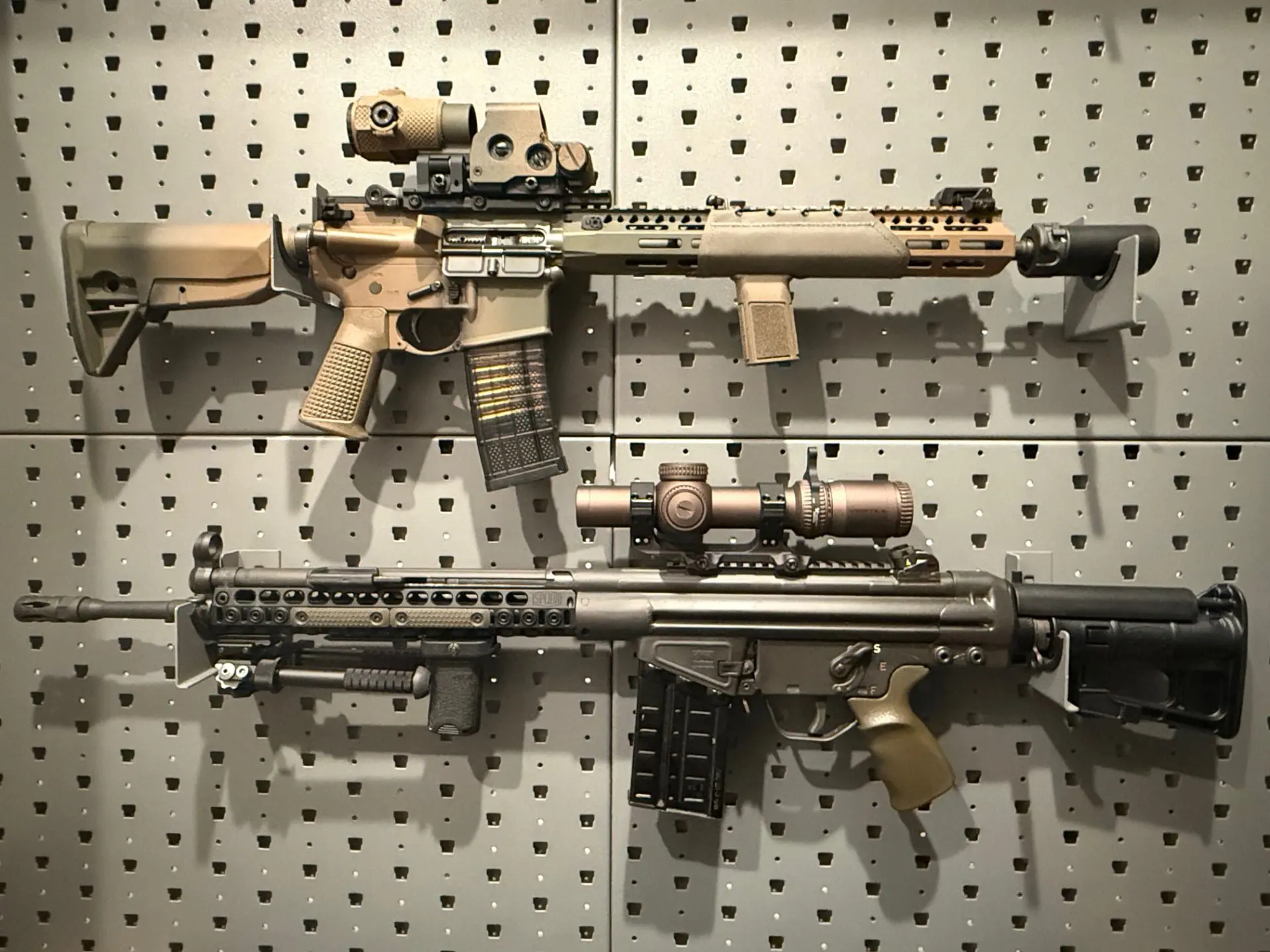
Hear me out. The Vortex Razor HD Gen III (a FFP Vortex 1-10 LPVO) is an excellent do-it-all optic. Don’t believe me? Give me a chance to convince you.
Estimated reading time: 15 minutes
Sometimes you have a project in mind, you know what you want it to be, and what you want it to do. All that remains is finding the perfect components to make it a reality. The solution must follow the problem, and there is nothing more satisfying than finding the perfect product or service.
As I outlined in my Main Battle Rifle / DMR Build article, I wanted a nearly “do it all” gun whose long-range capabilities exceeded those of the average AR, and I didn’t want to spend a fortune to achieve it. I knew I needed an optic that could function from 5 yards to 500 yards, and while I have been lukewarm on LVPOs in the past, I knew it would likely be what was needed for this.
Enter the Vortex Razor HD Gen III 1-10×24 FFP. Its staggering 1-10x range, combined with a daylight bright red dot, meant I might actually pull off my intended concept.
Disclosures and appreciations: I’d like to thank Vortex for providing this optic. I’m still at a point in my writing career where I am deeply honored when companies are willing to support me, and I hope I can provide you, dear reader, with some considerations others may not have touched on.
That said, I’m not going to pull any punches in my reviews, even if it ends with me on a double-secret gun industry persona non grata list. Or even just the one scrawled in marker on an apartment wall (cue Steve Buscemi putting on lipstick after adding my name a la Billy Madison).
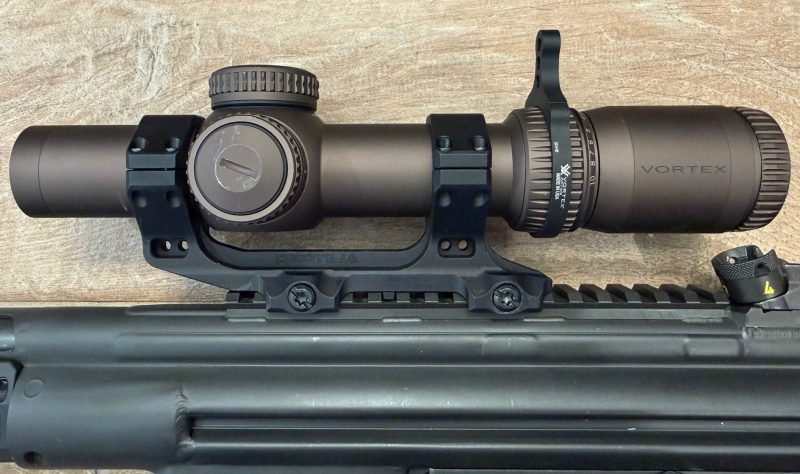
Vortex Razor HD Gen III 1-10×24 FFP
Breaking Down the Word Salad
My frustration with naming conventions continues across all parts of the firearms industry. Cool sounding doesn’t always equal descriptive/helpful. While the purpose of this article isn’t to teach you the anatomy of magnified optics, I think clarifying some of the terms I myself struggled with is worthwhile.
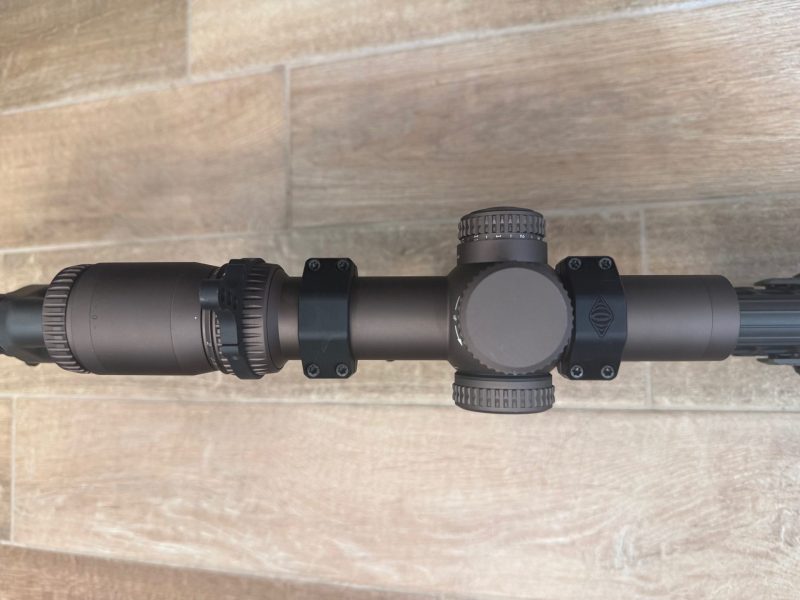
The tail end of this Vortex optic’s name does offer some clues to its attributes. Namely, its magnification can go from a 1x to 10 times magnification, and its “Objective Lens Diameter” is 24mm. But wait, you say, I looked up the website and the specs say it has a 34mm tube, what does that mean? If a Trijicon TR24 1-4x LVPO has a 24mm Objective Lens, then how is the tube only 30mm on that? Yeah, seems weird to me too but I’ll explain.
Lastly is the “FFP” meaning First Focal Plane, but what is that, why would I want it, what other types of planes are there, and why aren’t my parents proud of me? All good questions that confused the heck out of me when I first started shopping for these things. I can answer the first few of these questions clearly for you and guess at the last one.
Magnification is pretty straightforward, though I’ll discuss what a “true” 1x means later on, as 1 doesn’t always mean 1.
Tube and Objective lens size. The objective lens size determines light gathering and field of view (larger lenses = brighter/wider view), while tube size (e.g., 1-inch vs. 30mm) primarily affects the range of internal adjustments (more adjustment is available for larger tubes), not necessarily brightness, as quality glass and coatings are more important for clarity. So in general, a larger objective lens lets in more light, but a bigger tube allows for greater windage/elevation adjustments, crucial for long-range shooting, though a high-quality 1-inch scope can outperform a cheap large-tube scope. Confused yet? Great, let’s continue.
A first focal plane (FFP) optic places the reticle in front of the magnification system, so the reticle appears to grow and shrink with the target as you change magnification, keeping its measurements (like mil-dots or MOA) accurate at all power settings, which is ideal for long-range shooting where precise holdovers are crucial, unlike second focal plane (SFP) scopes where the reticle stays the same size. The downside of the FFP scopes is that it can make the reticle look too thick at high power or too thin at low power. Too thick is not a problem at 10x with the Vortex, but I wish the 3, 6, and 9 o’clock hash marks were more pronounced at 1x.
As for your parents, they likely won’t be proud of you until you get a fancy white-collar job and settle down with a “nice” girl like your older brother Chet. God forbid Chet ever does anything wrong because he’s the perfect one and you’re just the son that ruined the 1994 summer vacation to Mrytle Beach when you threw up everywhere in the family Ford Taurus.
The Reticle
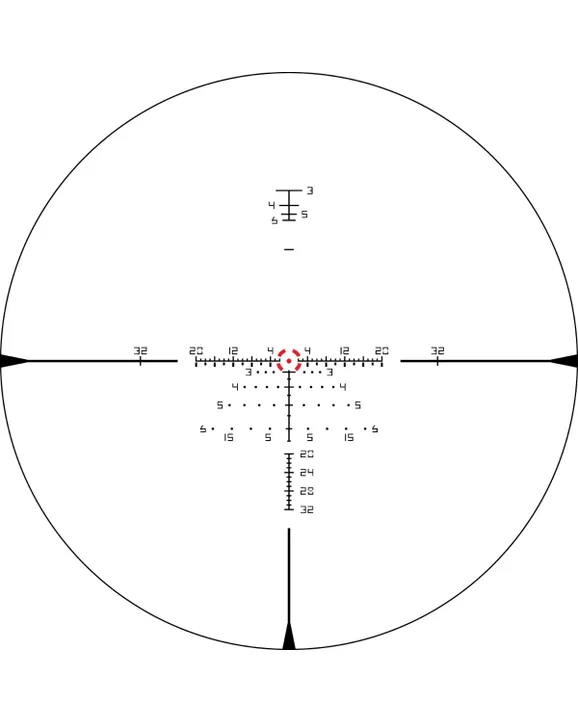
All of that said above and I still didn’t touch on the reticle which is a feature that can make or break the optic for many shooters. Here Vortex gives you two choices the “EBR-9 BDC (MOA)”, which I chose, and the “EBR-9 (MRAD)”. EBR of course stands for “Enhanced Battle Reticle” because who wants a “non-enhanced” battle anything? I feel like they missed an opportunity to work in “Tactical”, “Pro”, and “Extreme”. maybe EBTPER for next time.
I’m not going to get into all the ins and outs of the reticle, mainly because I’m not qualified as someone not classically trained in long-range shooting. Also, as mentioned, this is hugely personal preference. When I get around to talking about my actual shooting experience, I’ll tell you what I like and don’t like about these lines and numbers plastered all over the thing I’m trying to look at my target with.
How does it shoot?
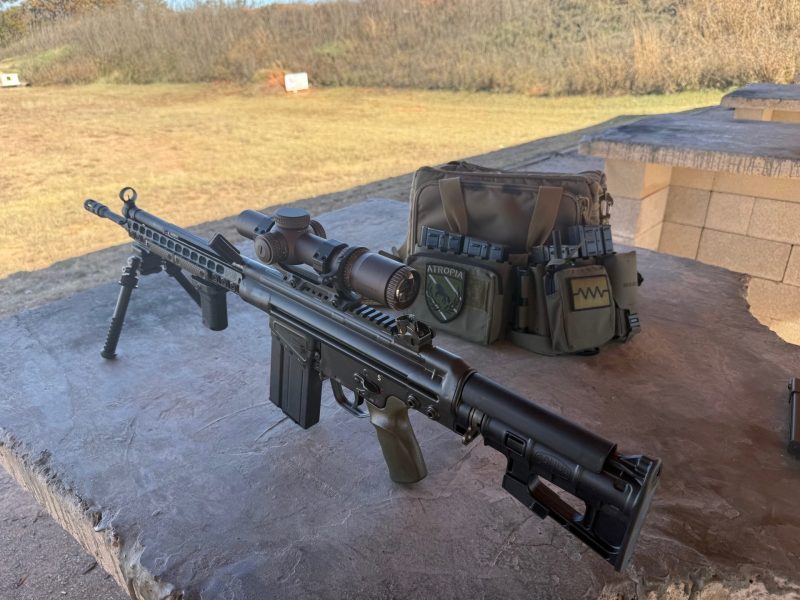
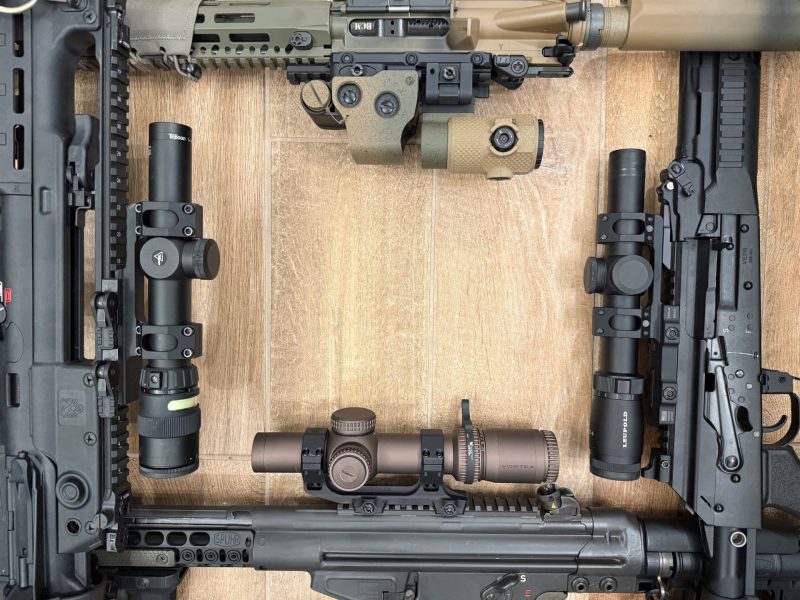
I’ve linked to the product page, and I’ll list the full tech specs at the bottom of the article, but regurgitating these is not what I do. This is because you can literally read them for yourself, and more importantly the sum of the parts is often very different in the hand or in use than the specs suggest. Any car lover knows this: take three cars of similar weight and horsepower, drive them back-to-back, and you’ll realize how different they can be from each other. Optics are like that too. You also won’t hear me mention weight, on this PTR-91, an extra 8 ounces is literally unnoticeable at this point. Even if it was noticeable compared to other, more stripped-down options, I’d make that trade-off for the versatility of an enormous magnification range and an illuminated reticle.
What am I looking for in practice: A true 1x on a 1x optic. Clear glass that doesn’t tint the world, doesn’t impede light (any more than physics requires), doesn’t have eye relief that makes me want to die, and of course, can take a beating (because the thing is on a freaking gun).
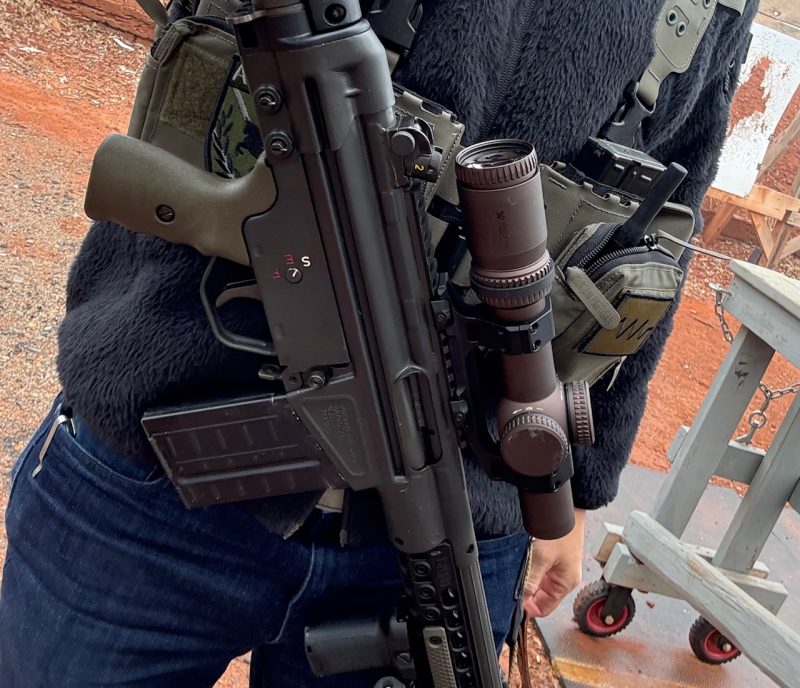
For this application, I also wanted a daylight bright red dot and this thing goes to “11”…literally. I don’t know if this was by accident or if someone at Vortex was a “Spinal Tap” movie fan, but I love it! I also find it really nice that the illumination dial turret for the dot has an “off” setting between each brightness setting. This means that if you regularly shoot on a sunny day on level 9, you can turn one click up or down and it is now off, rather than having to play spin the wheel like you are a final contestant on the “Price is Right”. When it comes time to get back at it, you guessed it, just one click (and one click only Vasili…oh wait, that was pings. Any other Hunt for Red October fans here?).

Up Close
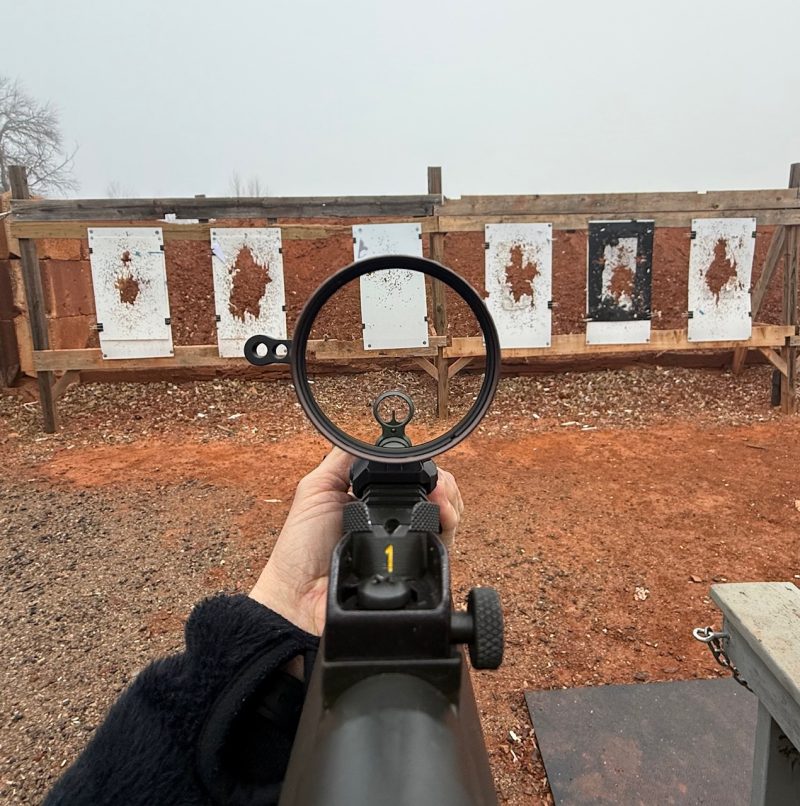
While I mention in my DMR-MBR article that this build skews much closer to the long range than the CQB, I did want that capability in a pinch. Here, I wish the dot started bigger and got smaller while I do like that the reticle started near invisible and got larger under magnification. To be fair, no LVPO will ever hold a candle to a dedicated 1x red dot like an Aimpoint Micro, EO Tech, or Holosun 503c. Thankfully, this illumination was not an afterthought, it definitely gets plenty bright, which makes it very useful. I’m probably being unfair because side by side, the dot itself looks the same as an Aimpoint H-2 2MOA dot, although I couldn’t find literature on what Vortex rates it as. However, because of the much larger window, the dot appears smaller due to perspective, so I might be alone in this criticism.
Lastly, this is a true 1x. You can tell this easily because when you look through the glass with both eyes open, what one eye sees matches what the other sees. Even a 1.2x “that”1x” setting that was common in some of the older, less expensive, large spectrum of magnification optics could mess with your brain big time. If I could have this I would go with something like the Trijicon 2-10x Credo knowing I needed to run a red dot at the 12 o’clock position. It’s more complexity and cost though, so I am thankful for what Vortex has done here.
Far Away
Under full magnification is where this optic shines. The reticle becomes clear and even for someone like me, not trained in long-range shooting, I can use the markings to get consistent holds on targets at distance. At a recent range trip, immediately after zeroing, I was able to ring a 10″ steel plate at 500 yards off my bipod 9 out of 10 shots with little skill and perhaps 4 out of 10 effort. Generally, in this scenario, you are best served by turning the illumination off, which can get a little thick and obscure the target.
A skilled user could certainly stretch this optic out to 800+ yards in a pinch, which for all my intents and purposes, would qualify this as a “stand off” distance weapon. Keep in mind also, back in WWII, the typical sniper rifle commonly ran between 2-4x magnification, while the “White Death” himself, Simo Häyhä, didn’t use optics at all. In short, having 10x magnification allows you to do a lot at significant distances.
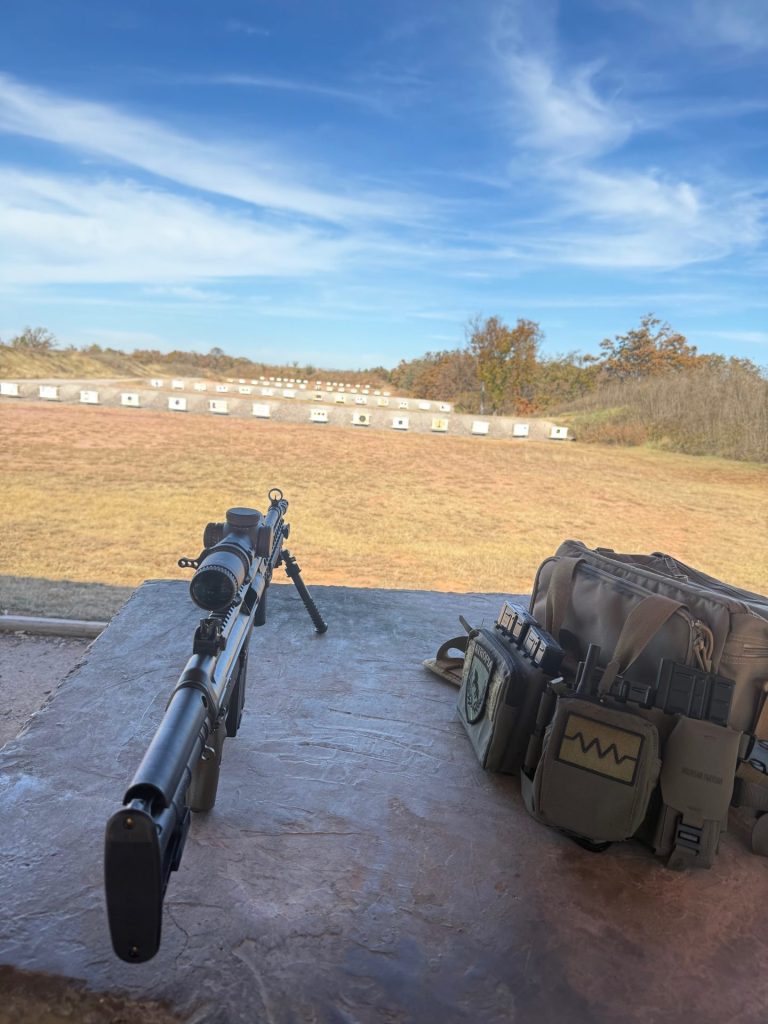
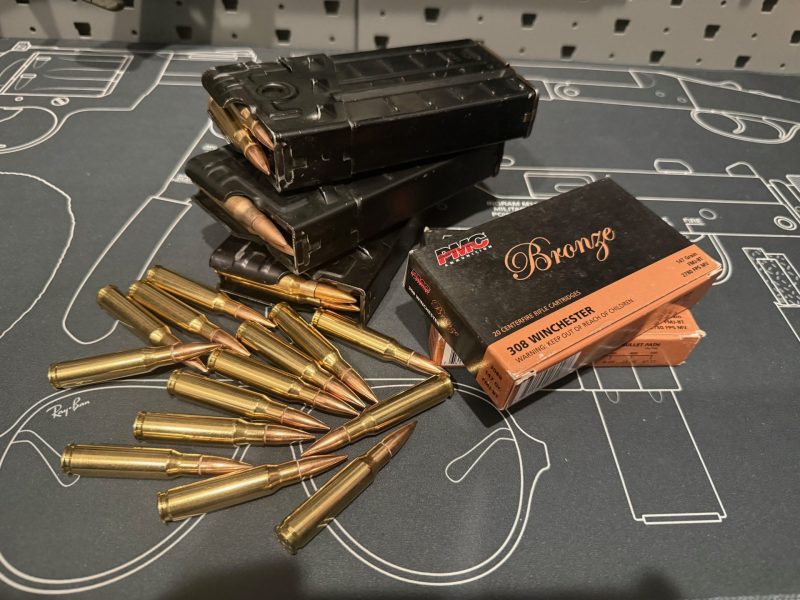
I’ll also give another plug to this PTR-91, even with inexpensive PNC 147-grain ball ammo provided by our friends at Ammo To Go, I was able to achieve 1.5 MOA or better accuracy out of a cheap semi-auto. I have heard it is something to do with barrel twist rates and harmonics and math, but I’m pretty sure it’s witchcraft.
Some Comparison
I don’t own a ton of LVPOs, though that may be changing now. However, I do have the Trijicon TR24 1-4x and the Leupold VX-6 1-6x optic. The question that has been on my mind is: When is a variable optic no longer “low power”? Ten times seems like an awful lot of magnification so at some point, here I’m going to need a guy that looks the part with a beard and sleeve tattoos to tell me what to think around this. I threw in my EO Tech 5x magnifier because, while not adjustable, it represents an alternative that in use, would be virtually identical to how I use the 1-6x. By that I mean I usually use 1 or 6x, there aren’t many times I think “Gee 3.8x is just right”. Despite all the things it got wrong, the binary 1 or 4x Elcan had that right.
LVPOs even on 1x have an eye relief to some degree, something, once you throw the magnifier out of the way, a red dot does not. If you are using night vision, there is no argument that you’d need a red dot on top of the LVPO for both the height and the easy of looking through. Those flip-up magnifiers tend to top out at about 6x at time of writing, is that enough for you?
Other stuff, how is the Vortex light transmission compared to the others? About the same, at least I can’t tell a difference. I’d give it a 23 out of 26 on my made-up scale. How about eye relief and eye box, and other stuff between these four at similar magnification. Again, about the same. I don’t think what sets the Vortex apart is some secret physics-bending sauce; it is the ability to be good across such a huge spectrum of performance criteria, allowing for the maximum number of use cases in one optic.
Final Thoughts
It always comes down to this: Should I spend my hard-earned wampum on this, a competitor’s offering for the same price, or a cheaper “just as good” Reddit-approved special? I want to punch my own face here with this answer but, “it depends”. Are you trying to build a gun to do something like I was? Do you need, or even like, the features and options this optic provides? If the answer is yes, then I can wholeheartedly recommend the Vortex Razor HD Gen III 1-10×24 FFP. It does everything I want it to do, and at retail/street prices, I feel you are getting great value for your money. Time will tell if it holds up, but so far, through regular spirited use and a series of mishaps like dropping my soft case with this rifle in it, optic facing down to break the fall with little more than 600D polyester fabric between it and the parking lot, it has proven tough.
The best advice I can give you is to go check one out in person at a gun store and play “eye spy” with several other options back-to-back to see what you think. It is a big purchase that you no doubt had to campaign with “Household 6” (the call sign us ex-military types feel very clever using for our spouses because “6” typically denotes the commander in a unit and “she’s the boss” wink, wink) to get approved to splurge on. I think you’ll find you get a lot of capability and value for your money with this. Also, if you want more on the mount I chose, head on over to the DMR-MBR build article I linked above. I went on a rant about optic height size that will likely make you wish you hadn’t.
Vortex Razor HD Gen III 1-10×24 FFP Specs
Magnification: 1-10x
Objective Lens Diameter: 24 mm
Focal Plane: First Focal Plane
Reticle: EBR-9 BDC (MOA)
Eye Relief: 3.6″
Field of View: 116.0′ – 11.7′ @100 yds
Turret Style: Capped
Tube Size: 34mm
Adjustment Graduation: 1/4 MOA
Travel Per Rotation: 25 MOA
Max Elevation Adjustment: 120 MOA
Max Windage Adjustment: 120 MOA
Parallax Setting: 150 yds.
Length: 10.1″
Weight: 21.5 oz

Olivo – Vortex Do It All Optic





Only one small problem. MSRP $999.99. Without scope mount, $230 cantilever mount. If we wait awhile the price may come down.