
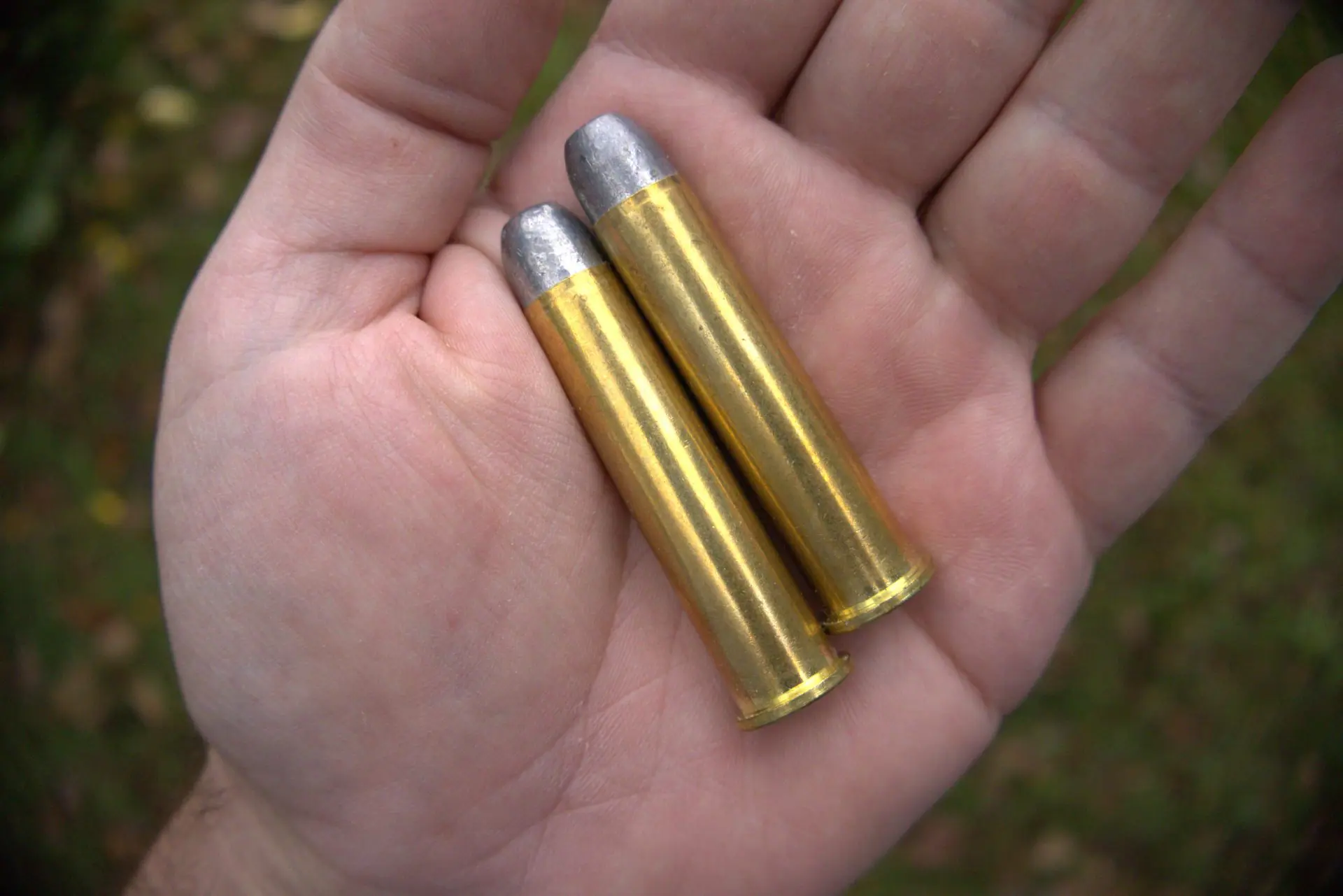
In a world of carbon fiber, high Ballistic Coefficient (BC) bullets, and poodle-shooting calibers, the .45-70 Government cartridge is an anomaly. It started life as a service cartridge when black powder and big lead bullets reigned supreme. But the round has become a perennial favorite among hunters and guides, in a number of powder, projectile, and rifle configurations that were unimaginable when the .45-70 began its long and industrious career of putting big holes in things. Below is the history of the 45-70, commonly referred to as the 45-70 Government cartridge (and occasionally the 45-70 Springfield.
We’ll look at how it transitioned from old rifles to new ones, and what it offers compared to comparable cartridges today.
Following the .45-70 Cartridge from the Little Big Horn to the Big Screen
History of the 45-70
The 45-70 began life in 1873 when it was developed for the US Army’s new Model 1873 Springfield rifle. The very first loading of the cartridge was a 405-grain .45 caliber bullet in front of a case filled with 70 grains of black powder, hence the term .45-70. Although big, slow, and often seen as a brush cartridge, the .45-70 was an early attempt at an efficient long-range cartridge.
To Get More Reach
The evolution began after the American Civil War. The US Army knew self-contained cartridges were the way of the future but had invested heavily in millions of muzzleloading .58 caliber rifled muskets. The war inflated American money, and the government accrued the largest debt in its history at that time. To get a cartridge rifle on the cheap, Erskine Allin of Springfield Armory developed a trapdoor cartridge conversion to allow the old muzzleloaders to become faster breechloading rifles.
The Model 1866 rifle even used the same barrels as the old muskets, and the cartridge reflected that. It used a short, squat .58 caliber rimfire cartridge. In 1868, the barrels were sleeved down to .50 caliber for the new .50-70 cartridge. 12 By 1873, the Army’s finances were in better shape and new Trapdoor Springfield rifles could be built. That opportunity allowed for the adoption of a new cartridge, the .45-70.

The Sandy Hook Trials
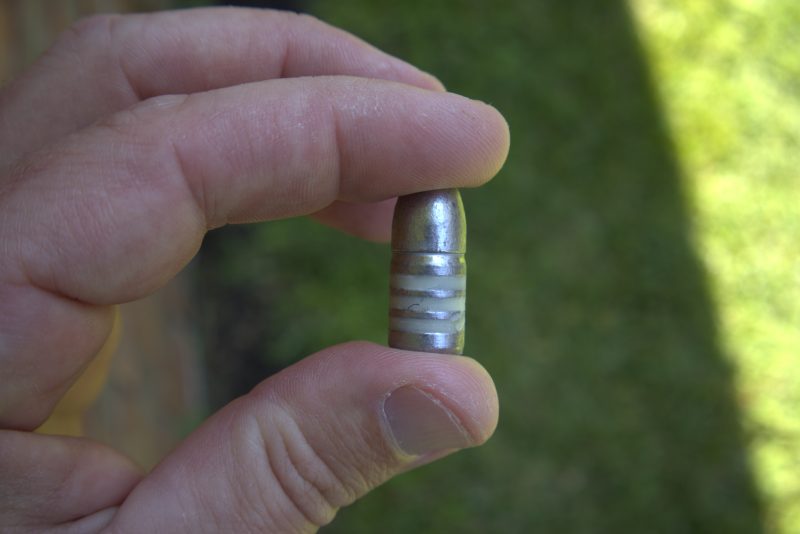
In its original format, the .45-70 was smaller caliber yet had a heavier bullet than either the .58 or .50-70. This bullet had a superior ballistic coefficient, a flatter trajectory, and better downrange ballistics. In 1879, a 500-grain bullet was introduced at the Sandy Hook Trials. In the hands of Springfield’s R.T. Hare, the new configuration made reliable hits out to beyond one mile. The 500 grain bullet was adopted for use in the infantry rifle. But the original load proved too sharp in the recoil department when using lighter cavalry carbines. A carbine load using a 55 grain charge and the old 405 grain bullet began to be issued along with the 500 grain rifle load starting in 1880.3 By then, Reconstruction and the Indian Wars were at an end and the US Army reverted to policing the border.
As the Army’s operations wound down, those of the Navy and Marine Corps picked up as America’s influence abroad expanded in response to aggressive European colonial powers in the latter decades of the 19th century. Instead of adopting the Trapdoor Springfield, the Navy and Marine Corps adopted the .45-70 in the guise of the Remington-Lee bolt action magazine-fed rifle in 1879. An improved M1884 was issued as part of President Chester Authur’s expansion of the Steel Navy fleet.4
The Mild Rise and Decline of the .45-70
Because of the logistics of supplying different types of ammunition across the vast expanse of the Western frontier, the .45-70 pull as a military cartridge brought more commercial appeal. But the popularity of the lever action rifle hemmed its popularity. The 1874 Sharps single-shot rifle was an early hunting rifle in the caliber. But it was not until the creation of the Winchester 1886 lever action rifle that the .45-70 truly gain a following. By then, the classic age of the Buffalo hunt had long past and the age of smokeless powder was about to begin.
Paper Patch Innovation
Although the .45-70 Government cartridge was a mild initial success on the commercial market, it was adapted to paper patch loadings. Paper patching was a method for hunters and target shooters to get the most out of their full-power black powder cartridges. Black powder leaves behind corrosive residue that is quick to harden without cleaning. In short order, accuracy will go downhill. The US Army used a grease-grooved bullet, as the grease will keep the fouling soft for repeated shooting and easy cleaning. Buying cartridges from the shop was little different in the 1880s than it is today, but quite a few hunters and shooters made use of Lyman reloading tools. While the grease-grooved bullet was most common, solid core bullets patched with paper were also used. The paper acted as a jacket to clean up fouling as the bullet traveled down the bore and burned up upon leaving the muzzle. It was an effective method of keeping fouling at bay without messing with lubricants that might contaminate the powder in the cartridge over time.
The End of the Line
The Army, Navy, and Marine Corps continued to field .45-70 Springfields and Remington-Lees at the turn of the 20th century in the Spanish-American War and the Philippine-American War. But they were officially superseded in 1892 by the .30 caliber Krag Jorgensen bolt action repeating rifle. Surplus Springfields provided a cheap big game rifle once on the civilian market. The Winchester 1886 continued to sell but would soon have to compete with rifles like the Marlin 1893 and Winchester 1894 chambered in .30-30, a lighter smokeless powder option whose power rivaled the old .45-70.5
Despite the creation of smokeless loads for the cartridge, the .45-70 entered a period of decline that was only slowed by the vast number of surplus guns put to use. That decline was underlined when Winchester finally discontinued the Model 1886 in the depths of the Depression in 1935.
The .45-70 Government Reborn
The .45-70 Government cartridge lay obsolescent until 1972 when the Marlin Firearms Company brought back their Model 1895 large frame lever action rifle. Although the original Model 1895 was not available in .45-70 during its original run, the new 1895 was. The new 1895 proved to be a popular seller, particularly in northern reaches like Montana, Canada, and Alaska, where the quick-shooting, yet powerful 1895 was a handy tool for hunting large game and bear defense. In 1998, the first dedicated Marlin Guide Guns were introduced specifically aimed at that market.6
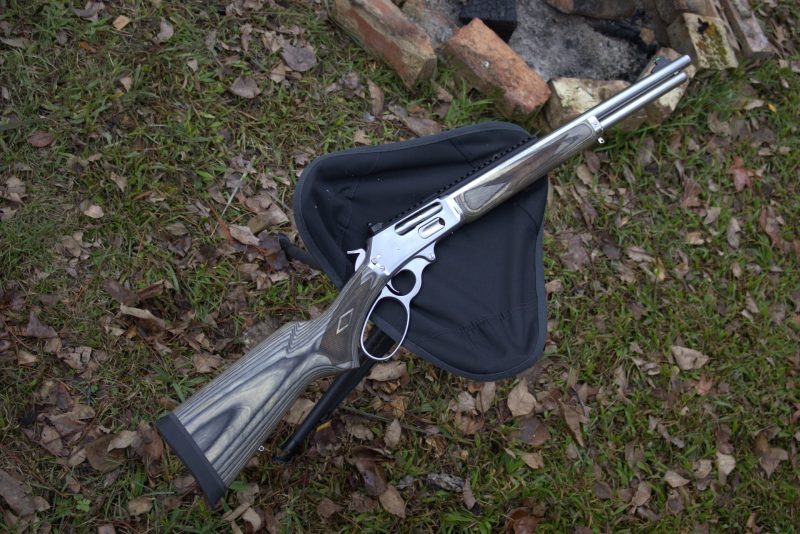
With the .45-70 revived, ammunition manufacturers like Buffalo Bore, Hornady, and Winchester sought to push the cartridge to its potential now that it was not limited to the relatively weak actions of old Trapdoors. The .45-70 cartridge became the defacto lever action rifle cartridge. The Marlin 1895 served as the original revival, but large-frame lever action rifles from makers like Rossi and Henry Repeating Arms are represented. Even Winchester brought back their Model 1886 in 2020. That popularity bled into single-shot rifles like historical replicas of rifles like the Sharps, the Remington Rolling Block, and new Trapdoor rifles. Modern break-action single-shots like the H&R Handi Rifle and the Henry Single Shot are also well represented. The .45-70 even made its way into handguns as large as the Magnum Research BFR and the tiny Bond Arms Cyclops. When a big bullet is required, particularly at closer distances, the .45-70 Government cartridge inevitably comes up.
Decoding .45-70 Ballistics
The .45-70’s legacy as a black powder cartridge translates to its greatest strength and greatest fault: a big bullet and a rainbow trajectory. If you are used to a modern smallbore round, the .45-70 will look, feel, and shoot like a different animal. But that does not mean it can be worked with as the truism of big bullet and an elliptical trajectory is not as true as it used to be.
Trajectory: How Far Will the .45-70 Shoot?
With a moderate velocity and a heavy for caliber bullet, the original .45-70 cartridge was flat shooting compared to the competition back in 1873. But times do change and any number of smallbore smokeless cartridges have a flatter point blank range by comparison. The original .45-70 cartridge used a honking 405 grain bullet going at about 1,400 feet per second and its trajectory is measured in inches even at relatively tame distances. Out of a 22 inch carbine, this load rises two inches above the point of aim at 50 yards before dropping back to the point of aim at only 100 yards.
Thankfully, we do not have to settle for original loadings. Lighter 300+ grain smokeless make up for loss in bullet weight with speed and at higher pressures than the old Trapdoor Springfield could handle. Take the Hornady LeverEvolution 325 grain FTX load as an example. From a 24 inch barrel, this load generates upwards of 2,000 feet per second at the muzzle. At 100 yards there is little discernable drop, but at 200 yards the rounds are dropping 4 inches below the point of aim.
While the .45-70 Government cartridge has a lethal reputation at ranges up to 1,000 yards in a military setting, some hunters term it to be a brush caliber only effective at close range. The truth is a little more realistic. The .45-70 is at its best inside 200 yards as there is minimal sight or scope adjustments needed to make effective hits. For today’s hunter, the .45-70 is less at home on the prairie and more so in thick timber.
How Does the .45-70 Kick?: Recoil and Ammo Pressure
If you put a .45-70 round in your hand, you will immediately notice that it is much bigger than most rifle rounds out there. Therefore, it must be very powerful and very punishing to shoot. That is not necessarily the case, given the longevity of the round and the sheer volume of ammunition types available.
Part of the recoil department is the power of the ammunition. In this case, there are three distinct pressure types loosely associated with the .45-70 Government cartridge: Trapdoor loads, lever action loads, and modern single-shot loads.
Whether made with smokeless or blackpowder, Trapdoor loads are loaded to pressures safe for old Trapdoor rifles. The chamber pressure is nominally held to a sedate 19,000 psi. Trapdoor replicas, thanks to their modern steels, can handle SAAMI spec .45-70 loads which are rated at 28,000 psi.7 Generally, loads like these yield velocities of between 1,100 and 1,400 feet per second.
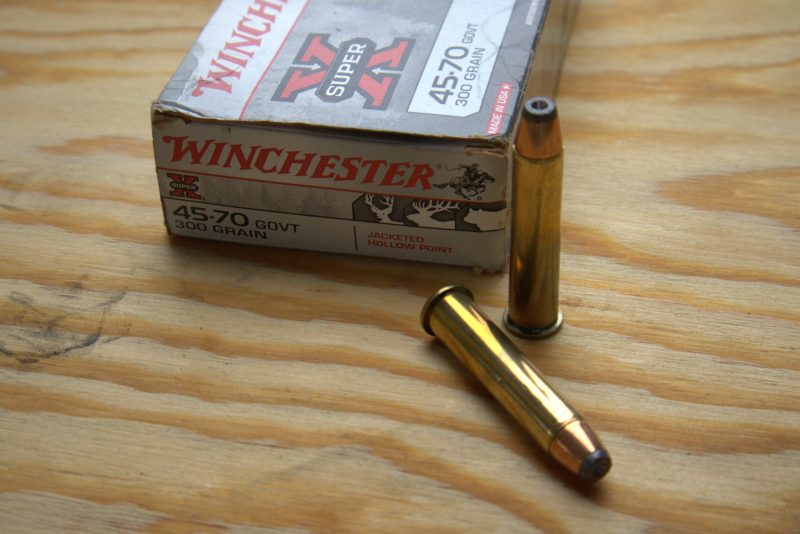
Lever-action rifles have a stronger locking action and can generally handle higher-pressure loadings, with muzzle velocities up to 2,000 feet per second. These include many popular 300-325 grain loadings like the Hornady LeverEvolution, Underwood Xtreme Hunter, and the old Winchester Super X. Pressures are generally kept at or below 40,000 psi.
The final tier of loads, generally the preserve of handloaders, are modern single-shot loads. These rifles include converted Siamese Mauser rifles and the Ruger No. 1 rifle and are among the strongest actions that can use .45-70 ammunition. Pressures up to 50,000 psi are possible. 8
There is an inverse relationship between the power of the cartridge and its recoil and range, given rifles of the same weight class. Higher-velocity loads generally have a flatter trajectory and longer range than traditional options. For example, the Hornady LeverEvolution 325 grain FTX load, with a 200 yard zero, rises to 5.5 inches at 100 yards and drops 23 inches at 300 yards. 9 The old-school 405 grain rifle load backed by black powder rises 8 inches at 100 yards and drops 32 inches at 300 yards with the same 200 yard zero.
On the other hand, with rifles of the same weight, the old school loads are easier on the shoulder. Chuck Hawes documented recoil energy across several .45-70 rifles and loads and found that a 7 lb. rifle with a stout 350-grain load at 1,900 feet per second produced 37.9 pounds of recoil energy. A 7.5 lb. rifle firing a standard 405 grain load at 1,330 feet per second produces 18.7 pounds of energy. By comparison, a standard .308 Winchester round generates between 9.7 and 17.5 pounds of energy. At any rate, the .45-70 is a thumper and rounds at the higher end of the spectrum may exceed the threshold for the average shooter.10
Comparative Ballistics: The .45-70 vs. Modern Cartridges
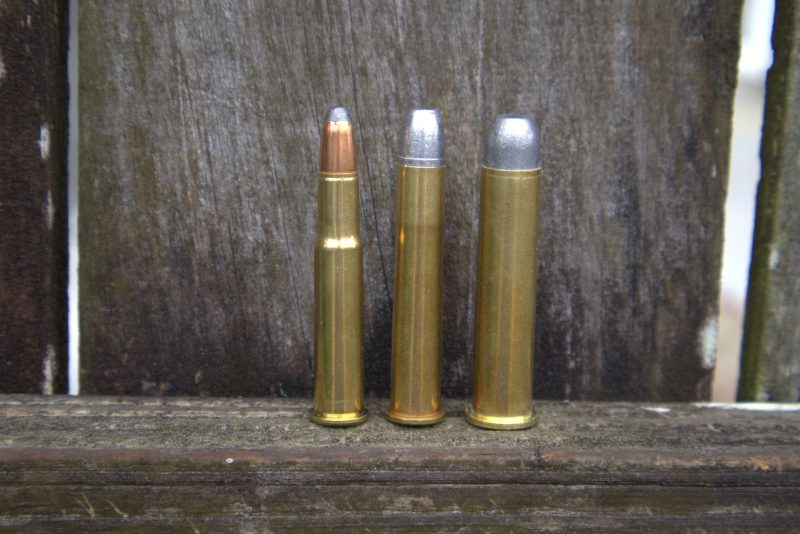
The old .45-70 round is large, slow, and has the trajectory of a thrown rock compared to even the earliest smokeless powder cartridges like .303 Savage and .30-30. But many loadings for the .45-70 elevate its game. Take once again the Hornady 325 grain LeverEvolution compared to other comparable Hornady loadings in .30-30, .308 Winchester, and .30-06 as an example.11
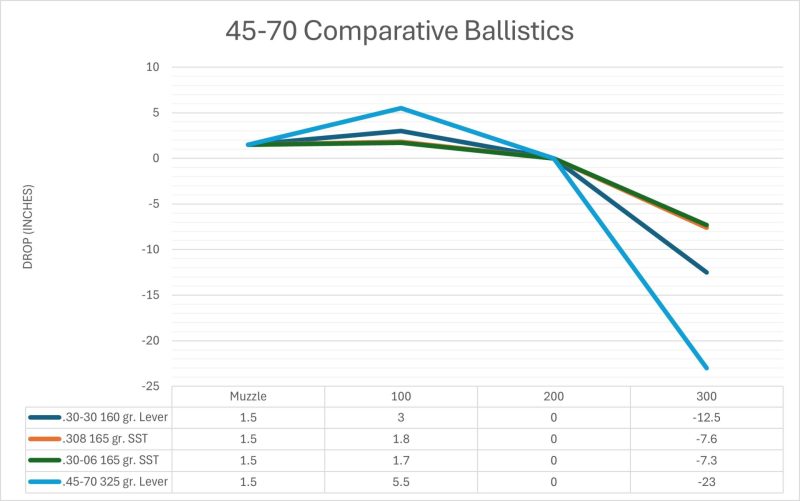
Even with the best ammunition, the .45-70 has a more elliptical trajectory than comparable bottlenecked rifle rounds. But within reasonable ranges, within 300 yards, the .45-70 can be effective. In this example, at 300 yards, both the .30-30 and the .45-70 yield comparable energy just north of 1,000 foot-pounds of energy. The .45-70 also has the added benefit of having a straight-walled case, making it legal in more places, and is available in solid-bullet offerings made for straight-line penetration on dangerous game, something atypical with other traditional hunting cartridges.
Modern Rifles
.45-70 rifles are as varied as the ammunition. You can opt for historical originals as well as replica firearms from Pedersoli and Uberti of the Winchester 1885 and 1886, the Trapdoor Springfield, the Sharps Model 1874, and the Remington Rolling Block. Pedersoli also splits the difference between replica and modern rifle with its line of 1886/71 rifles featuring modern rail systems and composite stocks, such as the Boar Buster and Guide Master.
Ruger has followed that lead with new renditions of the Marlin 1895 lever action and continues to make occasional runs of the Ruger No.1 in .45-70. Henry Repeating Arms’ Side Gate .45-70 is their long-standing large-frame lever action that continues to see new renditions. Their models range from traditional walnut/steel configurations to black-themed and railed Tactical models, as well as a lightweight carbon fiber barrel model in the new SPD.
Trivia, Obscura, and Fun Facts
The Gatling’s Best Friend
The Gatling gun is a hand-cranked multi-barrel piece of artillery that served the purpose of what a fixed machine gun would today. Early models of the Gatling that debuted during the American Civil War were chambered in the old .58 rimfire. When the .45-70 was adopted as the Army’s rifle cartridge in 1873, Colt ramped up production of .45-70 Gatling guns. Some 1,300 in all were bought by the US Army and Navy and saw service as late as the Filipino-American War.
The Bridger Line Gun
The .45-70’s service did not completely end at the turn of the 20th century. Some Trapdoor rifles were modified for naval use as a line gun meant to hurl lines from a rescuing ship to stranded vessels. Today, a blank .45-70 cartridge loading lives on in the Bridger Line Gun. The US Coast Guard-approved Bridger Gun can launch lines up to 750 feet.
45-70 Handguns
The .45-70 is a full-powered rifle round, but that has not stopped makers from chambering it in handguns. Thompson/Center made their Encore hunting pistol in .45-70, among many other rifle rounds. Magnum Research’s Biggest Finest Revolver is a five-shot single-action revolver made long enough to handle this long round. Finally, Bond Arms chambers their diminutive Cyclops single-shot derringer in .45-70, making it quite the handful.
In the Movies
The .45-70 moved from the Little Bighorn to the big screen in early Westerns and rural dramas. Famously, Travis Coates carries a Trapdoor .45-70 in the 1957 Disney classic, Old Yeller. The original 1989 Lonesome Dove miniseries features a variety of Sharps rifles in .45-70 in the hands of Blue Duck’s goons. More recently, the .45-70 has taken on the role of monster killer. The old 1886 makes a return in the hands of Juan and Black Hand Kelley to fight the burrowers in Tremors 4 (a true sh!t show if ever there was one). Chris Pratt carries a modern stainless Marlin 1895 in his starring role in 2015’s Jurassic World. To play up to the latter role, Marlin’s marketing team selected their 1895 series as rated for T-Rex.
It’s a powerful and colorful role for a big old cartridge that is anything but in the past.
- The “Trapdoor” Springfield: First of its Kind in the U.S. Ar – Guns and Ammo ↩︎
- .45-70 at Two Miles: The Sandy Hook Tests of 1879 – Research Press ↩︎
- #1 – Report of the Chief of Ordnance 1879. – Full View | HathiTrust Digital Library ↩︎
- The Remington-Lee Rifle: Ahead Of Its Time | An Official Journal Of The NRA ↩︎
- #409 – Recreation v. 5 (1896). – Full View | HathiTrust Digital Library ↩︎
- A Look Back at the Marlin Model 1895 | An Official Journal Of The NRA ↩︎
- SAAMI Z299.4 – 2025 ↩︎
- 45-70 pressures – official Marlin figures? | Marlin Firearms Forum ↩︎
- 45‑70 Government 325 gr FTX® LEVERevolution® ‑ Hornady Manufacturing, Inc ↩︎
- Rifle Recoil Table ↩︎
- Rifle Ammunition ‑ Hornady Manufacturing, Inc ↩︎



My brother had a Ruger No 1 in 45-70. It didn’t take him long to realize he wasn’t quite enough man for it. He offered it to me at a good price but I had seen him fire it and saw the flinch he had developed. I didn’t need any assistance in developing a flinch, so I politely explained that Inasmuch as I weighed about 50 pounds less than him I didn’t think it would be advisable for me to buy it as I would probably only fire it once and it would then become a safe queen. By the way, I want to complement the editors. This issue was a most informative issue. Thank you for it.I learned a lot from it
Thanks Chuck. We appreciate it. Yeah, the .45-70 would probably be at the top end for most folks. I like the old blackpowder loads, which don’t buck much.