
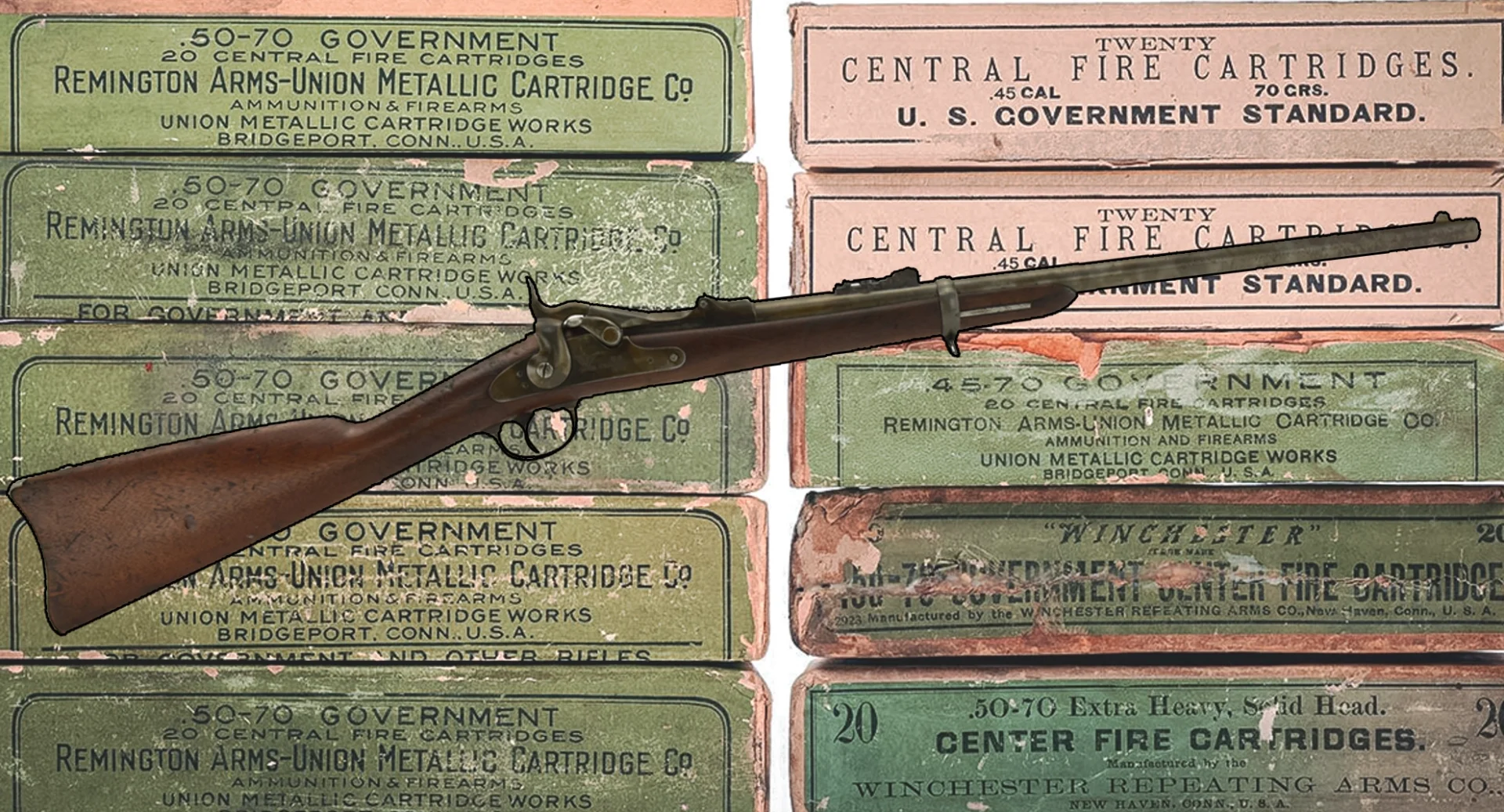
Today In Guns, 06 June 1872 (a Thursday). Today in Guns, back in 1872, the United States Congress recognized the superiority of .45-caliber cartridges over the others in service. It began as part of an appropriations act and eventually resulted in the primacy of what some people still refer to as “God’s Caliber.”
Among other things, that legislation helped direct and fund a study on behalf of the Secretary of War. That study, which took about a year, catalyzed the subsequent production and use of .45 caliber rifles and carbines, particularly those chambered in the (now venerable) 45-70 cartridge. The 45-70, arguably the quintessential cartridge of its time, ultimately leading to a very important Wednesday 39 years later (that would be in 1911).
“…[A]ll small arms rifles, carbines, and revolvers should hereafter be of .45 inch…” The Annual Report of the Chief of Ordnance to the Secretary of War for the Fiscal Year Ended June 30, 1873
That report answered the appropriations act mandate, providing more than 60 pages of evaluation procedures and testing results.
The Small Arms Caliber Board
The specifics of 1872’s “…Act making appropriations for the support of the Army for the year ending 30 June 1873…” [more here] included, among other things, a clause that required the adoption of a standardized action for all rifles and carbines. It took about a year to complete the process (which is why you see 1873 in the title above), but it was this Thursday, the 6th of June, when it all began.
This requirement was to be addressed by the “Board of Ordnance Officers for the Purpose of Determining the Proper Caliber for Small Arms,” also referred to as the Small Arms Caliber Board and, because it was administered by General Alfred H. Terry, the “Terry Board.”
Other members of the Small Arms Caliber Board included Col. Peter V. Hanger of the Ordnance Department, Col. Henry B. Clitz of the 10th Infantry, Capt. LaRhett L. Livingston of the 3rd Artillery, and Maj. Marcus A. Reno, 7th Cavalry.
You may remember the latter officer’s name from the Battle of the Little Bighorn a few years later.
That U.S. Army working group, which operated under special instructions from the Chief of Ordnance, was distinct from the “Board on Breech-Loading Small Arms,” though the two appear to have worked in conjunction.
.45 Caliber is Recommended
The Small Arms Caliber Board tested US cartridges of .40, .42, and .45 calibers. They also considered several foreign-made cartridges, ultimately deciding that only the English Martini-Henry .45 and Russian Berdan .42 calibers were worth further evaluation. Testing was conducted with powder charges from 60 to 80 grains in 5-grain increments, using the 50-caliber service cartridge for control comparison.
“…the trials and experiments made at the National Armory and at the Frankford Arsenal, for the determination of the best caliber for accuracy, penetration, and for giving the least load to the soldiers with the greatest efficiency, is appended in connection with the report of General Terry’s Board, by which the caliber was recommended for the Infantry arm.” ~ from the 1873 report of the Board of Ordnance Officers for the Purpose of Determining the Proper Caliber for Small Arms to the Chief of Ordnance
Testing also included evaluations of varying seating depths, straight-walled vs bottleneck cartridges, different bullet cannelures, and other considerations.
The results of their various evaluations led to the conclusion that the .45 caliber cartridge delivered a superior overall combination of penetration and accuracy, with the flattest trajectory, while producing the least fouling.
Specific results were annotated as follows:
- The .45 caliber is preferable to lesser calibers.
- The 24″ twist is preferable to a 30″ twist for .45 calibers.
- Flat grooving is preferable to ratchet grooving.
- The 75-grain charge is preferable to 70 or 80-grain charges.
- The heavier bullets are preferable to lighter ones.
- Performance generally is not superior in accuracy to the service ammunition (caliber .50), though the flatness of trajectory is…greater for 500 yards, the charge being heavier and the bullet lighter.
This led to the development of the following:
- a .45-70-405 rifle cartridge (a designation indicating it was a .45 caliber, 405-grain bullet with 70 grains of black powder); you have probably heard of, seen, or even shot the modern version of what was eventually called the 45-70 Government.
- a .45-55-405 carbine cartridge (which utilized 55 grains of powder and was for use in shorter barrels)
The rifle cartridge produced a reported muzzle velocity of 1350 fps; the carbine cartridge produced the correspondingly lower muzzle velocity of 1100 fps, and, of course, a more limited effective range.
The .45-caliber cartridge, specifically the 45-70, wasn’t new, but it was here to stay…eventually to be joined by the iconic 45 ACP.
And that is what happened TODAY IN GUNS.
And by special, we mean a lowered price and free shipping. 




0 Comments