Lever-action rifles have been part of American gun culture since the Henry .44 Flat hit the market in 1860. The platform has waxed and waned in popularity. Recently, the virtues of a lightweight, fast-firing rifle with reliable manual operation have been rediscovered, and the lever gun is back in a big way. New rifles boasting attachment-ready handguards, threaded barrels, and black cerakote share space with blued steel and wood-stocked models little changed from their counterparts made a hundred years ago. The Marlin 336 30-30 lever gun, otherwise known as the Marlin 30-30, has a leg in both camps.
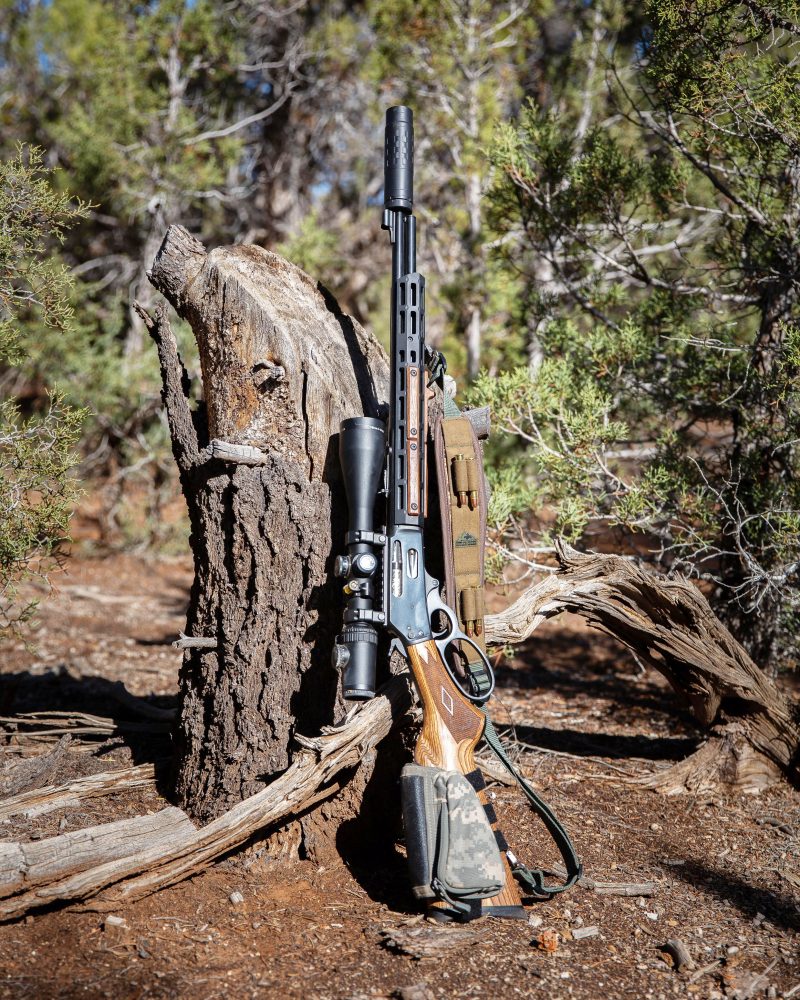
The Marlin Model 336, now made under Ruger’s tutelage, is available in a Dark model with all the upgrades, as well as in their classic configurations: a Trapper model made of stainless steel and a laminate stock, the Classic with tricked-out blued steel and walnut, and others (like the SRC, RC, etc.). Unfortunately, demand for these reborn 336 rifles outstrips supply, and it can be hard to get into a new lever gun.
Fortunately, the Marlin Model 336 was produced in quantity and quality well before Ruger bought back the brand, and there are millions of fine used examples to pick. Although I grew up with a Winchester 94, likely the most popular lever gun ever, as my deer rifle, the Marlin has always had a certain appeal. After years of hesitation, I finally sprung for an old Marlin 336.
Marlin 30-30: A Storied History
World War II had forced gun companies to curtail their normal operations to meet war demand, and workers lived in a rationed economy, earning dollars that simply sat. The post-war boom reabsorbed the 16 million GIs returning from overseas, and the country entered into a demand-side explosion. Companies could return to normalcy as Americans could now spend their money while a wrecked world looked to American factories to revive their fortunes.
Marlin’s Model 1889, which was chambered in a variety of pistol-length cartridges (.44-40, .38-40, and the like), is a significant progenitor of the 336. This design introduced the solid-top receiver and side-ejection system to prevent hot brass ejected from a topside port from hitting shooters in the face. It had the additional, commercial advantage of making it easier to mount a scope (which could be problematic on Winchester competitors, and thus a commercial advantage for Marlin).
The Marlin Firearms Company had gone through the wartime motions and emerged from the war with a line of dated lever-action rifles. The Marlin 1893, economized in 1936, served as the company’s mid-sized deer rifle. It was hard to produce and lacked the action strength of its competition: the Winchester 1894. It also now had to compete with a renewed interest in farther-shooting bolt-action rifles that were intimately familiar to returning GIs. Marlin diversified its rifle line and gave the venerable Model 1936 a facelift.
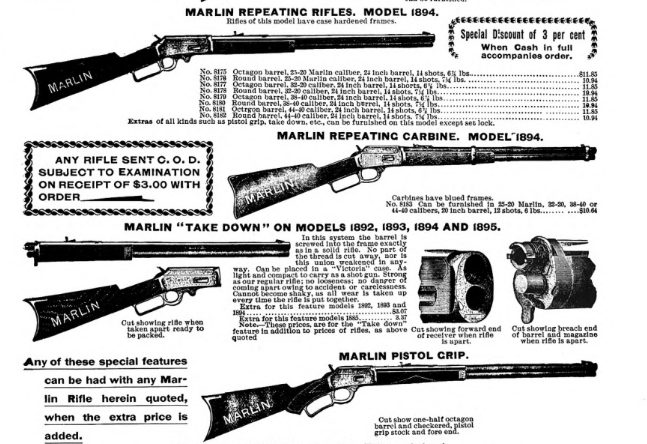
Sears Roebuck’s 1897 mail catalog shows the latest Marlin wares. The Marlin 1893 sold well, but by 1948, it was showing its age. It was an important predecessor to the 336, though, for several reasons. It was the 1893 that extended the 1889 solid-top, side-eject concept to accept full-length rifle cartridges like the 30 WCF (30-30). 38-55, and others. It also transitioned away from a flat-sided square-cut bolt raceway to a more reliable round-bolt configuration. That sliding, vertical-lock bolt engaged the rear of the breech block. This enabled it to handle higher-pressure smokeless powder cartridges that the extended solid-top/side-eject side now allowed.
1948: Enter the Marlin 336
Despite the challenges facing the lever action and the Marlin company, the Model 336 proved to be unbelievably popular. To date, over four million examples have been produced, making it the second most popular lever-action rifle on the American market. It’s second only to the exceptionally long-lived 1894 Winchester.
The Model 336 has been produced in a number of barrel lengths ranging from 16 to 26 inches and in calibers ranging from varmint rounds like the .219 Zipper to the big bore .375 Winchester and .38-55. But by far, the most popular chamberings are .30-30 Winchester (hence its most common other name, the “Marlin 30-30”) and .35 Remington.
The .30-30 Winchester is, by far, the most popular chambering for the Marlin Model 336. But all the others are serviceable.
The Marlin 336 was immediately appealing thanks to its stronger action and the retention of the 1893’s side ejection port. Winchester rifles ejected their hot brass skyward, ideally over your head and, wrongly, down your shirt. Side ejection also let the shooter mount an optic on top of the receiver. The first Marlin 336 rifles were not tapped and drilled for a Weaver mount, but that addition was quickly implemented. Curiously, until recent production, the 336 featured two plug screws on the left side of the receiver that allowed the shooter to mount a Williams-style peep sight, a feature immediately familiar to shooters used to the M1 platform of rifles from the war.
The Marlin 336 came in a number of wood grades ranging from birch to walnut and made use of stainless steel in some later models. But the archetypal 336 is the 20-inch carbine model with a plain birch stock and blued steel appointments. That rifle was chambered in the equally archetypal lever-action round, the .30-30 Winchester.
In addition to the redesigned bolt, the Model 336 featured an improved spring-steel extractor and solid sidewall receiver intended to maximize frame rigidity (eliminating the through-cut rear raceway slot in the process). In the early 1950s, Marlin began experimenting with “Micro-Groove Rifling”, introduced by Thomas R. Robinson Jr.’s Model 336 redesign. Previously, their various rifles used “Ballard Cut” rifling (more on this below).
Marlin Firearms Company continued to produce the Model 336 in North Haven, Connecticut, for several years. In that time, there was only one appreciable change to the design: the addition of a crossbolt safety in addition to the half-cock safety implemented in the 1980s.
Fast Forward 50 Years to NFA-Type Troubles
Then, in the 1990s, the gun industry underwent enormous changes on two fronts: changes to the business model and changes in politics. The 1990s saw the Clinton Assault Weapons Ban that nullified modern rifle features to make them legal, while handgun companies reduced magazine capacities and individual states implemented restrictions to make it more difficult to sell in their states without onerous safety features.
In 1993, George H.W. Bush left the White House. He was the last World War II veteran to occupy the position, and his departure signaled a changing of the political guard and an economic guard as well. The Greatest Generation, which had come to own so many rifles like the 336, also had jobs for life fitting these rifles off the assembly line.
Now that generation headed for the exit to enjoy their golden years, leaving fewer trained replacements with each passing year. Labor costs continued to rise, and capital costs rose in parallel simply to keep up production at a given quality.
Although these changes hampered modern rifle makers, it also hurt those who made older designs that needed more hand fitting. The 1990s famously spelt trouble for revolver makers like Smith & Wesson and Colt, but it also brought about the demise of classic rifles like the Savage 99. Winchester gave up on American manufacturing altogether in 2006, and Marlin continued on wearily.
In a Sears/K-Mart-like merger, Marlin bought a struggling H&R and consolidated in Gardner, Massachusetts. Although it might have been hoped that the two struggling companies could buoy each other and diversify their risks, it didn’t work. The Freedom Group, an investment consortium that had bought a struggling Remington and DPMS, picked up Marlin in 2007.
The new operation helmed by Freedom Group was renamed the Remington Outdoor Company. The legendary New Haven plant closed in 2010, and Marlin began operating out of Remington plants at Ilion, New York. Over the next decade, many noticed a downward slide in quality, a decline that only ended with the bankruptcy of the Remington Outdoor Company in 2020.
Sturm, Ruger & Co. bought the troubled Marlin assets and reintroduced the Marlin Model 336 to the public in 2023.
Ballard vs Marlin Micro-Groove Rifling
Prior to the big changes in the 1950s, Marlin lever guns used traditional “Ballard rifling”, which was a 6 groove cut. However, in the early 1950s the comapny began experimenting with a new style of rifling in their .22 rimfire rifles. The new method, part of a patent by Thomas R. Robinson, was called Marlin Micro-Groove, and was soon added to their centerfire line. Micro-Groove rifling consistedof as many as 16 or more shallow barrel grooves designed to minimize projectile deformation and extend barrel life. Learn more from this excellent article by Ranger Point Precision.
Prior to the big changes in the 1950s, Marlin lever guns used traditional “Ballard rifling”, which was a 6 groove cut. However, in the early 1950s the comapny began experimenting with a new style of rifling in their .22 rimfire rifles. The new method, part of a patent by Thomas R. Robinson, was called Marlin Micro-Groove, and was soon added to their centerfire line. Micro-Groove rifling consistedof as many as 16 or more shallow barrel grooves designed to minimize projectile deformation and extend barrel life.
Robinson filed U.S. Patent No. 2,465,553 on Febrary 27th. It was granted on March 29, 1949 and was the foundational step in transforming the Model 36 into the 336.
Marlin 336 Features: JM Marlin Style
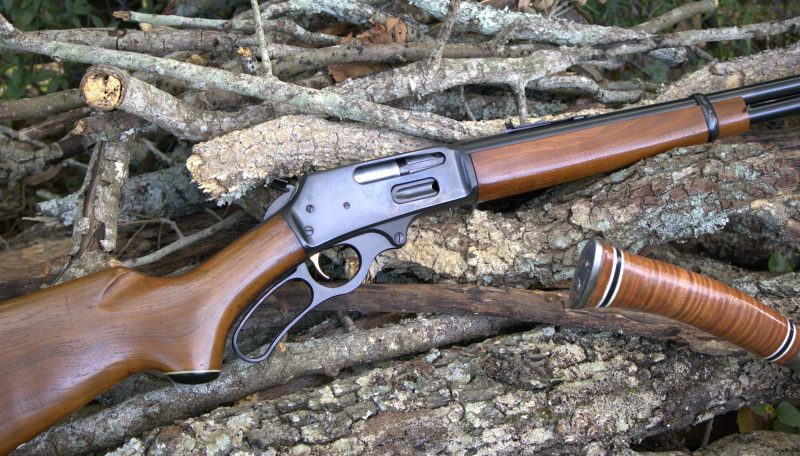
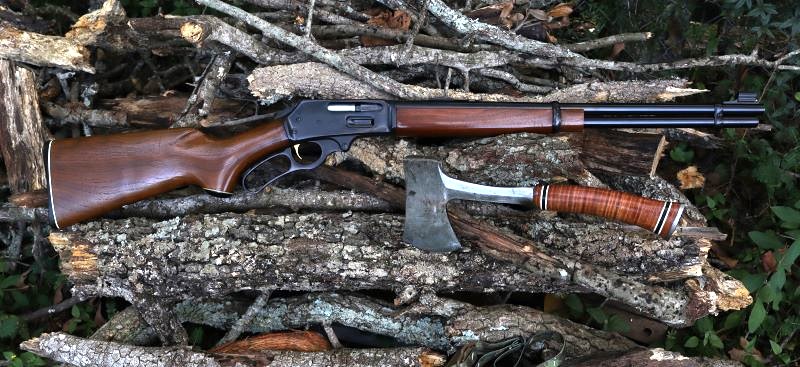
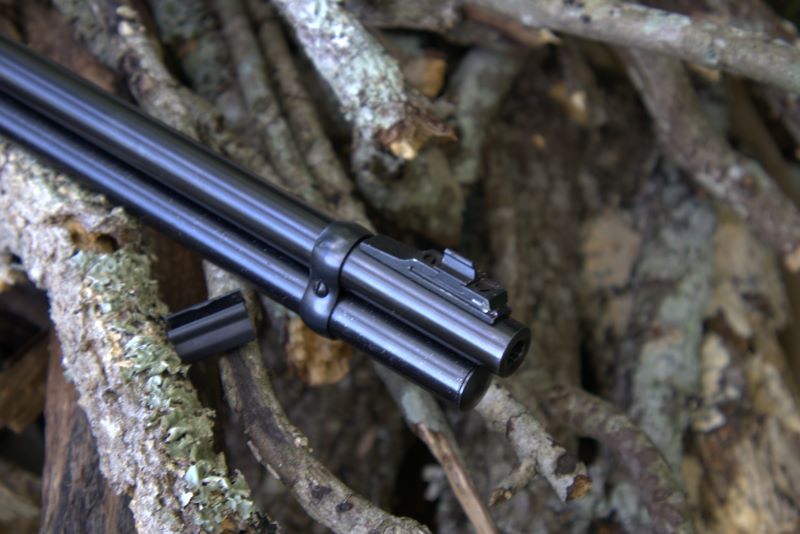
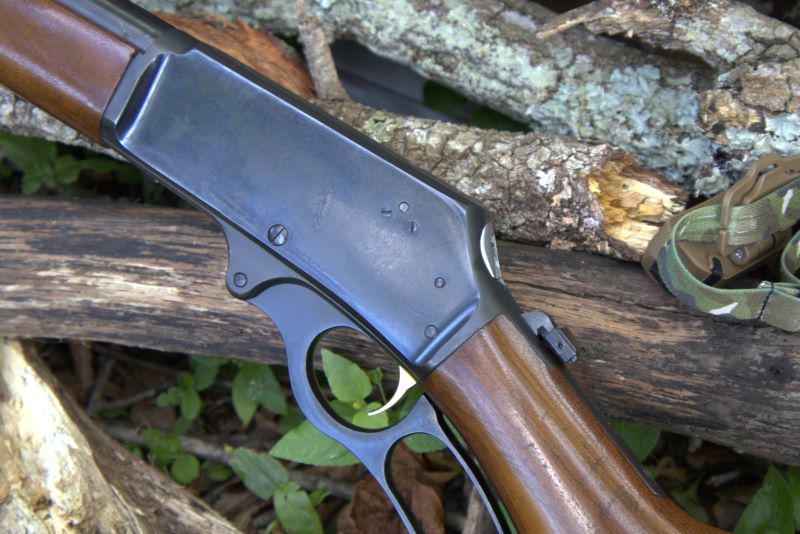
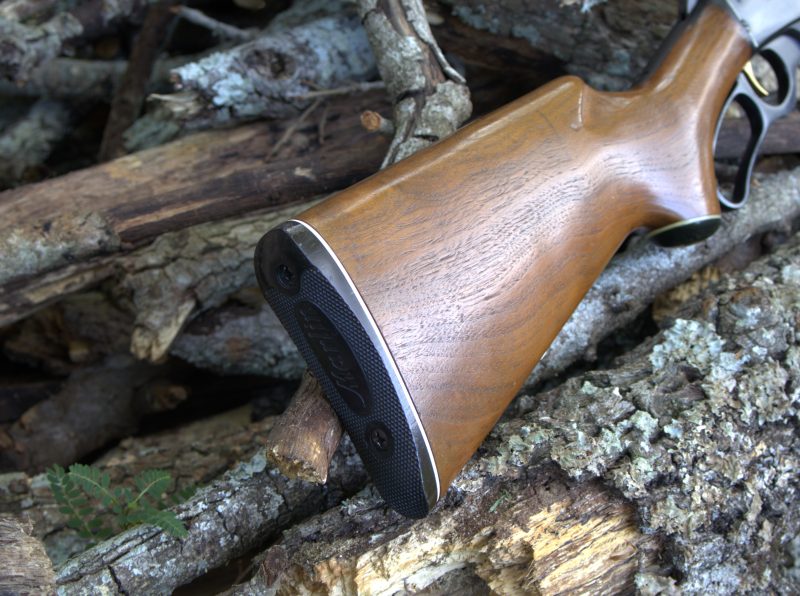
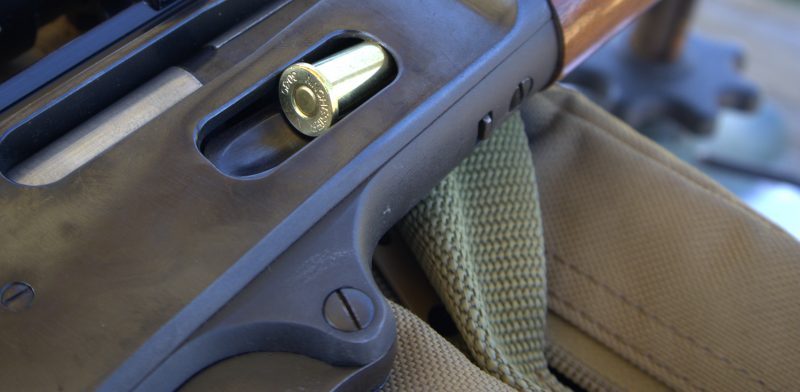
My particular Marlin 30-30 was made in the New Haven plant in 1972. Aside from one prominent rust spot, it is a bog-standard 336 that is only marginally different from the new ones you can get today. It features an uncheckered birch buttstock and fore-end and a deep-blued finish on the solid steel receiver, standard lever loop, barrel, and magazine tube. The tube extends nearly the full length of the 20-inch barrel and holds six rounds. Like all other Marlins, the 336 loads through a gate on the right side of the receiver.
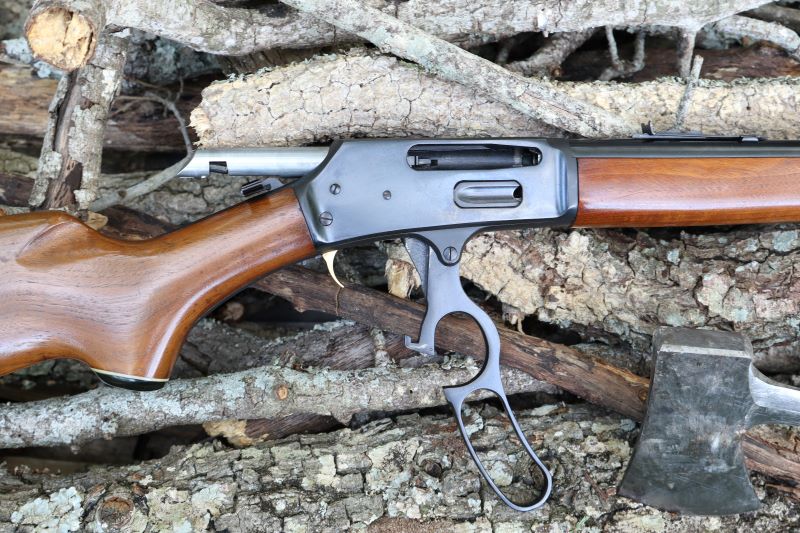
Above the loading gate is the prominent bare steel round bolt, the chief differentiation between the 336 and the earlier 1893. The bolt retracts rearward to cock the exposed hammer on the cycling stroke of the lever. Bringing the lever back pushes the bolt forward, and a lug at the rear of the lever pushes a floating locking block into the recess at the back of the bolt. This rifle was made before the inclusion of a cross-bolt safety and features only a half-cock safety.
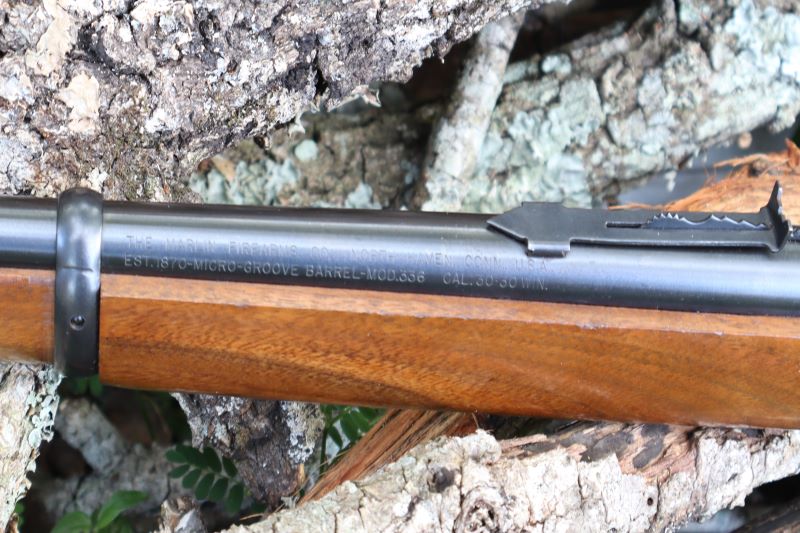
The top of the receiver is solid except for four tapped plug screws, which can be removed to mount a Weaver scope base. Unlike the newer rifles, this vintage 336 includes two plug screws on the left side of the receiver for mounting a peep sight. A Skinner sight could also be mounted on top in lieu of a scope. When fully dressed down, the 336 has a ladder-adjustable rear sight notch and a hooded bead front sight to guard against sun glare.
This rifle features the JM Marlin gold trigger. It breaks clean at 3 1/4 lbs.
This 336 features a checkered plastic butt plate and grip cap at the bottom of the pistol grip of the buttstock. It also features the characteristic black bullseye inlay just behind the grip cap. There is no feature here, but it is a Marlin signature. Another signature of original JM Marlins is the aforementioned Micro-Groove rifling, a set of smaller rifling grooves in the barrel that produces less deformation on the bullet and aids accuracy.
Pieces of plastic are few and far between on the Marlin 336.
Marlin 30-30 Quick Specs
Caliber: .30-30 Winchester
Capacity: 6+1
Barrel Length: 20 inches
Overall Length: 38 1/4 inches
Length of Pull: 13 5/8 inches
Weight: 6 1/2 pounds
On the Range with the Marlin Model 336
The Marlin 30-30 is a proven platform that is about as handy on the shoulder as a modern AR-15, and it has plenty of power to take most game animals and function as a personal defense option. As we count, it has nearly 80 years of history to lean on. In that time, it has become the archetypal deer rifle, though it can do much more.
If you are looking for a rifle to fit any of the above-mentioned roles, the Marlin 336 is a formidable option, among many, to consider. My trigger time with the 336 so far won’t outweigh the history, but it might give a few insights and set a baseline of what you, the shooter, might want to know.
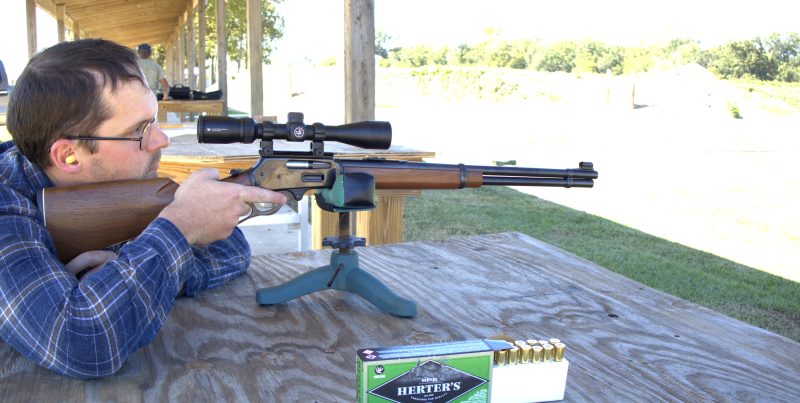
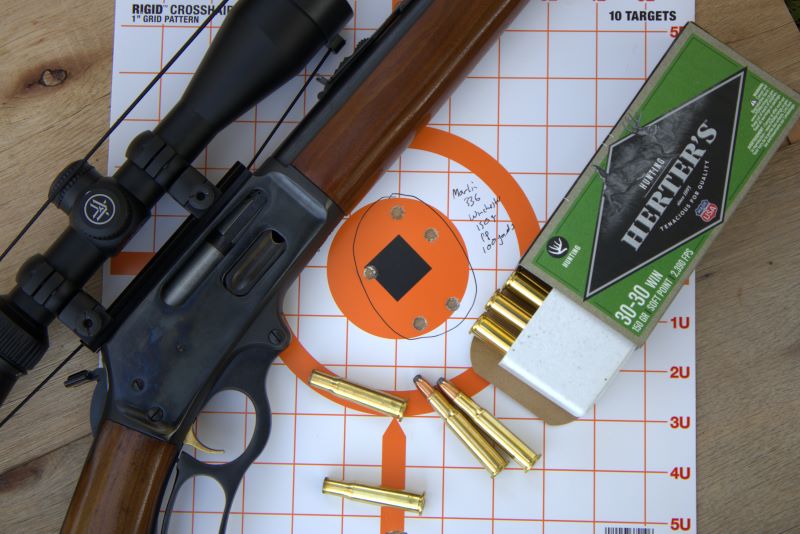
I bought this particular Marlin 336 because I wanted to get back in with a cartridge I like, the .30-30. But it also gave me a chance to shoot a Marlin lever for the first time. Although the 336 comes with very usable iron sights that are excellent for snap shooting inside 75-100 yards, I did most of my shooting mounted with an optic. Most folks today will opt for a scope or even a red dot. I used a Vortex Crossfire II 3-9×40 (an excellent budget optic) in order to evaluate the different types of ammunition I ultimately ran through the 336.
I began my reacquaintance by sighting in the scope to the rifle from a distance of fifty yards. Loading the 336 is straightforward, but it is not as effortless as pushing in a magazine and letting fly. The rounds are depressed against the gate, pushed into the tube one by one until the tube is full. The magazine spring isn’t butter-smooth, but I didn’t have to fight to get the rounds into the rifle. To unload, the action has to be cycled, and the rounds ejected. Unlike the bigger Marlin 1895, you can’t easily depress the gate to coax the rounds from the magazine.
Sighting It In
My first round of Winchester Power Point 150 grain ammunition touched high and right, and I made my adjustments and walked my rounds into the bullseye. I was surprised how little recoil the .30-30 had. I remembered it having more, but there is a good reason the .30-30 is often handed to kids as a first rifle. From the bench, recoil was a slow push on the shoulder, and my eyes were back on the scope in no time.
The Marlin cycles smoothly without disturbing the sight, and without the rattling I had grown accustomed to on my old Winchester. I would put the action’s effortlessness on par with modern Henry lever actions.
I moved my target out to 100 yards, rezeroed with the same ammunition. After calling it a day, I set back out with more ammo and more targets to see how different .30-30 ammunition behaved at different distances from 100-300 yards. I shot the Marlin using Winchester 150- and 170-grain soft-point ammunition, as pedestrian a load as the .30-30 comes.
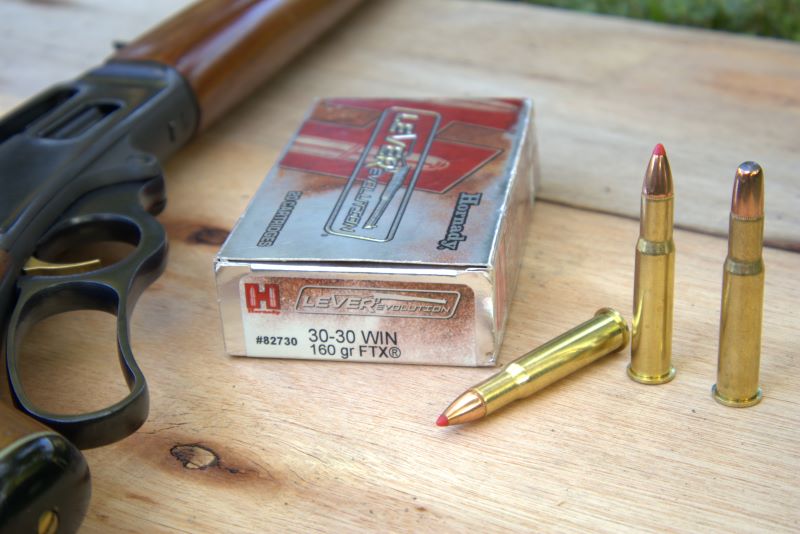
Until recently, soft point flatnosed bullets were the only safe option to load nose-to-primer in a tubular magazine. Most .30-30 ammo will have a flat profile, but I also tested Hornady’s LeverEvolution 160-grain FTX spitzer load, which is about as aerodynamic as .30-30 gets. I also tested a new-to-me load in the Federal 150-grain Barnes TSX, an all-copper, lead-free hollow point.
The Problem with .30-30
Because of its historical baggage in use with tube magazines, the .30-30, which is not particularly high velocity compared to newer .30 caliber cartridges, is perceived to have short legs and low power. I was raised to never shoot anything with a .30-30 past 100 yards because the round loses all of its power and it will not leave any blood to track an animal.
Of course, that advice was wrongheaded. While light on the shoulder, the .30-30 has killed everything from lynx to lions and that flat-nosed bullet. It is slower and not as aerodynamic as a spitzer round, but it is still a smokeless high-velocity round that doesn’t drop like a fly at any reasonable distance.
Shooting Impressions
Once zeroed, the Marlin 336 had no appreciable drop at 150 yards with any of the ammunition I used, except for the Winchester 170 grainers, which dropped 2 inches from the point of aim. Not enough to talk about, depending on what you are shooting at. The .30-30 starts to go off the rails at 300 yards, where those 170-grain pills are shooting 28 inches low. The Hornady LeverEvolution round was the flattest shooting. It dropped just 14 inches, with the other 150-grain loads running at the 19-inch mark.
All the ammunition functioned flawlessly in the 336, and I had no failures to feed or fire. But those LeverEvolution and 170-grain Winchester rounds did thump the shoulder a bit more and, with a high-mounted scope, the comb of the stock got friendlier with my cheek.
I did not expect bolt-action accuracy out of the 336. It has a rear locking bolt and the barrel certainly is not floated or made of carbon fiber. As shocking as it might sound, no one has retrofitted a 336 in a new round with Creedmoor in the name. But accuracy comes down to the shooter. The .30-30’s reputation for a shorter range is partly due to the stock iron sights, which don’t lend themselves well to bullseye shooting.
Using the Winchester 150-grain load, I could coax five rounds into a 2-inch group at 100 yards. The 170-grain load was a bit wider with a 2.3-inch group, and the Barnes load split the difference. The LeverEvolution round was the clear winner in accuracy. This ammunition was consistent and gave me a 1.5-inch group at 100 yards. All things considered, all these loads are MOA for deer and varmints as long as you know your drop.
Overall, this Marlin 336 is lightweight, low recoiling, and ambidextrous for my left-handed sensibilities. The accuracy isn’t target-rifle grade, but it’s better than some would give it credit for and more than usable for the purposes I intended: deer hunting in timber where shots will likely never exceed 200 yards.
Alternatively, this old hand could take a red-dot optic and use it as a home-defense rifle with a good hollow-point load. The only knock on this great rifle is that this particular variation doesn’t come with sling studs, a point that is easily fixed given the Marlin 336’s expansive aftermarket of parts and accessories.
Marlin 336 for Sale: Where to Buy
New vs Used?
Ruger is making an excellent product, but when searching for your first or next lever action, don’t overlook a good used rifle. Plenty are out there with decades of life left to live.
There are many types of Marlin 336 for sale, in every conceivable condition. The iconic lever action wasn’t gone for long before popular demand brought it back under Ruger’s umbrella. Ruger makes them in a few different configurations, all in .30-30, and all command a premium. Some of that is because demand simply exceeds supply. Add-on optional peep sights, stainless steel hardware, and checkered walnut stocks, and the prices climb relative to the millions of existing, plain-jane pre-Ruger 336s.
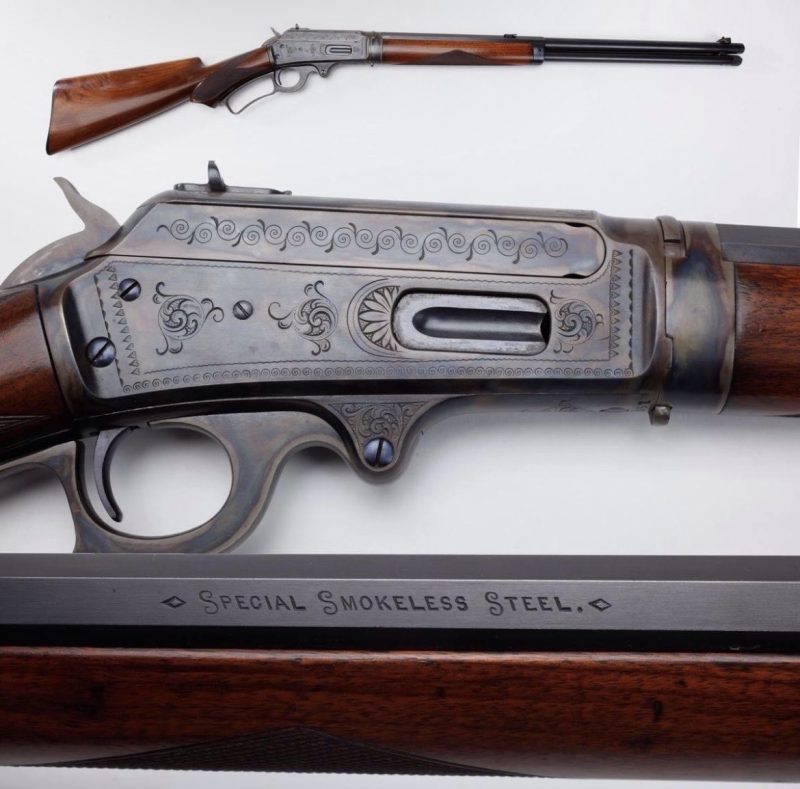
A Marlin 30-30 lever gun from 1893 (?); unknown photo credit. Maybe, just maybe, when you go hunting for a Marlin 336 for sale, you’ll stumble across a beauty like this!
If you’ve been “on the bench” (pun intended) about picking up a Marlin Model 336, I hope this gives you the last bit of encouragement you need to get one. I don’t think you’ll be disappointed.
A variety of fits for a variety of guns for a variety of optics for a variety of carry styles!
H The Marlin 336 – Why I Learned
Get banged on the regular, sign up for the newsletter!
Find what’s in stock, and where, and compare prices.
⚠️ Some hyperlinks in this article may contain affiliate links. If you use them to make a purchase, we will receive a small commission at no additional cost to you. It’s just one way to Back the Bang. #backthebang









0 Comments