
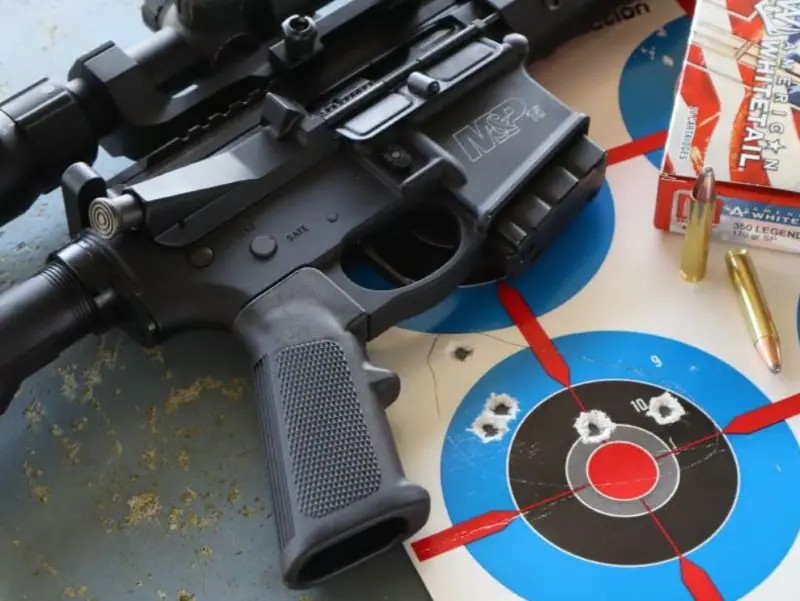
The .350 Legend was developed in 2019 as a straight-walled rifle cartridge for use in states that don’t allow conventional bottlenecked rifle cartridges for hunting. But you don’t have to live in a restricted state to take a gander at the .350.
The .350 Legend is a versatile round that rivals the famed .35 Remington in the deer woods. It has the same case length as the .223 Remington and can be used in rifles ranging from single-shot break-action rifles to AR platforms.
But as a relatively new round on the market, questions inevitably come up. Is it as powerful as the marketing hype suggests, and if so, how far can you effectively shoot it? As a new student of the .350, I sought the answer the only way I knew how: by shooting targets and inferring the external ballistics from there.
Ballistics Charts vs Real Shooting
Often, factory ammunition will have a ballistic chart indicating the muzzle velocity and ballistic drop of the round in the packaging. Although these charts provide a rough idea of how a round will perform, they are compiled using laboratory test barrels in a variable-free environment. There will be some variation in real-world guns and ammo that has to fight wind and gravity. It also happens that some guns will shoot certain rounds accurately, and some will not. This phenomenon often comes down to how fast or how slow the barrel’s rifling twist is so as to stabilize a round of different grain weights.
The downside of straight-walled rifle cartridges is that they tend to be large-bore rounds with a lower velocity and a rainbow trajectory that is more dramatic than smaller-caliber bottlenecked rounds. Rounds like the .45-70 Government and .450 Bushmaster come to mind, but even pistol cartridges put into a rifle platform suffer similarly. The .350 Legend is noteworthy for helping to change the stigma around straight wall rounds by having a flatter trajectory compared to the time-tested but dated competition.
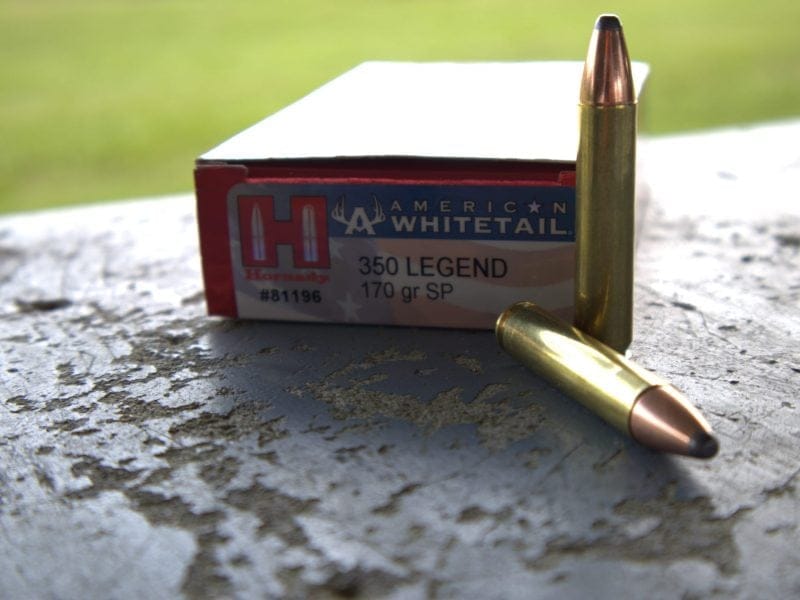
To sample the breadth of .350 Legend ammo currently available, I picked two vastly different load options for various uses. The Hornady American Whitetail 170-grain load is a bonded soft point hunting load pushed at a velocity associated with most hunting and target loads in this chambering. According to Hornady, this load has a muzzle velocity of 2,200 feet per second out of a 20-inch barrel. With a 200-yard zero, this load is starting out 1.5 inches high at the muzzle and 4.5 inches high at 100 yards. At 300 yards, the round drops more dramatically from zero to -19.4 inches.
These stats are coming from a place of optimism at the factory, and their value might be even more suspect, depending on what game you are getting and the distance you expect to shoot. For me, the 200-yard zero was of no value when most of my hunting shots occur in thicker brush, where 60 yards would be a far shot. On the other hand, even with this in consideration, Hornady’s tables do check out with other ammunition makers, and the .350 overall is presented as a relatively flat shooting cartridge that doesn’t get too elliptical until you get past 200 yards. But I wondered how shifting to a closer 50-yard zero might impact the external ballistics as presented to us. I packed up some ammunition, some paper targets, and my BCA .350 Legend 20-inch upper to see how far I could connect.
At the Muzzle: Where the .350’s External Ballistics Start
The Hornady American Whitetail 170-grain load delivers on the claim that the .350 Legend is a replicated .35 Remington load. I began by firing a five-shot string across my chronograph from a distance of 10 feet away. This load gave us an average velocity of 2,248 feet per second. Taken together with that 170-grain bullet, it is a bit faster than a typical .30-30 with the same grain of bullet and just under .35 Remington, which typically uses a slightly heavier bullet at the same velocity.
To expand the sample size a bit, I also tried a box of Hornady 250-grain Sub-X subsonic loads. These are low-velocity loads meant for suppressed use at closer distances. Hornady has their velocity advertised at 1,050 feet per second. With a 100-yard zero, these rounds are supposed to be hitting -1.5 inches below the point of aim at the muzzle and down to -35.5 inches at 200 yards. Hilariously, Hornady has this load down to -113.3 inches at 300 yards. That is almost 9.5 feet of drop! On my chronograph, these rounds averaged 1,014 feet per second with 554-foot pounds of energy. That is equivalent to firing a .357 Magnum handgun round at the muzzle, which is more than enough for an ethical kill on a whitetail deer or similar game, but the distances should be restricted!
Close In and Far Out
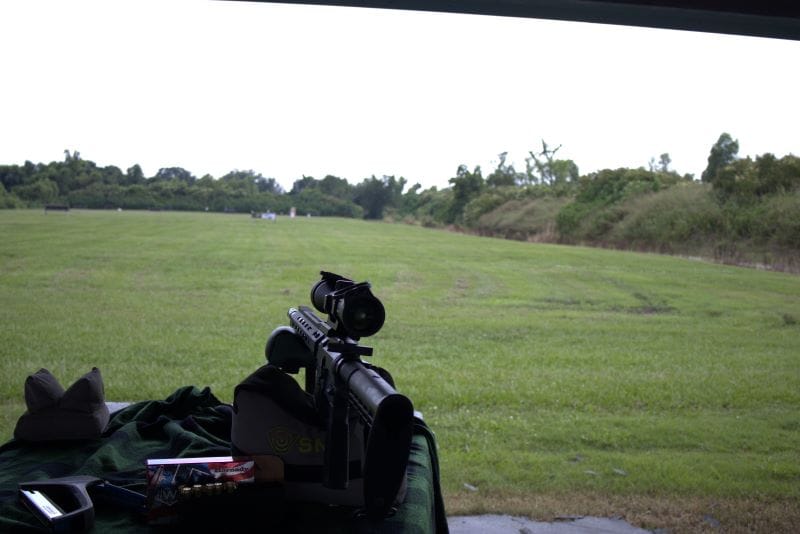
The distance at which you zero your rifle is a deeply personal choice. Part of it boils down to the distances you expect to shoot. Part of it comes down to how much drop the round in question has and whether it would make or break a solid hit at distances before and beyond the sight-in. Finally, you might choose your zero based on your optic, how your eyes agree with it, and how comfortable you are taking a shot at a given distance. You might even be constrained by the rifle range you choose for practice. The maximum distance of many public ranges is usually 100 yards, and here in the Deep South, it is a rather far shot on game in terrain constituting thick brush.
Because of the elliptical drop of the Hornady Subsonic load and the relatively flat trajectory of the supersonic load, I settled on a 50-yard zero for both. After collecting my velocity data, I set a series of small, lettered silhouette targets at 50, 100, 150, 200, and 300 yards.
Things started off well with the Hornady 250-grain Subsonic loads, although velocity was low enough so that it would not eject from my upper. But I could keep a group inside 1.5 inches at 50 yards on paper. But at 100 yards, the group doubled in size, and the round struck 9 inches below my aiming point. At 150 yards, the rounds hit the very bottom of my target with a drop of 15 inches from my point of aim. At 200 and 300 yards, hitting without any scope adjustment was impossible. I spent time adjusting my Sig Buckmaster 3-9×40 scope. Based on the preexisting drop and those adjustments, I had to compensate 32 inches at 200 yards and 62 inches at 300.

The Hornady American Whitetail 170-grain load was more straightforward. With a 50-yard zero, I printed three rounds 2.5 inches high at 100 yards—a minute difference that is easy to compensate for on the fly. At 150 yards, those bullets ceased rising and dropped back to zero. At 200 yards, my group was noticeably wider but hitting only 4 inches low. Although my target was harder to see and my groups even wider at 300 yards, my rounds struck only one foot low.
The .350 Legend: Keeping Perspective
As an intermediate AR-friendly round and a straight wall cartridge, the .350 Legend is a compromised round meant to satisfy the needs of hunters across states with a patchwork of different laws. The reloader will be baffled by the use of proprietary .355-inch projectiles that are uncommon among rifle rounds. Although the .350 is similar to the .223 in case length and dimensions, it is not identical, which can lead to issues in AR platforms that are not properly set up to take the round. With that in consideration, the .350 Legend round itself is an excellent choice for medium game.
It has a more forgiving trajectory of on-the-fly adjustments than other straight-wall cartridges. Although the .360 Buckhammer and .400 Legend have since come on the market to improve on the .350 in various ways, the .350 Legend is a round you do not want to overlook if it fits your particular hunting circumstances.
Support us by checking out Wilder Tactical!
More of Jim’s Gems:
Glock 19 vs. CZ P01: The Art of the Compact Pistol | Breach Bang Clear
The .22 Rifle: Practical and Tactical? | Breach Bang Clear
Head-to-Head: Colt Official Police and Smith & Wesson M&P | Breach Bang Clear




Well last December was my first time ever hunt deer! I used the BCA 350 Legend upper 20″ HSS on my AR lower. Sighted it in with Hornady 170 gr SP for 100 yards. Was shooting a 1 inch group at 100 yds! Figured that was good! Well December 7 I got my first deer! Dropped his 10 point right were he stood! Hit him at about 125 to 150 yds, both lungs and heart were damaged. I have a battery pack in my chest. The 400 legend and 450 bushmaster bruise my should and broke my battery pack. I am extremely Happy with my 350 Legend! It filled my freezer!
Well last December was my first time ever hunt deer! I used the BCA 350 Legend upper 20″ HSS on my AR lower. Sighted it in with Hornady 170 gr SP for 100 yards. Was shooting a 1 inch group at 100 yesterday! Figured that was good! Well December 7 I got my first deer! Dropped his 10 point right we’re he stood! Hit him at about 125 to 150 yds, both lungs and heart were damaged. I have a battery pack in my chest. The 400 legend and 450 bushmaster bruise my should and broke my battery pack. I am extremely Happy with my 350 Legend! It filled my freezer!
I zeroed my ar15 with a 16” barrel at 50 yards with the Winchester power point 180g. Wasn’t able to shoot past 50 yards, should I expect to see roughly the same bullet drop?
We already had that round. It was called the .357 Maximum. It was sold as a pistol round and only in a rifle barrel in the Thompson Center format as far as I know. I had a TC barrel in .357 Max but never performed the experiment the author did. I do know that it would ring the ram at 200 meters with authority. It’s too bad it got such a bad name in revolvers because people went for velocity and used 158 gr. bullets and got flame cutting. If they had used 180 grain and heavier bullets which is what really made the Max shine, they wouldn’t have had the problem. Of course it used its own cases and one couldn’t convert something else to .357 Max without a lot of trouble. I suggested to a couple of companies that they chamber one of their rifles in that caliber and got nowhere. R.I.P. .357 Max.